REVIEW · LONDON
Black Taxi Tour Of London
Book on Viator →Operated by London Sightseeing Tours · Bookable on Viator
Four hours, six seats, London on your terms. This private black cab tour turns major landmarks into a custom route, with request stops and big views from a glass roof.
I love the flexibility. You can shape the plan around your interests, from Wellington’s story to the Thames bridges. I also like the viewing comfort: the taxis have big windows for photos and easy spotting of sights as you roll past.
One consideration: the time is tight, so you’ll often see places from the cab rather than going deep inside every stop. If you want long interior visits, build in extra time on your own.
In This Review
- Key takeaways
- Why a black cab beats the big bus for Westminster days
- Price and value: what $603.08 per group really buys
- Meeting point and timing: how to plan your 10am start
- Apsley House and the Wellington story at the edge of Buckingham Palace
- Parliament, the Thames, and Big Ben’s name change you can actually use
- Downing Street: what you can see, and what you shouldn’t expect
- Westminster Abbey: coronations, royal weddings, and the two-tower view
- Bridges of the Thames: the photo route from London Bridge to Tower Bridge
- Victoria Embankment and St Paul’s: the dome moment at the end
- The guide factor: why Morris, Brian, Dave, Boris, Tony, and Sheldon matter
- Tips to make your four-hour cab loop feel like more than four hours
- Should you book this London black taxi tour?
- FAQ
- How many people can join this tour?
- How long is the tour?
- Where does the tour start, and do I get picked up?
- Can I customize the stops on the tour?
- What major sites are included in the route?
- Is the taxi accessible for mobility needs?
- Is there free cancellation?
Key takeaways
- Private black cab for up to six at one flat group rate for a 4-hour loop
- Request stops or let the guide choose based on your interests
- Big windows and a glass roof for better sightlines (and photos)
- A guide who adjusts the pace for adults, kids, and mobility needs
- No crowd stress because it’s just your group in the vehicle
- Great value for families when you split the group price
Why a black cab beats the big bus for Westminster days
London’s top sights are close together in a way that feels almost unfair—yet big tour buses still come with crowds, timing conflicts, and the same fixed order for everyone. A private cab solves a lot of that. In four hours, you’re not trying to “win” against the line at the next stop. You’re just getting a clear, human-scale version of London.
I also like that this isn’t only about standing in front of famous buildings. You get the context while you’re moving. That makes Westminster, Parliament, and the river bridges feel connected instead of like separate photo traps.
The cab setup matters too. The vehicle design (big windows and a glazed roof) helps you read the city as you pass it, even when you’re stuck in traffic or the light isn’t perfect.
You can also read our reviews of more tours and experiences in London.


Price and value: what $603.08 per group really buys
The price is $603.08 per group for up to six people and about 4 hours of private guiding and taxi time. If you book with a full group, you’re effectively spending around $100 per person for a custom, door-to-sight sightseeing block.
That’s the key value here: one vehicle, one guide, and one route that can bend. For families, that often beats doing separate taxis plus a walking tour, especially if you want landmarks rather than a neighborhood-only day.
If you’re traveling as two adults, it’s still a real option if you care about comfort, quick context, and getting around fast. But if you’re trying to do everything as cheaply as possible, a cab-based private tour is a “pay for time and convenience” choice.
Meeting point and timing: how to plan your 10am start

Your tour starts at Embankment Place, London (WC2N) and ends back at that same meeting point. Pickup and drop-off are available, including from your hotel or Airbnb, as long as you’re within 5 miles of Trafalgar Square.
Most tours start around 10:00 a.m., though you can request another starting time. The operation is listed for 9:00 a.m. to 11:00 a.m., Monday through Sunday, so if your schedule is tight, it helps to lock in your preferred hour early.
For timing strategy, think of the day as “ride, look, and learn,” not “park and wander.” The itinerary is packed with major landmarks along the Westminster and central City axis, so you’ll get the best results if your goal is overview plus a few targeted moments.
Apsley House and the Wellington story at the edge of Buckingham Palace

Your tour begins with Apsley House, the home of the Duke of Wellington, dating to 1825. This isn’t just a pretty façade stop. The setting links you to the big personalities that shaped Britain’s modern political identity.
Across the way you’ll see the Wellington Arch, which has had a surprisingly complicated life. It was moved and repurposed over time, and it also aligns with Constitution Hill and Buckingham Palace’s outer framing. The current grand equestrian centerpiece—placed in 1912—features Nike, the Goddess of Victory, riding the chariot.
The detail that makes this stop worth it is the “history of history.” You learn how statues were taken down, relocated, and replaced as Britain’s public mood and priorities changed.
Practical note: this is a great start because it frames the rest of the day. Once you understand Wellington’s monument setting, Westminster’s power center feels less abstract.
Parliament, the Thames, and Big Ben’s name change you can actually use
The route moves into the Westminster power corridor, where you’ll see the site of the original royal palace dating back to the 11th century. It burned in 1512 and later faced total destruction again in 1834, leaving behind elements like the crypt, Jewel Tower, and Westminster Hall—a standout survivor dating back to 1097.
Then comes the main political show: Parliament on the north bank of the Thames. The current Houses of Parliament were rebuilt from 1834 to 1870, with the designs associated to Augustus Pugin and Charles Barry.
Next up is the landmark people call Big Ben—though the official term is the Clock Tower, and it was renamed Elizabeth Tower in 2012 for Queen Elizabeth II’s Diamond Jubilee. It opened in 1859 and remains one of the city’s most recognizable silhouettes.
This is one of my favorite stops on this kind of tour because it connects architecture and identity. You’re not just seeing a clock tower. You’re seeing how Britain re-built after major losses and turned government into a visible civic brand.





Downing Street: what you can see, and what you shouldn’t expect
You’ll pass Downing Street, the official residence of the Prime Minister (No. 10) and the Chancellor of the Exchequer (No. 11). The street traces back to 1680, when it was built by Sir George Downing.
In real life, Downing Street is mostly about the approach—angles, sightlines, and context—rather than a “tour the building” moment. That’s not a flaw. It’s actually why a cab tour works. The guide can explain what the street represents while you stay moving and don’t waste time trying to get a photo at an impossible angle.
If you’re hoping to feel the weight of British governance without waiting through a formal security experience, this stop is a strong payoff.
Westminster Abbey: coronations, royal weddings, and the two-tower view
Westminster Abbey is one of those places where the facts sound dramatic because they are. It’s formally the Collegiate Church of Saint Peter, mostly Gothic in design, and it’s the site of every Coronation since William the Conqueror.
You’ll also hear that it has hosted sixteen royal weddings and it’s tied to the burial of many English and later British monarchs. The Abbey sits as a Grade One listed building and a World Heritage Site, and it’s been standing since 960 AD.
Architectural standouts you’ll likely notice include its two towers, added in the 18th century by Nicholas Hawksmoor, working under the umbrella of Christopher Wren’s influence. The guide can point out how these additions shape what you see today.
A balanced way to approach this stop: if you want a quick “I get it” understanding, it’s ideal. If you want a long interior religious and historical experience, you may find the four-hour window limits how long you can stay. Still, even as a viewpoint and context stop, it’s a major London anchor.
Bridges of the Thames: the photo route from London Bridge to Tower Bridge
This is the part that makes the tour feel like London instead of just Westminster. The Thames gives you movement, reflections, and the chance to watch the city reorganize around water.
You’ll start with London Bridge, with records of the original bridge dating to Roman-era wooden crossings, then the stone rebuild between 1176 and 1209. That old London Bridge was the first stone bridge across the Thames and reportedly measured close to 906 feet and was famously lined with shops, houses, restaurants, and even a chapel.
Then it’s Tower Bridge, built between 1886 and 1894, described as a combined bascule and suspension bridge. Today, people often call it the “Wonder Bridge.”
Finally, you’ll see Albert Bridge, which connects Chelsea to Battersea. It’s known for spectacular lighting used in film, and there’s even a story about instability: there used to be a sign instructing troops to break step because it was known as the “Trembling Lady.”
Practical note: bridge time is best when you’re okay with quick stops and short looks. The cab keeps things efficient, but you won’t have the luxury of lingering for every angle.
Victoria Embankment and St Paul’s: the dome moment at the end
You’ll also visit the Victoria Embankment, running along the north bank of the Thames from the Palace of Westminster to Blackfriars Bridge. It’s known for memorials such as the Battle of Britain and it includes permanently retired vessels like the H.M.S President plus public gardens.
This section matters because it ties the grand politics to everyday city life—green space, public memorials, and a river edge that feels designed, not accidental. The embankment was built between 1865 and 1870, influenced by Joseph Bazalgette’s engineering work that significantly narrowed and shaped the Thames channel.
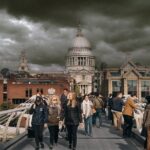
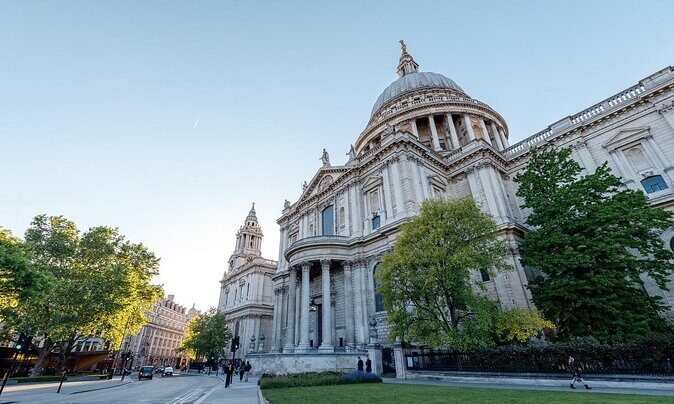
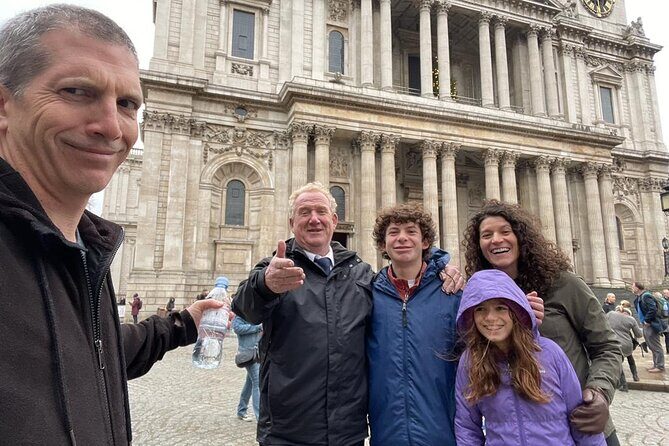
The finish (and often the emotional payoff) is St Paul’s Cathedral. The site has records back to 604 AD and has hosted multiple cathedrals. The current cathedral you’ll see was built between 1675 and 1710 and is strongly associated with Christopher Wren, who is also buried under the dome.
St Paul’s dome is described as 365 feet high and weighing around 65,000 tons, and St Paul’s stood among the world’s tallest buildings until 1666 and again after construction history notes. Even if you don’t memorize those numbers, the scale hits when you’re viewing it at City level.
This ending works because it brings your day full circle: you went from monuments of power (Wellington, Parliament, Downing Street) to the river’s connective tissue, and then to a cathedral that symbolized British identity for centuries.
The guide factor: why Morris, Brian, Dave, Boris, Tony, and Sheldon matter
The biggest difference between a normal sightseeing run and something you remember is the guide’s ability to match your interests without losing the plot.
Names that come up often in this operator’s guidance include Morris, Brian, Dave, Boris, Tony, and Sheldon. The common thread is flexibility. You’ll get a plan that can follow your lead—whether you’re interested in heavy history, kid-friendly stories, or a particular theme like the Beatles.
The second standout is care with pacing and comfort. In multiple cases, guides handled mobility needs smoothly, including help for guests using a wheelchair or a mobility scooter and a ramp designed for getting into the black cab. The taxi itself is described as wheelchair compatible, plus it’s fully air-conditioned and built for good views.
If you’re traveling with children, there’s a real advantage in having a guide who can keep explanations clear and fun rather than just delivering facts. You can move through major sights without turning the day into a stamina contest.
Tips to make your four-hour cab loop feel like more than four hours
A cab tour can go two ways: either you feel rushed, or you feel like you’re getting the city’s skeleton. These tactics help you land on the good side.
- Tell the guide your “must hit” list first, and your “nice if time” list second. That makes it easier to avoid duplicating your own plans.
- Ask for a photo approach. With big windows and a glass roof, the guide can place you for angles that are hard to get on foot.
- If mobility is an issue, communicate it at the start. The vehicle can be set up to make entry easier, and the guide can adjust how long you stand versus where you pause for views.
- Don’t treat Westminster Abbey and St Paul’s as guaranteed long-interior stops. Plan to absorb the most important visuals and context, and add separate time later if you want deeper access.
Should you book this London black taxi tour?
Book it if you want a private, flexible way to get grounded in London fast—especially if your group includes kids, mobility needs, or anyone who’d rather sit and absorb than sprint between stops.
Also book it if your style is “see the landmarks, understand why they matter, then move on.” This tour is designed for overview with enough explanation to make the city feel coherent.
Skip or rethink if you’re trying to maximize interior visits at multiple major attractions in one go. With only about four hours, you’ll get best results when you think of it as a high-quality orientation, not a complete museum-and-cathedral day.
FAQ
How many people can join this tour?
The tour is for groups of up to six people, with one flat fare per group.
How long is the tour?
The duration is approximately 4 hours.
Where does the tour start, and do I get picked up?
It starts at Embankment Place (WC2N, UK). Pickup and drop-off are offered within 5 miles of Trafalgar Square, and pickup from your hotel/Airbnb is available.
Can I customize the stops on the tour?
Yes. It’s a private custom taxi tour, so you can request stops and explain your interests, or let the guide choose for you.
What major sites are included in the route?
The highlights include Apsley House and Wellington Arch, Westminster (including Parliament and the Houses of Commons and Lords area), Big Ben/Elizabeth Tower, Downing Street, Westminster Abbey, several Thames bridges (including London Bridge, Tower Bridge, and Albert Bridge), Victoria Embankment, and St Paul’s Cathedral.
Is the taxi accessible for mobility needs?
The taxis are described as spacious and accessible with big windows and a glazed roof for viewing. Service animals are allowed, and wheelchair compatibility is indicated in the experience information provided.
Is there free cancellation?
Yes. You can cancel for a full refund if you cancel at least 24 hours before the experience start time.