London reads differently from a bike. This 4-hour ride links the Thames, the City of London, and the East End with a local guide telling the stories behind each stop.
I love how the route mixes big names (St Paul’s, Tower Bridge) with smaller, quieter places you’d miss on your own (things like the Tower-side docks and the old dockyard canal zones). You’ll also get a fast orientation for a first visit, without feeling stuck in traffic-jammed walking lines.
One consideration: this is real cycling. You need moderate fitness, and it runs in all weather, so plan for rain gear and a pace that keeps you moving. Also, snacks and drinks aren’t included, so bring your energy or plan to buy something along the way.
In This Review
- Key highlights to look for
- A Thames-and-East-End route that gives you bearings fast
- Bike setup, helmets, and how the small group changes everything
- Roupell Street to The Cockpit: working-class London before the famous icons
- Stop 1: Roupell Street (1820s working-class Georgian London)
- Stop 2: Blackfriars Bridge (Dominican Friars meet the Thames)
- Stop 3: The Cockpit pub (Shakespeare’s gatehouse connection)
- St Paul’s, Bow bells, and Guildhall: City of London power in short stops
- Stop 4: St. Paul’s Cathedral (from weddings to funerals)
- Stop 5: St. Mary Le Bow (Bow bells and the Cockney line)
- Stop 6: Guildhall (medieval traditions that refuse to die)
- Stop 7: Mansion House (Roman importance and modern civic influence)
- Stop 8: Leadenhall Market (Diagon Alley vibes with Roman context)
- Stop 9: Lloyds of London area (Richard Rogers shapes the skyline)
- Stop 10: London Wall (a Roman anchor in modern streets)
- Cable Street to Shadwell Basin: East End streets with real bite
- Stop 11: Cable Street Mural (1936 conflict, told in paint)
- Stop 12: Shadwell Basin (original docks, modern regeneration)
- Stop 13: Tobacco Dock (ornamental canal and old warehouses)
- Stop 14: St Katharine Docks (last docks built, first closed)
- Tower Bridge to HMS Belfast: the Thames pageant you actually understand
- Stop 15: Tower Bridge (design, engineering, and the 800 lifts a year detail)
- Stop 16: Tower of London area (Traitors Gate and the Crown Jewels)
- Stop 17: HMS Belfast (WWII history with a Hollywood tie-in)
- Stop 18: City Hall (Norman Foster design nod)
- Stop 19: St Dunstan in the East (a quiet pocket in the City)
- The Great Fire monument, Shakespeare’s Globe view, and Tate Modern
- Stop 20: The Monument to the Great Fire of London (urn math and 202 feet)
- Stop 21: Southwark Bridge (Shakespeare’s Globe reconstruction viewpoint)
- Stop 22: Tate Modern (modern art in a repurposed power station)
- Price and value: is $103.35 worth it?
- Should you book this Hidden Gems bike tour?
- FAQ
- What’s the meeting point and finish location?
- How long is the tour?
- Is admission to major attractions included?
- Is the tour suitable for beginners or only experienced cyclists?
- What should I bring regarding weather and comfort?
- Can I cancel and get a full refund?
Key highlights to look for
- Small-group feel (max 12) helps you move through crowded areas with less stress
- Bike-first route lets you cover far more than a walking loop in half a day
- City-to-docks contrast: medieval walls, then shipyard-era London
- Photo-friendly stops at major landmarks like Tower Bridge and the Tower of London area
- Streets with stories like Roupell Street and the Cable Street mural
A Thames-and-East-End route that gives you bearings fast
This tour is built for one thing: helping you understand London quickly. You start near Waterloo and trace a line that makes sense geographically—Thames riverfront, then into the City of London, and finally into the East End’s old docks and canal-world.
The best part is the “why” behind what you see. Instead of just pointing at landmarks, your guide ties each location to a moment in London’s timeline—fires, monarchs, friars, working-class housing, dock work, and the people who got swept up in it.
And because you’re on a bike, the feel is different. You glide past view corridors that walking can’t replicate, and you also get to see how neighborhoods change block by block.
You can also read our reviews of more city tours in London


Bike setup, helmets, and how the small group changes everything
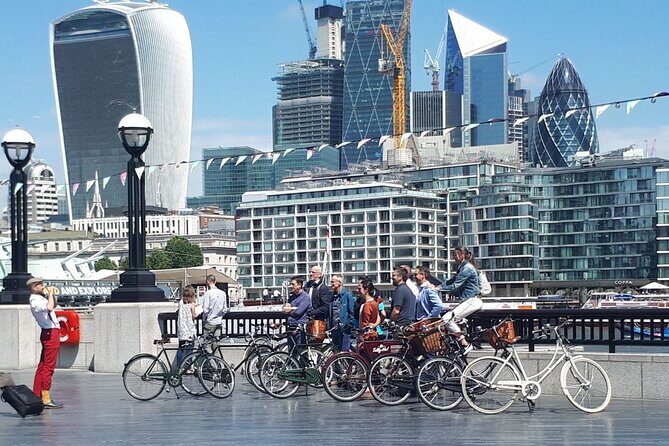
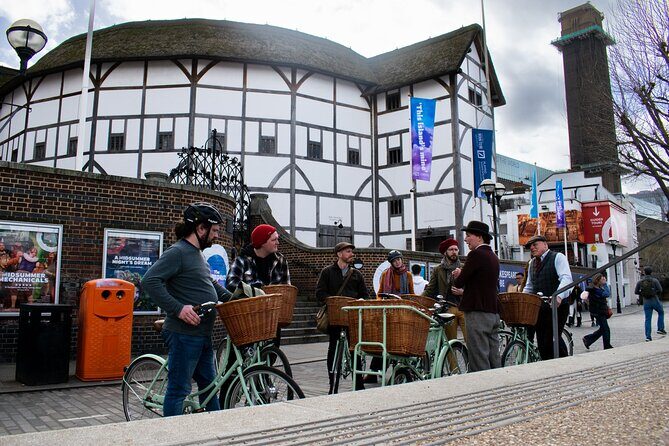
You’re riding a hand-built British bicycle, and that matters more than it sounds. It’s the kind of practical detail that can make a few hours feel smooth rather than tiring.
Your group size is capped at 12, which usually means easier navigating and more chances to ask questions when you want context. In one review, the group was just four people with Katie, and that small size made it easier to avoid the busiest knots of the route.
Helmets are optional, not forced, but you should seriously consider wearing one. You’ll also get a rain poncho if required, plus the option of a tweed cap. (Yes, it’s a bit cheeky. Also, it’s a fun way to fit the day’s vibe.)
The practical reality: there’s cycling time before and after every stop. If you’re not used to bikes or tight city riding, think of this as a “see London by momentum” experience, not a stroll.
Roupell Street to The Cockpit: working-class London before the famous icons
This first stretch is a nice warm-up. It starts with streets and buildings tied to everyday life, not just royal pageantry.
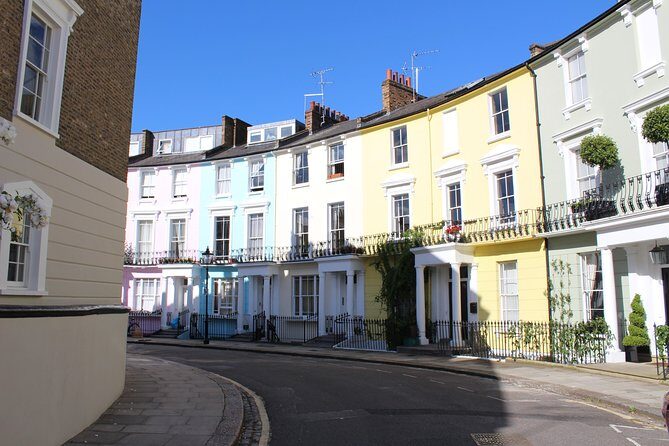
Stop 1: Roupell Street (1820s working-class Georgian London)
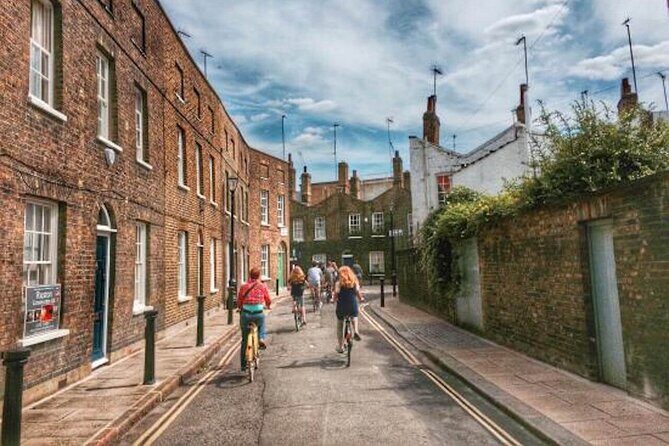
Roupell Street is a concentrated dose of early 1800s London character: charming Georgian houses built for the working class. You’ll learn how John Roupel reclaimed marshy land and named the streets after family, and you’ll also hear about confusion over postmen’s mail that led to name changes.
A standout detail here is the link between architecture and fire safety. After a near-disaster in 1829, fire insurance rules left reminders on houses. You’ll notice plaques that explain how private firefighters might only respond if your home had the right marking. Even after WWII bombings, the streets still exist—so it’s a rare “past still here” feeling.
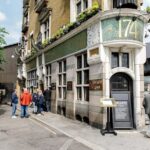
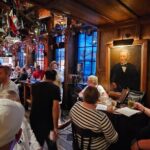
You also stop at The King’s Arms, a Grade II Victorian pub. It’s known for having 10 real ales, including local brews. The tour notes its past life as an undertaker’s and magistrates’ court, and you can also connect it with current-day use, including top-notch Thai cuisine.
Ticket note: this stop is described as free to visit, and the pub stop includes no admission ticket requirement for the tour itself.
Stop 2: Blackfriars Bridge (Dominican Friars meet the Thames)
Next up is Blackfriars Bridge, opened by Queen Victoria in the late 1860s, according to the tour details. It’s named for the Dominican friars who had their monastery at the north end.
The small design detail I like here: the top of the support columns are shaped like pulpits, keeping the friars’ memory in the structure. That’s the kind of “London pays attention to history in the details” moment that makes a guided bike tour worthwhile.


Stop 3: The Cockpit pub (Shakespeare’s gatehouse connection)
The Cockpit is another story-heavy stop. It ties monastic life and the friars’ presence here to Shakespeare’s later use: the guide explains Shakespeare bought the gatehouse and lived in the area.
Ticket note: the Cockpit stop is listed as not included for admission. Practically, that means you’re likely getting more of a quick look and photo moment unless you choose paid time on your own.
St Paul’s, Bow bells, and Guildhall: City of London power in short stops
Once you’re in the City of London, the mood shifts. You get thick layers of official history—church power, civic authority, and medieval rules that still leave a mark.
Stop 4: St. Paul’s Cathedral (from weddings to funerals)
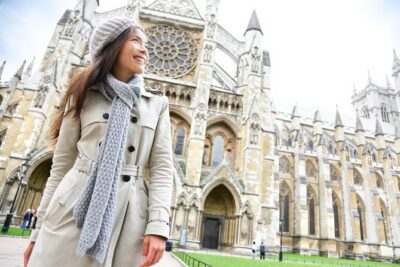
St Paul’s is the kind of landmark you already recognize from photos, but the tour adds a timeline you can actually use. The guide connects it to major 20th-century events: Prince Charles and Lady Diana’s wedding, plus Winston Churchill’s funeral.
You’ll also learn about older layers: Wellington and Nelson are laid here, and St Paul’s dates back to 604 AD in its earlier form. The Great Fire of London in 1666 destroyed the old cathedral, and Christopher Wren rebuilt it—turning resilience into a visible civic symbol. Then the tour brings in WWII bombing, explaining how the cathedral still stands.
Ticket note: admission isn’t included. Plan for a quick stop and outside/short peek time, with the option to pay separately if you want to go deeper.
Stop 5: St. Mary Le Bow (Bow bells and the Cockney line)
St Mary Le Bow is famous for its bells. If you’re born within the sound of Bow bells, you’re a Cockney Londoner—simple rule, big identity.
This is a good reminder that London history isn’t just kings and wars. It’s also language, pride, and local identity codes that feel weirdly specific until you learn them.
Stop 6: Guildhall (medieval traditions that refuse to die)
At Guildhall, the guide focuses on medieval London and the City’s town hall. What stands out here is the mention of weird, archaic traditions that have been unchanged since the Middle Ages.
Even if you don’t catch every tradition detail in a 5-minute stop, the effect is clear: the City of London has its own rules and personality, and they’re not just museum pieces.
Stop 7: Mansion House (Roman importance and modern civic influence)
Mansion House is tied to the Lord Mayor of London and to the broader civic importance of the highest point in the City of London since Roman times.
The tour also connects it with the Bank of England. That combo—ancient significance plus modern finance—helps you understand how the “City” stayed influential even as the city changed around it.
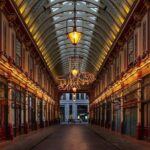
Stop 8: Leadenhall Market (Diagon Alley vibes with Roman context)
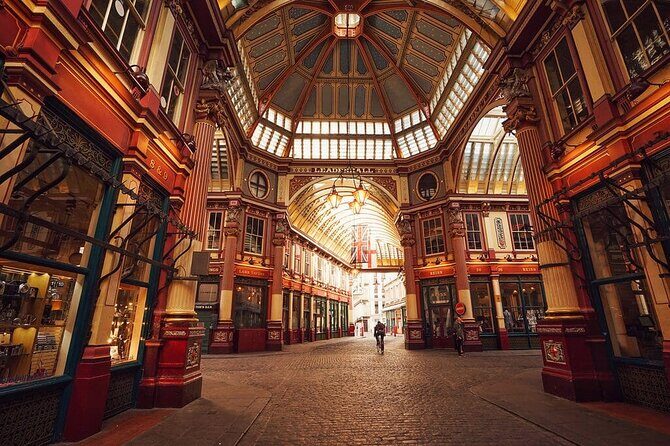
Leadenhall Market is a Victorian market designed by Sir Horace Jones. The fun part is the guide’s way of linking it to older ground: in Roman times, the location was the Forum and Basilica.
Then the tour points out Harry Potter connections like Diagon Alley and the Leaky Cauldron. If you like linking pop culture to the physical place, this is the stop where it feels most playful.
Ticket note: this stop is free for the tour. Admission isn’t required, and you can enjoy the setting without paying again.
Stop 9: Lloyds of London area (Richard Rogers shapes the skyline)
At Lloyds of London, you’ll see the architectural contrast that makes the City feel like a controlled experiment. The guide highlights Richard Rogers’ Lloyds skyscraper and places it alongside the Cheesegrater and the Gherkin—modern forms right next to older structures like St Andrew Undershaft, described as a pre-1666 fire church built in 1517 under Henry VIII.
It’s a great reminder that London isn’t “old” or “new.” It’s both, in the same shot.
Stop 10: London Wall (a Roman anchor in modern streets)
Finally in this cluster, London Wall brings you back to the Roman era. The tour describes the Roman wall of London, noting parts built around 200 AD. It’s a quick stop, but it’s one of those moments where you suddenly realize how long this city has been here.
Cable Street to Shadwell Basin: East End streets with real bite
This is the part of the tour that tends to feel more human and more intense. You move away from ceremonial icons and into places shaped by immigration, ideology fights, dock work, and redevelopment.
Stop 11: Cable Street Mural (1936 conflict, told in paint)
Cable Street is famous in London history for resistance and crowds. The guide explains the mural was completed in 1983 and depicts the battle between fascists and protesters in 1936 in an area that had been predominantly Jewish.
This stop is short, but it lands because it’s visual history. A mural like this turns a textbook event into something you can stand with and read.
Stop 12: Shadwell Basin (original docks, modern regeneration)
At Shadwell Basin, the tour takes you to one of London’s original docks. You’ll learn the area has been regenerated since the 1980s and hear that about 100 years ago it was described as the busiest docks in the world.
This is a stop where the guide’s tone matters. You’re not just seeing water and warehouses; you’re getting a sense of work and movement—ships arriving, goods moving, and entire lives built around the dock economy.
Stop 13: Tobacco Dock (ornamental canal and old warehouses)
Tobacco Dock brings the docks into focus again: ornamental canal, old tobacco warehouses, and redevelopment since the 1980s. The “tobacco” story adds a trade dimension—what was shipped, where it went, and how industrial London generated its power.
Ticket note: admission isn’t included for this stop, so expect viewing time rather than an extended indoor visit.
Stop 14: St Katharine Docks (last docks built, first closed)
St Katharine Docks is described as the last docks to be built in 1825 and the first to close in the 1960s. The tour also adds the earlier human layer: a hospital called St Katherine’s by the Tower, founded in 1147 by Queen Matilda.
Short stop, but it gives you a clean sense of how dock functions shifted as London’s economy changed.
Tower Bridge to HMS Belfast: the Thames pageant you actually understand
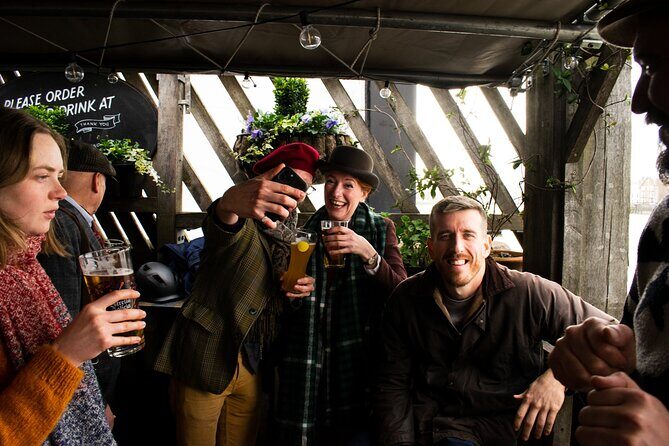
Now you start hitting the iconic river landmarks that make people want to come to London. The tour still keeps it grounded, though, by pairing each photo spot with a fact or story that adds meaning.
Stop 15: Tower Bridge (design, engineering, and the 800 lifts a year detail)
Tower Bridge is treated as more than a postcard. The guide explains it’s a combined bascule and suspension bridge, designed by Sir Horace Jones and engineered by Sir John Wolfe Barry, completed in 1894.
You’ll hear about the neo-Gothic towers and the central walkway, and the tour mentions the Tower Bridge Exhibition in the towers, including panoramic views from the glass-floored walkway. The detail that sticks: the bascules raise around 800 times a year to let tall ships through.
Ticket note: admission isn’t included. Plan on a quick look and photos; if you want views from inside, that would be extra.
Stop 16: Tower of London area (Traitors Gate and the Crown Jewels)
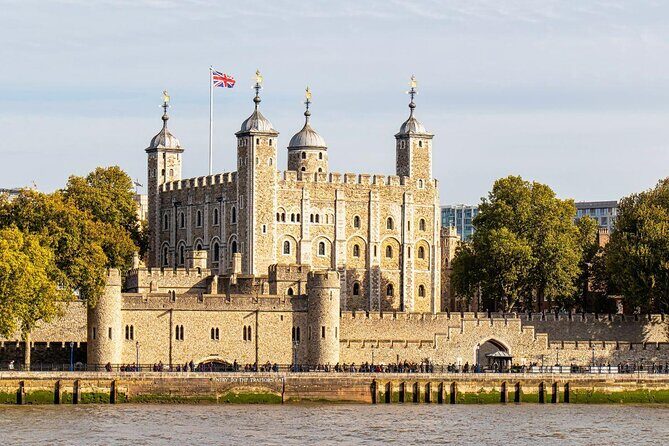
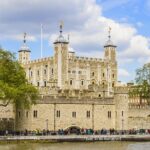
The Tower of London is where the stories get heavy. The tour explains it was built by William the Conqueror shortly after 1066. It served as palace, menagerie, observatory, and armoury, then became known most for imprisonment and executions.
Traitors Gate is highlighted as an entry that often led to grim fate. The guide names people connected to it: William Wallace, Thomas More, Henry VI, Edward V, plus Henry VIII’s wives Anne Boleyn and Catherine Howard. Today, the Crown Jewels are the must-see draw.
Ticket note: admission isn’t included, so your stop is likely exterior and short time. If you want the full Crown Jewels experience, budget extra time and ticket cost.
Stop 17: HMS Belfast (WWII history with a Hollywood tie-in)
HMS Belfast is a World War II cruiser-class destroyer ship, and the tour connects it to the Titanic shipyard link: built in the same shipyard as the Titanic in Belfast.
It protected convoys in WWII and the Korean War, and it’s listed as part of the D Day Landings on June 6, 1944. Today it’s a floating museum, and the tour also notes the ship’s interiors doubled as the Royal Yacht Britannia in Netflix’s The Crown.
Ticket note: admission isn’t included. You can expect an exterior/quick look unless you pay to enter separately.
Stop 18: City Hall (Norman Foster design nod)
City Hall is a quick architectural stop, described as the former City Hall of London and credited to Norman Foster. In a half-day tour, it’s mainly a “see the modern side of the river” checkpoint.
Stop 19: St Dunstan in the East (a quiet pocket in the City)
St Dunstan in the East is your reset button. The tour asks you to take a moment in a quiet space in the middle of the City. It explains the original church was destroyed in the Great Fire of London in 1666, then rebuilt by Wren.
Even in a short stop, that pause matters. London is louder than people expect; this gives you a breath.
The Great Fire monument, Shakespeare’s Globe view, and Tate Modern
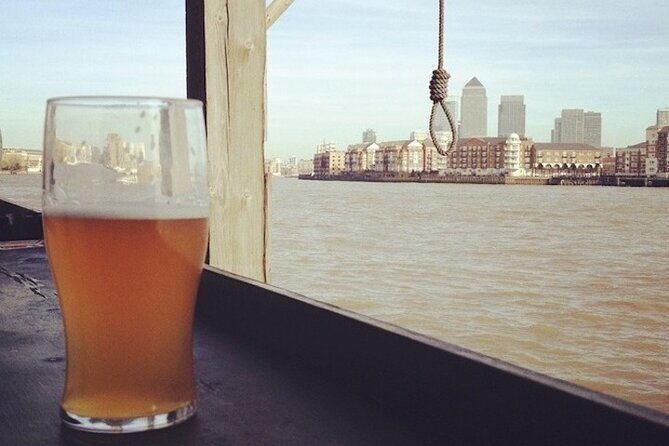
The final stretch pulls together London’s storylines: fire, theatre, and modern art.
Stop 20: The Monument to the Great Fire of London (urn math and 202 feet)
The Monument is described as 202 feet high. The guide includes a vivid detail: if you lay the golden urn on top on its side, it would land at Thomas Farriner’s bakery shop on Pudding Lane—the place where the fire started on 2 September 1666.
This stop is short, but it helps you picture the distance and origin, turning the Great Fire from a date into a location.
Stop 21: Southwark Bridge (Shakespeare’s Globe reconstruction viewpoint)
Southwark Bridge gives you a view of Shakespeare’s Globe. The tour notes it’s a 1997 reconstruction of the original 1599 venue, linked to the Lord Chamberlain’s Men and the debut of many Shakespeare classics.
If you’re a theatre fan, this is an easy win. If you’re not, it still helps you connect London’s cultural identity to physical space.
Stop 22: Tate Modern (modern art in a repurposed power station)
Tate Modern ends things with a building that’s part of the attraction. The tour says it opened in 2000 after transforming a 1950s Bankside Power Station. You’ll see the twisted brick pyramid extension from 2016 and the 10th-floor viewing gallery.
You’ll also hear about the turbine hall hosting changing, monumental commissions. Even if you don’t chase art, this stop can still work because the space itself is a landmark.
Ticket note: admission isn’t included. Depending on your timing and energy, you might add time on your own.
Price and value: is $103.35 worth it?
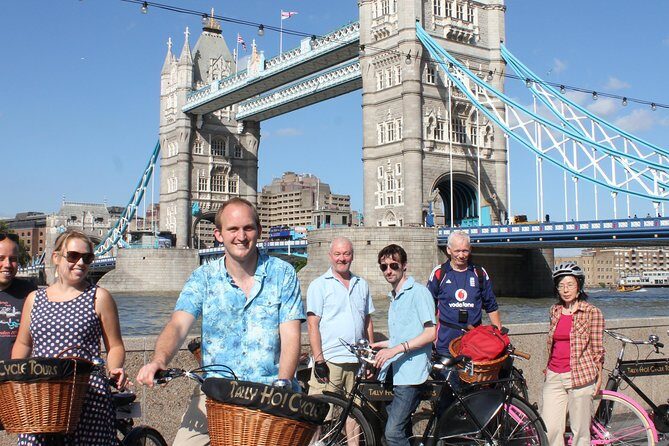
For $103.35 per person, you’re paying for more than sightseeing. You’re paying for: a bike (hand-built), a local guide, helmet optional gear, and a rain poncho if needed. You’re also paying for a tight route that’s designed to hit major areas—Thames, City, East End docks—without you having to plan every segment.
This is usually good value if:
- You have limited time and want to leave with a mental map of London
- You’d rather spend your energy riding than researching
- You like guided context, especially around history and places with layered meaning
It’s less ideal if you want long, inside-the-building visits at every stop. Many stops are short photo-time style, and admission to several major sites isn’t included. You may need to plan follow-up visits on other days (like Tower of London or Tate Modern proper) if those are priorities.
Also remember: snacks and drinks aren’t included. I recommend doing one of two things before you go—either eat a proper meal beforehand or plan to grab food on the way. In one review, a guide suggestion was exactly that: a big breakfast helps.
Should you book this Hidden Gems bike tour?
Book it if you want an efficient half-day that mixes major icons with story-driven street-level London. The bike format really does help you cover ground, and the small-group size (up to 12) makes the experience feel more controlled than a typical walking crush.
Skip it or reconsider if:
- You’re not comfortable with cycling for a few hours
- Rain and bad weather are deal-breakers for your plans (it runs in all weather conditions, with ponchos provided only if required)
- You want lots of seated time indoors; admission isn’t included for key stops, and the tour cadence is built for moving
If you’re a first-time visitor, or you just want your bearings fast before you branch out on your own, this is the kind of tour that can set up the rest of your trip.
FAQ
What’s the meeting point and finish location?
You meet at 189 Hercules Rd, London SE1 7LD, UK. The tour ends back at the meeting point.
How long is the tour?
It runs for about 4 hours.
Is admission to major attractions included?
No. Several stops list admission tickets as not included, meaning you’ll typically rely on short viewing/photo time unless you choose to pay separately on your own.
Is the tour suitable for beginners or only experienced cyclists?
It’s designed for guests with moderate physical fitness. It runs on a bike route, so you should be comfortable cycling at city speed and for a few hours.
What should I bring regarding weather and comfort?
Wear appropriate clothing for all weather conditions. The tour provides a rain poncho if required, and you’ll have the option of an optional helmet.
Can I cancel and get a full refund?
Yes. You can cancel for a full refund if you cancel at least 24 hours before the experience’s start time. If you cancel less than 24 hours before, the amount paid won’t be refunded.