Brighton turns into a game with cryptic clues. You follow maps on your phone, solve clue prompts at your own pace, and pick up stories as you go. What I like most is the self-guided freedom and the phone-based flow that feels as easy as WhatsApp, with hints when you get stuck. A fair heads-up: the clues can take a minute to figure out, and if you’re only a small group you may lean on hints more often.
You start at India Gate in Brighton and finish back there, and the whole thing runs for about 2 hours 30 minutes at a relaxed strolling tempo. You’ll see a mix of big-name Brighton spots and more off-the-radar corners, plus you can stop, look longer, and even build your own break plan if something catches your eye.
In This Review
- Key things that make this Brighton treasure hunt work
- Why this treasure hunt format beats a standard walking tour
- Captain Bess and your phone maps: how the clue system feels
- Where you meet and how to plan your 2.5 hours
- Royal Pavilion: the big first stop that sets the tone
- Brighton Dome and the approach to puzzle-solving
- North Laine and Theatre Royal: street level fun with real choices
- The Lanes: where the hunt gets personal
- Brighton Palace Pier and West Pier: coast views with a puzzle twist
- Finishing at the Theatre zone and wrapping back at India Gate
- Price and value: is $20.83 worth 2.5 hours?
- Who should book this treasure hunt?
- Quick FAQ for planning your hunt
- FAQ
- How long does the treasure hunt take?
- What does it cost?
- Where does it start and where does it end?
- Do I need to download an app or print anything?
- What if I cannot solve a clue?
- Can I start at any time?
- Is this a private tour?
- What is the cancellation policy?
- Is it good for people who walk a lot but have moderate fitness?
- Should you book Treasure Hunt Brighton?
Key things that make this Brighton treasure hunt work

- Phone-based maps and clues: no printing, no fuss, and nothing to install
- Captain Bess guides the game like a chat, with hints built in
- Self-guided pacing: you can linger or zip ahead without a fixed group schedule
- A route built around classics plus quieter streets (so you’re not only doing the obvious)
- Good for teens and mixed groups because it turns sightseeing into a challenge
- Saves you decision fatigue: you always know what to look for next
Why this treasure hunt format beats a standard walking tour

This isn’t a sit-there-and-listen tour. It’s a treasure hunt you control.
You get step-by-step maps on your phone and clue prompts that lead you between landmarks. Because it’s self-guided, you’re not stuck marching with strangers who move at a different pace than you do. That matters in Brighton, where you can hit stop-and-go crowds at the most popular corners.
Also, the tone is playful and light. You’re not just reading facts; you’re hunting for answers, then getting little stories along the way to keep the walk from feeling like homework. If you’re the type who likes to explore with a goal, this format clicks fast.
One more practical win: you can start when you want. That flexibility turns the hunt into something you can tuck into a day trip plan, not an all-day commitment.
You can also read our reviews of more tours and experiences in Brighton.



Captain Bess and your phone maps: how the clue system feels
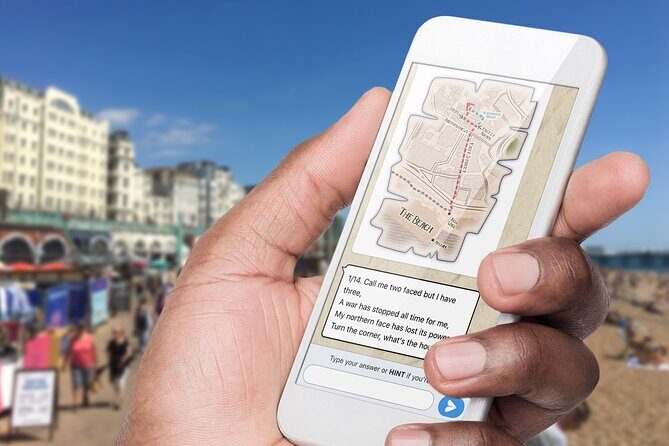
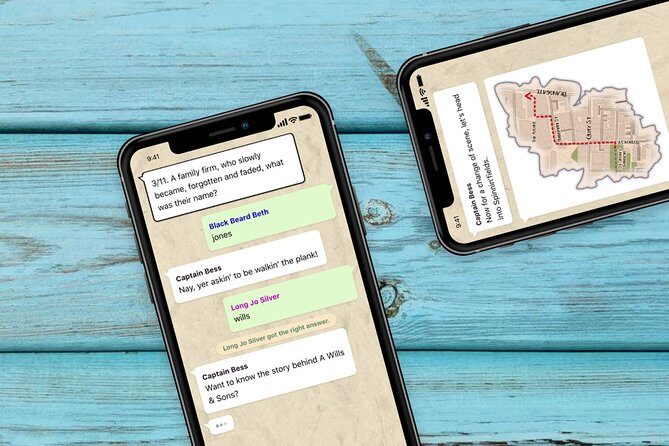
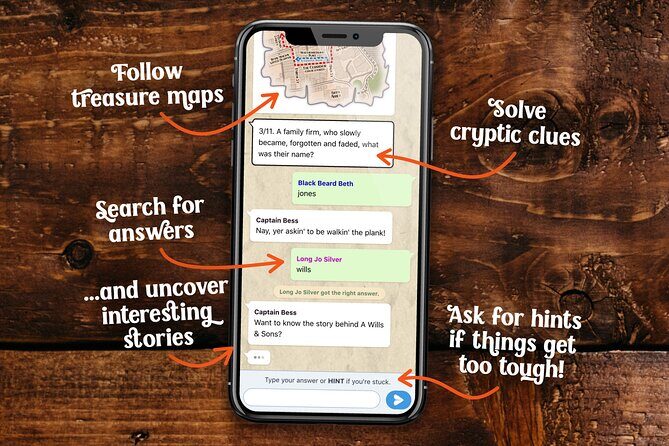
The experience runs through your phone like a chat. Captain Bess invites you, then sends treasure maps and clue questions as you move around Brighton.
Here’s what you should expect from the clue flow:
- You’ll get maps that point you toward the next location
- You’ll get cryptic-style clues that push you to look at details around you
- If you can’t solve something right away, you can ask for hints
- You don’t need to download anything or grant permissions
- You don’t need anything printed
I like this setup because it handles two common problems with self-guided city walks: you always know where you’re going next, and you don’t lose time if you’re stuck. The hints also keep the game moving so you aren’t stuck staring at a wall for 20 minutes.
A small caution: the hunt has a learning curve. Some people take a little while to understand how the clues are meant to be read. Once you crack that first pattern, the rest tends to feel much more straightforward.
Where you meet and how to plan your 2.5 hours
The start and finish is India Gate (Brighton and Hove, Brighton BN1 1EE, UK). It ends back at the meeting point.
The activity is listed as open 7 days a week, 8:00 AM to 8:00 PM. That gives you a lot of flexibility for when you want to go, especially if you’re trying to dodge peak crowds.
Time-wise, plan on about 2 hours 30 minutes. Wear comfortable shoes. This is still a city walk, and the pacing can be longer if you pause to read, shop, or ask for extra hints.
You’ll also want a decent battery life. Even though you don’t download anything, you’ll be using your phone for maps and the clue chat the whole way.
And yes, this is a private experience for your group, so you’re not competing with other teams for attention when you need to stop and figure something out.
Royal Pavilion: the big first stop that sets the tone
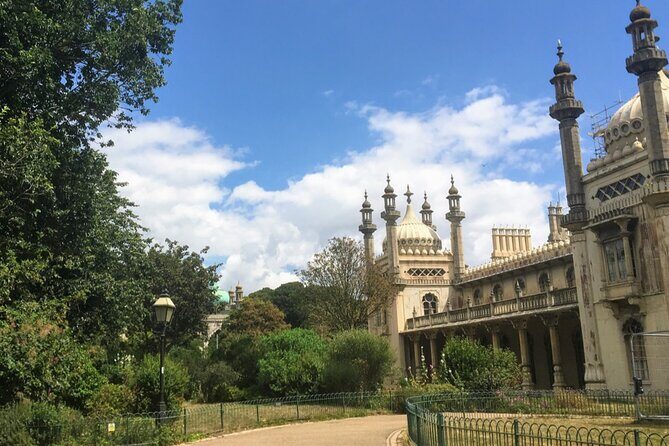
The route starts with Royal Pavilion.
Why this is a smart opener: big landmarks are easy anchors. Even before you solve the first clue, you can orient yourself around a well-known starting point and get used to the game rhythm.
At this stage, expect two things:
- You’ll switch from sightseeing mode to “look closely” mode.
- Your clue prompts will teach you what kinds of details the hunt is asking you to find.
If you’re new to treasure hunts, this first stop is where you want to take your time. Once you understand what the clue style is doing, the rest of the walk typically feels smoother.
Brighton Dome and the approach to puzzle-solving
Next up is Brighton Dome.
This section is where you build momentum. The hunt’s system is meant to keep you moving city to city, but it also leaves room for little detours if you want to explore what’s around you.
Drawback to consider: some stops can feel less like classic postcard sights and more like “you have to look for it” locations. The hunt is designed to mix well-known areas with smaller side streets, so if you expected only the most obvious viewpoints, you may feel a bit of a surprise in the middle.
If you get stuck here, use hints early rather than late. It’s usually faster to reset your thinking and keep going than to brute-force a cryptic clue.




North Laine and Theatre Royal: street level fun with real choices
After Brighton Dome, the route goes to North Laine, then Theatre Royal Brighton.
This is a good pairing because it changes your vibe. North Laine is the kind of area where you can naturally slow down. You’re likely to be looking at shopfront details while you follow clue prompts, and it’s easy to turn the hunt into a casual wander without feeling lost.
Also, the experience explicitly encourages flexibility. If something grabs your attention in a shop window, you can pause and check it. In fact, you can even treat the hunt like a loose structure and stretch it into your own evening plan.
At Theatre Royal, your clue questions may nudge you to pay attention to architecture and signage-type details rather than views. If you’re the type who enjoys solving rather than taking photos, you’ll probably like this part a lot.
The Lanes: where the hunt gets personal

Then you’ll head to The Lanes.
This is where the experience often feels most like an actual adventure. Narrower lanes mean you’ll have more visual stuff to scan, and cryptic clues tend to work well in areas where there’s plenty of detail to notice.
A practical tip: if your group splits into different directions while searching, agree quickly on a meet-back point. The phone-based maps keep you on route, but the lanes can get busy, and it’s easy to lose each other if you wander independently while solving.
If your group is small (like two people), you may find certain clues harder without extra eyes. The hunt’s hint system is there for a reason—use it so you stay in the fun zone instead of getting frustrated.
Brighton Palace Pier and West Pier: coast views with a puzzle twist

The next major steps are Brightbrighton Palace Pier and then West Pier.
This part gives you a change of scenery. Even if you’re focused on clues, being near the seafront helps break up the walk and gives you a chance to reset.
One note: the route includes both famous and more quietly encountered elements of Brighton. West Pier in particular can feel like a contrast point—more atmospheric, less “fast stop, fast photo,” more “slow look, solve, and move.”
If you’re the kind of person who likes to take a scenic break, schedule it here. The hunt format won’t punish you for pausing; it’s designed for you to control the pace.
Finishing at the Theatre zone and wrapping back at India Gate
The route also includes Theatre Royal Brighton (earlier) and ultimately brings you back to your start point at India Gate.
By the end, the hunt is designed to give you a broad overview of Brighton—big sights, key neighborhoods, and the kinds of streets you’d likely miss if you only did a straightforward checklist.
This last stretch is where the value shows. You’re not only consuming sights; you’re building a mental map of where you want to go next—whether that means returning for a longer sit-down meal, shopping time, or a second walk to repeat the areas you enjoyed most.
Price and value: is $20.83 worth 2.5 hours?
At $20.83 per person, this is positioned as a budget-friendly way to turn sightseeing into an interactive challenge.
Here’s the value logic that makes sense for this format:
- You’re getting a structured route through multiple parts of Brighton
- You’re getting real-time guidance on your phone (maps + clues)
- You’re getting built-in help through hints
- You’re paying for flexibility—no appointment-waiting with a guide and no pressure to stay in a fixed group pace
The only price risk is if you dislike puzzle-style scavenger hunts. If you want passive sightseeing with narration, this may feel like more work than you expect. But if you like a light mental challenge, it’s a cost-effective way to cover ground without feeling rushed.
Who should book this treasure hunt?
This fits best if you:
- Want to explore at your own pace and dodge group-tour timing
- Like games, puzzles, and clue-based walking
- Enjoy learning city stories while you move (not while you sit still)
- Are bringing teens—this kind of activity often lands well with younger explorers who get bored during long explanations
- Prefer a route that includes famous places plus quieter streets
It may be less ideal if:
- Your group hates clues or puzzle-solving
- You’re a very small group and want zero ambiguity. If there are only two of you, you may need hints more often.
- You only want the most obvious top-tier tourist stops. The route is designed to balance major sights with less expected locations.
Quick FAQ for planning your hunt
FAQ
How long does the treasure hunt take?
It runs for about 2 hours 30 minutes, roughly. Build in a little extra time if you stop to shop, scan details slowly, or request several hints.
What does it cost?
The price is $20.83 per person.
Where does it start and where does it end?
It starts at India Gate (Brighton and Hove, Brighton BN1 1EE, UK) and ends back at the same meeting point.
Do I need to download an app or print anything?
No. It works on your phone like WhatsApp, uses a mobile ticket, and you do not need to download anything or print materials.
What if I cannot solve a clue?
You can ask for hints along the way. That’s part of how the experience keeps you moving if you get stuck.
Can I start at any time?
You can start when you want. The activity window is listed as 8:00 AM to 8:00 PM.
Is this a private tour?
Yes. It’s a private tour or activity, so only your group participates.
What is the cancellation policy?
You can cancel for a full refund up to 24 hours before the experience starts. If you cancel within 24 hours, the amount paid is not refunded.
Is it good for people who walk a lot but have moderate fitness?
It’s listed as requiring a moderate physical fitness level. Since it’s a city walk, wear comfortable shoes and be ready for steady walking.
Should you book Treasure Hunt Brighton?
I think you should book this if you want a fun, flexible way to explore Brighton without committing to a rigid guided schedule. The mix of big landmarks like Royal Pavilion and Pier, plus neighborhood walking like North Laine and The Lanes, makes it a strong “get your bearings” day—especially if you like solving clues and learning as you go.
If you’re trying to keep things low-effort and you want only narration and minimal thinking, consider skipping it. But if you’re the type who enjoys playful challenge, you’ll likely have a great time figuring it out, asking for hints when needed, and walking away with a clear sense of where you want to spend your next hour in Brighton.