REVIEW · STRATFORD UPON AVON
Stratford Town Walking Tour 365 Days a Year
Book on Viator →Bookable on Viator
Shakespeare, but on foot and at street level. This Stratford-upon-Avon walk links the famous names with quieter sights, so you see more than postcard spots. I especially love the car-free streets and alleys you get on this route, and I like that the local guides bringing the stories to life can be folks like John, Georgina, or Grace, based on names I saw in guide praise.
One thing to think about: it’s a fairly brisk 1.5–2 hour stroll with lots of short stops, and entry to the Shakespeare sites and major interiors is not included. If you want to go inside every building mentioned, you’ll likely need extra tickets and a little time buffer in your day.
In This Review
- Key takeaways
- The Bancroft Gardens start: easy to find, easy to focus
- Price and value: what $16.67 gets you (and what it doesn’t)
- Shakespeare’s Birthplace on Henley Street: more than a photo stop
- Shakespeare’s New Place and Hall’s Croft: status, legacy, and everyday life
- Holy Trinity Church and the Guild Chapel: sacred places with real stories
- Shakespeare Schoolroom, Guildhall, Town Hall, and High Street: education and civic power
- Theatre district on foot: Royal Shakespeare Theatre to The Other Place
- Extra stops that add texture: canals, memorials, and writers
- Morning vs afternoon tours: how to plan your day like a local
- Who should book this walking tour—and who should skip it
- Should you book the Stratford Town Walking Tour 365 Days a Year?
- FAQ
- FAQ
- Is the Stratford Town Walking Tour 365 Days a Year offered in English?
- How long is the walking tour?
- What is included in the price?
- Which places are visited during the walk?
- Are there discounts for Shakespeare attractions?
- Do I need a printed ticket?
- Where does the tour start, and where does it end?
- Is the tour suitable if I have trouble standing or walking?
- What’s the cancellation policy?
Key takeaways
- Start at the Swan Water Fountain by Bancroft Gardens so you can get oriented fast
- Shakespeare’s story, in the exact town locations where key family chapters played out
- The route reaches areas cars can’t, including tight lanes and historic corners
- The theatre stop sequence is a highlight: Royal Shakespeare Theatre, Swan Theatre, and more
- Short stops mean you learn fast, then you can choose what to revisit later
- Discounts on Shakespeare attractions can make the paid entries feel less painful
The Bancroft Gardens start: easy to find, easy to focus
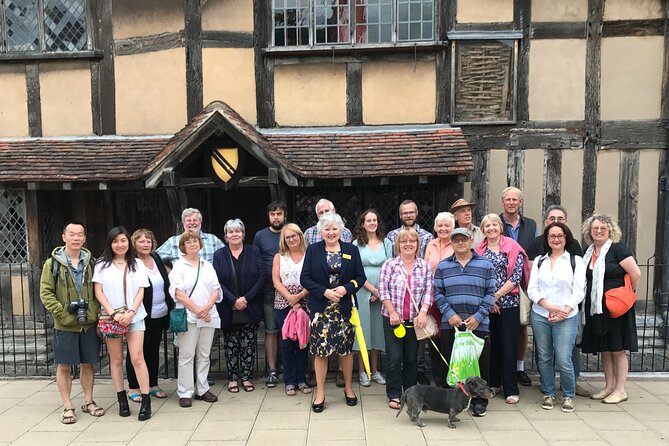
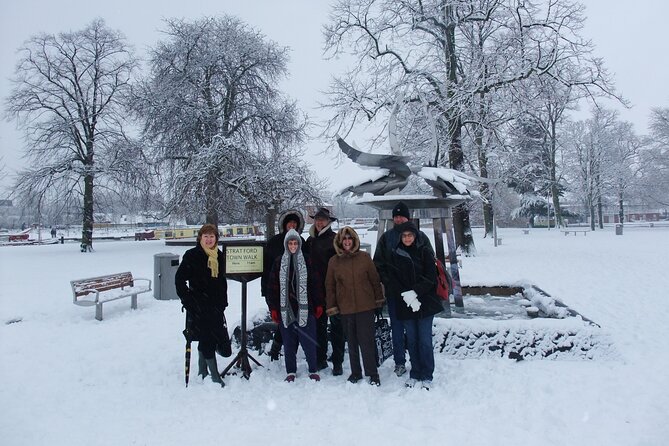
The tour meets at the Swan Water Fountain in Bancroft Gardens on Waterside, right by the river. Look for your guide wearing a flash of yellow, standing by a lamppost with a yellow sign showing the company name. It’s a smart setup because you’re already in a scenic, walkable area before anyone launches into Tudor details.
From there, you’re on foot for a planned loop of highlights and story-driven stops. The exact route can vary, and the guide will tell you where the walk finishes. That matters because Stratford’s center is compact, but not every path is identical—having a real-time end point saves you from wandering off on your own when your legs start making decisions.
One practical upside: public transportation is nearby, and there are cafes and conveniences around town. So if you want coffee before you start—or a quick bite after—you won’t feel trapped in tour-only timing.
You can also read our reviews of more tours and experiences in Stratford upon Avon.



Price and value: what $16.67 gets you (and what it doesn’t)
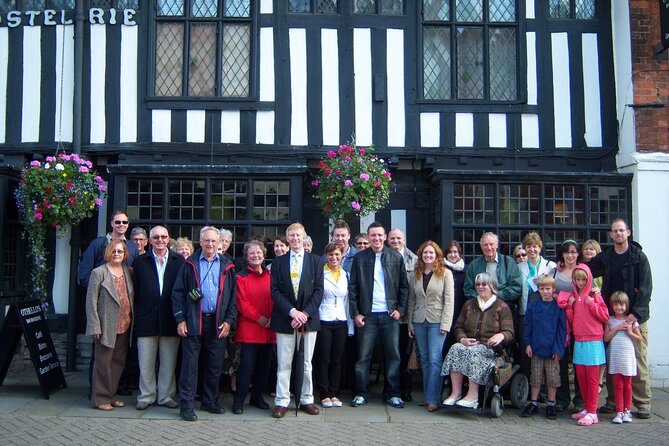
At about $16.67 per person, this is priced like a “make your day easier” tour rather than a museum-ticket experience. You’re paying for a local professional guide, plus an itinerary built around context—history, architecture, and Shakespeare connections—delivered at street level. You’re also getting a small group experience (up to 25 travelers), which keeps things lively without feeling like you’re in a cattle pen.
What’s not included is just as important as what is. Entry tickets are listed as not included for major places like Shakespeare’s Birthplace, Shakespeare’s New Place, Hall’s Croft, Holy Trinity Church, the Guild Chapel, and other attractions on the route. So the tour works best as a high-quality “field guide” to help you decide where to spend paid entry time.
The good news: the tour offers discounts on Shakespeare houses/attractions. That can soften the cost of adding one or two interiors—especially if you’re the type who wants to see the inside of the most important sites, not everything everywhere.
Shakespeare’s Birthplace on Henley Street: more than a photo stop

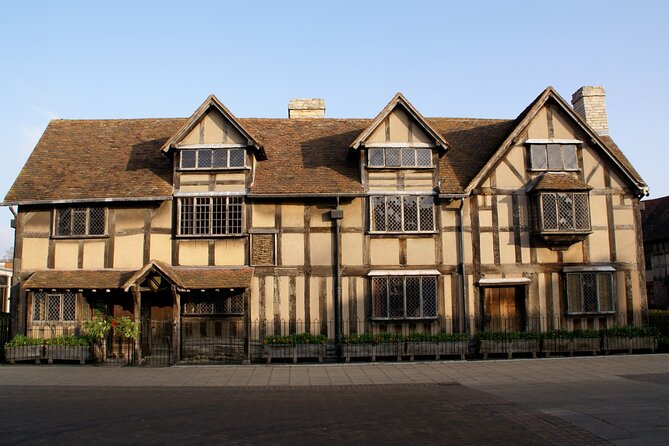
Your walk swings through the heart of Stratford’s Shakespeare geography at places that feel immediate, not staged. Shakespeare’s Birthplace is a beautiful 16th-century half-timbered house on Henley Street, tied to William Shakespeare’s family—John and Mary Shakespeare—and to his birth in 1564.
This stop is designed to answer the question you’re probably thinking: how did childhood, work, and family shape the writer later? You’ll hear about the Tudor household and the glove-making business John Shakespeare established, plus how William grew up there and later lived with Anne Hathaway after marriage. That context is what turns a famous building into a more personal story.
A practical tip: if you’re thinking of doing a paid interior visit, there’s a note that you can get a discount if you choose to visit Shakespeare’s Birthplace before or after the tour. So even though entry isn’t included on the walk, you’re not left totally on your own when you decide you want to go deeper.
Shakespeare’s New Place and Hall’s Croft: status, legacy, and everyday life
Outside New Place, you’re in a different kind of moment. Shakespeare purchased New Place when he was 33 and lived there with his family until his death at 52. You’ll stand outside the magnificent gates and hear why the large house was demolished in 1759.
That demolition detail is more than trivia—it helps you understand how the town’s Shakespeare memory has changed over time. Buildings vanish, but stories keep moving, and towns like Stratford often rebuild their interpretation again and again.
Then you’ll move to Hall’s Croft, the Jacobean home of John Hall, who married Susanna, Shakespeare’s eldest daughter. This stop connects theatre-world fame to real family ties and real professions. You’ll also hear stories tied to medieval medical cures, which is a fun tonal shift: it’s not just quill-and-ink life, it’s the history of how people tried to heal themselves.
Holy Trinity Church and the Guild Chapel: sacred places with real stories
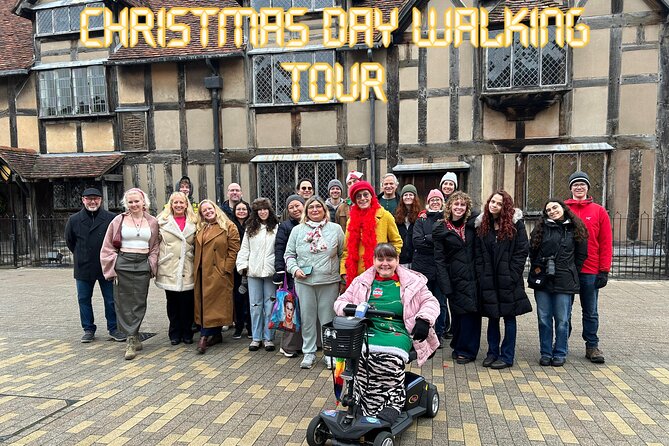
Holy Trinity Church is one of England’s most visited parish churches, and it’s on the River Avon—so the setting does half the work for you. This is where Shakespeare was baptized and worshipped, and where he was buried within the chancel. Approach along the avenue of lime trees, and you’ll get that classic English church-courtyard feeling before any facts start flying.
A drawback to note: the tour stop is short, so you’ll get the storyline, not a long, inside-only visit. If you want the full experience of being in the space, you’ll likely want to add the entrance separately when it fits your schedule.
Next up is the Guild Chapel, dating back to 1269 and tied to the Guild of the Holy Cross. This building is especially worth your attention for its medieval wall paintings—called out as a rare series across Europe. That’s the kind of detail that makes a quick exterior stop feel like a meaningful lead-in.






Shakespeare Schoolroom, Guildhall, Town Hall, and High Street: education and civic power
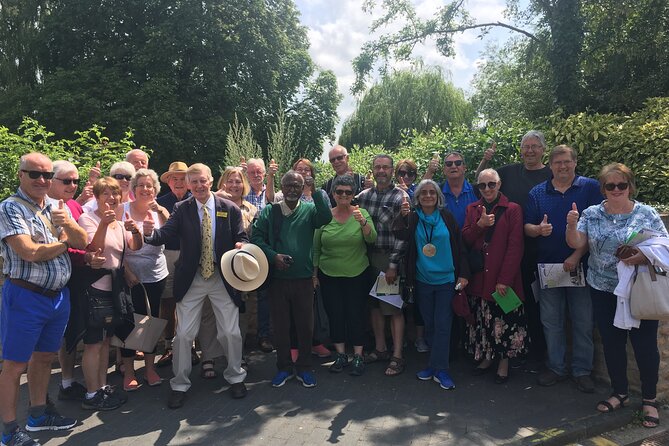
You’ll pass by Shakespeare’s Schoolroom, a half-timbered building dating back to the 1400s. It’s the place to talk about education: Shakespeare’s schooling and inspiration, tied to the King’s New School (now King Edward VI Grammar School, also known as K.E.S). This is one of those stops where the town’s architecture feels like a worksheet—you start seeing how civic structures formed the environment around the arts.
Below the schoolroom sits the Guildhall, and in 1553 it served as headquarters of Stratford Borough Council. That’s over 400 years of civic life in one place, and it gives you a sense of how local governance sat next to education and community identity.
Then you’ll look at the Town Hall, a Grade II listed building from the mid-1700s that was built on a Market House site. During the English Civil War the Market House was used as a munitions store, and later it was damaged by a gunpowder explosion. David Garrick officially opened the current building in 1769, and a Shakespeare statue was placed in a niche on the front—again, showing how often Shakespeare was used to brand Stratford as his fame grew.
The High Street stop adds the smaller, weirder details: a High Cross once marked the market junction, and a small building sometimes called The Cage sat at the corner of High Street and Bridge Street. The jail was beneath it, and it was also connected to Judith Shakespeare and her husband Thomas Quiney, a vintner. These are the stops that make Stratford feel like a living town instead of a curated “Shakespeare zone.”
Theatre district on foot: Royal Shakespeare Theatre to The Other Place
If you think Stratford is only about museums and houses, this section changes your mind. The Royal Shakespeare Theatre dates back to 1932 and was designed by Elisabeth Scott, who won a competition for the design. It replaced the Shakespeare Memorial Theatre destroyed by fire in 1926, and it remains home to the Royal Shakespeare Company.
Then comes the Swan Theatre, built within the surviving red-brick gothic facade after the earlier 1879 memorial theatre fire. The Swan Theatre opened in 1986 thanks to fundraising and benefactors, and that mix of preservation and reinvention is a big part of how Stratford’s theatre story continues.
The stop at The Other Place gives you an interesting contrast: in the 1970s it was a corrugated tin rehearsal room and experimental theatre studio. Redeveloped later, it reopened in 2006 as The Courtyard Theatre, with a flexible layout and a 200-seat setup for performances, rehearsals, and costume storage. Even if you don’t go inside, the logic of the space tells you something about Stratford’s creative risk-taking.
A practical angle: these theatre stops are shorter, but they’re timed well if you’re trying to see a lot in one day. And if you decide you want a ticket to a show later, this walk helps you understand what you’re looking at.
Extra stops that add texture: canals, memorials, and writers
Not every Stratford highlight is directly Shakespeare. Along the route you’ll also pass points that widen the lens on the town.
The Gower Memorial sits near the main road into town by Clopton Bridge, with the Royal Shakespeare Theatre visible behind. It was created in 1888 by Lord Ronald Gower and features Shakespeare characters including Hamlet, Prince Hal, Lady Macbeth, and Falstaff, plus a Shakespeare statue. It’s the kind of public art that’s easy to miss if you’re only scanning for the obvious tourist signs.
You’ll also hear about the Birmingham to Stratford Canal, opened in 1816. It was used to move goods like coal and wood, and later it became a more holiday-facing feature, with the canal terminating in the basin where you can access the River Avon. It’s a reminder that Stratford wasn’t built only on literature—it was built on transport and trade too.
There’s also a stop connected to Marie Corelli, a famous Victorian novelist known as Shakespeare’s Champion. She lived in Stratford and worked as a conservationist, which adds a literary layer beyond the Bard without turning the town into a one-author theme park.
Finally, Rother Market is included for the fact that it’s the weekly market held Fridays and Saturdays. Even if you’re not there on market day, it helps explain Stratford’s rhythm as a town that sells, chats, and sustains itself—not just a place people visit for two hours.
Morning vs afternoon tours: how to plan your day like a local

You get a choice of morning or afternoon tours, and that’s more useful than it sounds. If you start in the morning, you’ll be better set up to add paid interior visits with fewer time crunch moments later. If you do the afternoon version, you can treat the walk as your “choose what to do next” plan and then expand in the evening.
Because entry tickets are not included, you’ll want to decide early where you’ll spend extra money. The tour pairs highlights with attractions you might not find as easily on your own, and that’s perfect for helping you pick: do you want the inside views of one major Shakespeare house, or do you want to spread time across several short stops?
Also remember the walk can vary a bit, and the tour ends in a different location. That’s normal and fine, but it’s one more reason to keep your schedule flexible—especially if you’re connecting to a show at the Royal Shakespeare Theatre later.
Who should book this walking tour—and who should skip it
This works best if you love stories tied to buildings and streets. If you like your history in the form of real places—where Shakespeare was baptized, where civic life happened, and how theatre spaces evolved—this tour will make the town click.
It also fits well if you enjoy a brisk pace. The walk runs about 1 hour 45 minutes to 2 hours, with multiple stops, most around ten minutes. You’ll get a lot of orientation fast, which is ideal for first-timers.
Skip it or consider a different format if standing and walking are tough for you. It’s specifically noted as not recommended for travelers who have difficulty standing or walking. And because many stops are outside or involve short transitions, you’ll want to be comfortable moving through town at a steady pace.
Should you book the Stratford Town Walking Tour 365 Days a Year?
Yes—if you want a compact, story-driven introduction to Stratford-upon-Avon that helps you plan paid entries smartly. At $16.67, you’re buying a guide-led route that reaches parts of town cars can’t, plus a clean storyline from Birthplace to the theatre district. The discounts on Shakespeare attractions are a nice bonus if you add one or two interiors.
If your dream day is sitting still and going deep inside lots of places, this might feel like too many stops and not enough time inside. In that case, you can still book the walk for context, then spend your ticket money only on the places that genuinely matter to you.
FAQ
FAQ
Is the Stratford Town Walking Tour 365 Days a Year offered in English?
Yes. The tour is offered in English.
How long is the walking tour?
Plan for about 1 hour 45 minutes to 2 hours.
What is included in the price?
You get a local professional tour guide and the guided walking tour experience. Admission tickets/entry fees to the Shakespeare houses and other attractions are not included.
Which places are visited during the walk?
The walk includes major Stratford Shakespeare and historic theatre spots such as Shakespeare’s Birthplace, Shakespeare’s New Place, Hall’s Croft, Holy Trinity Church, the Guild Chapel, the Royal Shakespeare Theatre, the Swan Theatre, The Other Place, and more, plus extra stops like the Gower Memorial, the canal, and Rother Market.
Are there discounts for Shakespeare attractions?
Yes. The tour offers discounts on attractions, including Shakespeare’s houses. There’s also a note that Shakespeare’s Birthplace discounts are available if you visit before or after the tour.
Do I need a printed ticket?
No. The tour uses a mobile ticket.
Where does the tour start, and where does it end?
It starts at the Swan Fountain at Bancroft Gardens (Waterside), Stratford-upon-Avon (CV37 6BA). The activity ends in a different location, and you can ask your guide for where the tour finishes if you need it.
Is the tour suitable if I have trouble standing or walking?
It’s not recommended for travelers who have difficulty standing or walking. Service animals are allowed, and there are disabled parking bays nearby.
What’s the cancellation policy?
There is free cancellation. You can cancel up to 24 hours in advance for a full refund, based on the experience’s local time.