REVIEW · BATH
Best of Bath Walking Tours – Georgian Tour
Book on Viator →Operated by Best of Bath Walking Tours Ltd. · Bookable on Viator
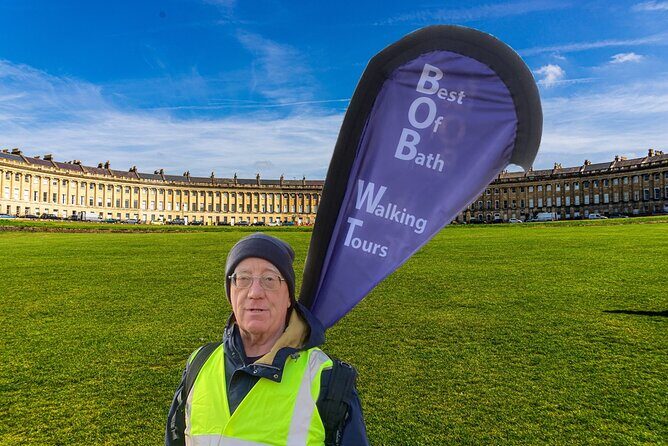
Georgian Bath makes sense on foot. This Best of Bath Walking Tours walk (with Bob as your guide) stitches together the big-name buildings and the people behind them, so you understand why Bath looks the way it does. I love the small group size (max 15), and I especially love Bob’s pacing and storytelling style that keeps questions flowing without turning the walk into a lecture.
The only thing to plan for is separate admission: the Roman Baths and the Royal Mineral Water Hospital are specifically marked as not included, so you may add tickets depending on how much you want to go inside.
In This Review
- Quick hits before you go
- Starting in Bath Abbey: where the day’s timeline clicks
- A guided route that prevents the usual Bath wandering
- Abbey Churchyard: history you can actually place
- Roman Baths: the ticketed pause that changes the mood
- Queen Square, the Circus, and the Royal Crescent: Georgian design, explained
- Assembly Rooms: where fashionable Bath social life happened
- Pulteney Bridge and Guildhall Market: water meets everyday life
- Time, tickets, and what $27.73 really buys you
- Who this walk suits best (and who should skip it)
- Should you book the Best of Bath Georgian Tour?
- FAQ
- Where does the tour start?
- How long is the Georgian Bath walking tour?
- What language is the tour offered in?
- How large is the group?
- Are the Roman Baths and Royal Mineral Water Hospital tickets included?
- What’s the walking fitness level?
- Are service animals allowed?
- Can I cancel for a full refund?
Quick hits before you go
- Max 15 people means you get personal attention and easy question time.
- Bob’s Georgian focus covers the architecture you came for, plus the real reasons it was built.
- Bath Abbey as the start point puts the whole day’s history in the right order.
- Most stops are free to see, with only a couple ticketed sites not included.
- A loop around the classics takes in Queen Square, the Circus, Royal Crescent, Pulteney Bridge, and the Guildhall Market.
Starting in Bath Abbey: where the day’s timeline clicks
If you’ve ever wandered Bath and thought, I know I’m seeing famous places, but I’m not sure what connects them, this is your fix. The tour begins at Abbey Churchyard in front of Bath Abbey (St Peter and St Paul). That matters because it anchors your walk in the long sweep of Bath’s story, not just the glossy Georgian façade.
Bath Abbey’s timeline is part of the tour’s charm: it was founded in the 7th century, reorganised in the 10th, then rebuilt in the 12th and 16th centuries. Even if you only catch a slice of that while walking, it helps you read the city like a timeline in stone. And since the tour ends back at Abbey Churchyard, you get a natural sense of closure—like you finished the puzzle, not just checked boxes.
This is also a good first stop because the meeting area is simple to find and you’re right where your bearings should be. Plus, the tour uses a mobile ticket, so you’re not stuck juggling paper in a crowded city center.
You can also read our reviews of more walking tours in Bath


A guided route that prevents the usual Bath wandering
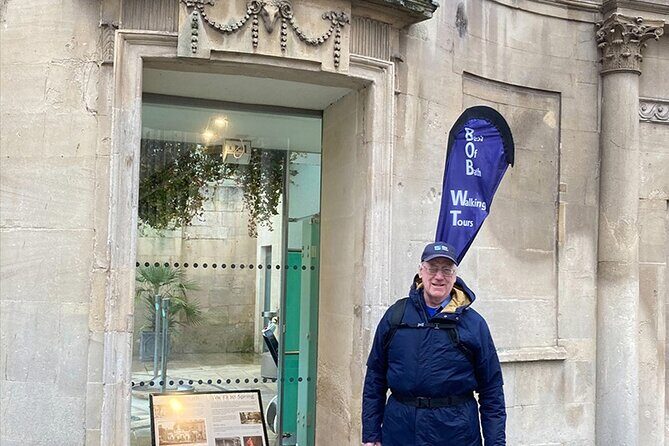
Bath is compact, but the streets can still feel twisty—especially if you’re hopping between major sights on your own. The value of a guided walk is that you don’t waste time figuring out routes. Bob takes you through the heart of Georgian Bath with a route that links the highlights into a sensible pattern, so you keep seeing more instead of circling back.
The walking pace is set up for a holiday rhythm: the duration is about 2 to 3 hours, and the fitness level is listed as moderate. That usually means you should be comfortable walking city sidewalks at a steady pace, but not expecting long, strenuous hikes.
Also, this is in English, and the group size stays small. In plain terms: you’re more likely to hear details clearly, and Bob can tailor answers when people ask. Several tour comments point to his humor and his habit of handling questions well—so if you like to ask why something was built a certain way, this style fits.
And yes, if you like seeing Bath beyond the obvious photo stops, you’ll likely appreciate the extra context. The route includes several named areas along the way, including the Hot Springs and the Old City Wall, plus the Gravel Walk—those are the kinds of bits you might miss on your own.
Abbey Churchyard: history you can actually place
Abbey Churchyard isn’t just a backdrop. It’s where the tour sets up the contrast that makes Bath interesting: Roman water, medieval development, and then the Georgian reinvention.
Bath Abbey is described as an Anglican parish church and a former Benedictine monastery. Even if church architecture isn’t your main interest, the guide’s explanation helps you see how religious and civic life overlapped in Bath. And because the stop is short, you’re not dragged into a long sit-down. You get enough to understand the role of the abbey in Bath’s identity, then you keep moving.
This is a smart format for a walking tour. A quick, focused start builds momentum. By the time you reach the next major stop, you’re already primed to notice details: the way streets and sightlines open up, and how the city’s major structures sit in relation to each other.
Roman Baths: the ticketed pause that changes the mood
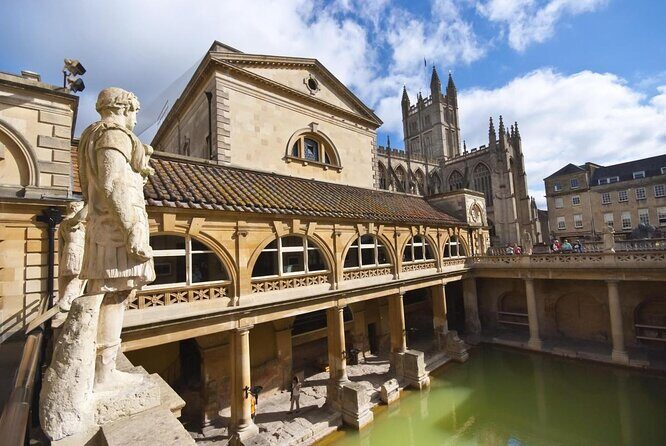
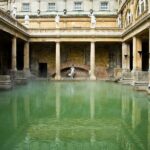
The Roman Baths stop is brief but important: it’s where Bath’s water story gets real. The Roman Baths are described as well-preserved thermae, with a temple constructed on the site between 60 and 70 AD in the early decades of Roman Britain. The tour also notes that the original Roman baths were in ruins a century later, according to the Anglo-Saxon Chronicle, and that the surrounding springs area was redeveloped across the early and late Middle Ages.
That sequence—Roman arrival, decline into ruins, then long redevelopment—helps explain why Bath doesn’t feel like a single era city. It’s layered.
One practical note: Roman Baths admission is not included. So if you want to go inside, check what that means for your timing. If you don’t plan to enter, you’ll still get a guided orientation that makes the exterior and setting much easier to understand. But if you’re the type who wants to fully experience a famous site, budget for the extra ticket.
The upside? You’re not guessing. You’ll know what you’re looking at and why it matters.
Queen Square, the Circus, and the Royal Crescent: Georgian design, explained

Now you hit the reason most people come to Bath: Georgian architecture in full display. The tour moves from Queen Square to the Circus and then to the Royal Crescent, tracing how the city’s planners built a visual system.
Queen Square is your first “sequence” clue. It’s described as a square of Georgian houses and specifically noted as the first element in the architectural sequence that includes the Circus and the Royal Crescent. The buildings around Queen Square are Grade I listed, which is the strongest UK protection category for buildings of exceptional interest. Even if you’re not a listings nerd, that tells you the city is protecting something it considers truly special.
Then comes the Circus: a ring of large townhouses designed by John Wood the Elder, built between 1754 and 1768. The tour calls it a pre-eminent Georgian example, and there’s a key detail worth noticing from street level. Each segment faces one of three entrances, so the classical façade is always presented straight ahead. In other words, the design isn’t random—it’s engineered for view.
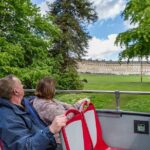
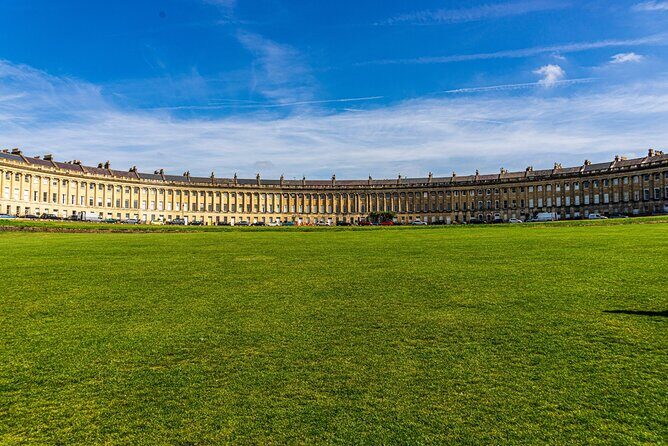
Finally, the Royal Crescent. You’ll see 30 terraced houses arranged in a sweeping crescent, designed by John Wood the Younger and built between 1767 and 1774. It’s also Grade I listed and described as among the greatest examples of Georgian architecture in the UK. The tour’s approach helps you see the crescent as a statement about status, not just a pretty curved street.
Bob’s strength here is connecting the look to the story: who built, what “fashionable Bath” meant, and why these places were laid out the way they were.




Assembly Rooms: where fashionable Bath social life happened
The Assembly Rooms is one of the more human stops on the walk, because it’s not only about architecture—it’s about what people did inside those rooms.
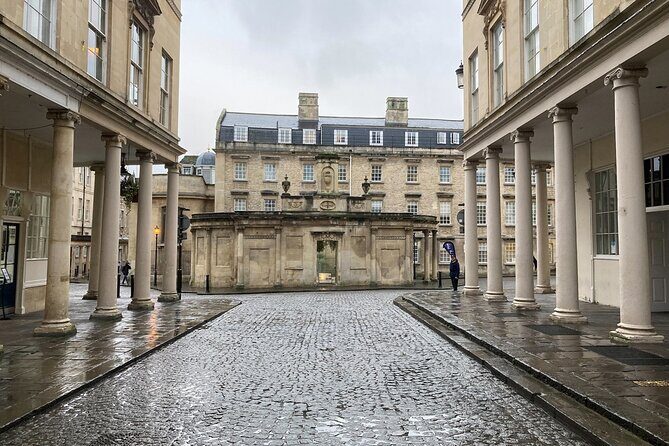
Bath became fashionable in the Georgian era, and John Wood the Elder and his son laid out new housing areas for residents and visitors. The tour notes that the Assembly Rooms were built early in the 18th century, but that a new venue for balls, concerts, and gambling was envisioned between Queen Square, the Circus, and the Royal Crescent. The upper assembly rooms opened with a grand ball in 1771, and they became a hub of fashionable society. The guide also links the scene to famous literary names—Jane Austen and Charles Dickens are both mentioned as frequented by fashionable society, along with the nobility of the time.
This kind of context is why a guided walk beats a guidebook. You can see the building on your own, but you won’t always know what social machine it was.
Assembly Rooms admission is not included on this tour, so if you want to go inside, plan for that separately. Even from outside (or from a quick look at the site), the guide gives you a sense of what the place meant in daily life during Bath’s heyday.
Pulteney Bridge and Guildhall Market: water meets everyday life
A Georgian city isn’t just crescents and townhouses. Bath also ran on practical needs—trade, movement, and water-driven economy. Two stops make that clear.
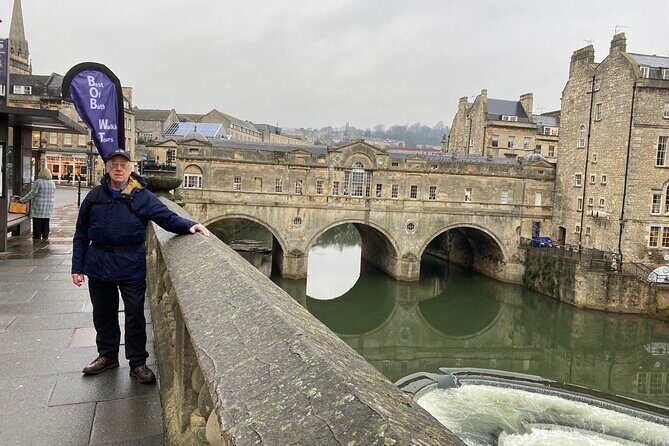
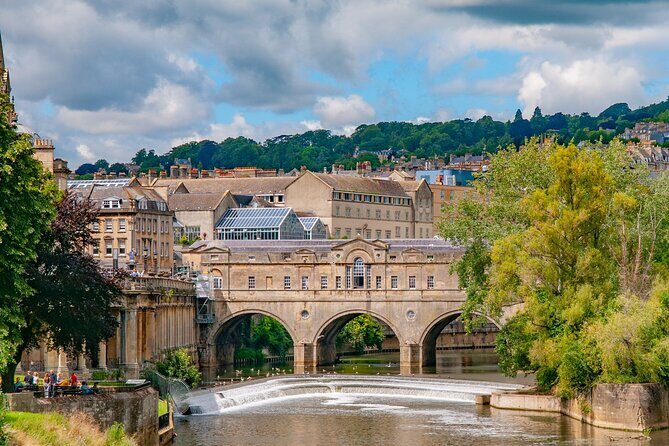
Pulteney Bridge is completed by 1774, designed by Robert Adam in a Palladian style, and it’s unusually commercial. Shops are built across its full span on both sides. That’s not a trivial detail. It shows how Bath used its bridge as a piece of infrastructure that doubled as a marketplace—making the city’s elegance functional.
Then you’ll reach Bath Guildhall Market. The Guildhall building houses an indoor market wander, and the market has been established since 1284. Even with the focus on Georgian Bath, this stop grounds you in how long Bath has kept commerce going. In a city that markets itself as heritage, it’s a relief to see a place still doing a basic job: feeding the daily rhythm of locals and visitors.
If you like to snack and wander a little, this is the part where that naturally fits, because you’re not hustled toward the next photo angle. You’re given room to look around.
Time, tickets, and what $27.73 really buys you
At $27.73 per person for about 2 to 3 hours, the value depends on what you want from your Bath day. If you’re trying to cram famous architecture into a short window, a guided walk helps you get more meaning per hour.
Here’s the key financial reality: the tour includes a lot of viewing stops, with Roman Baths and the Royal Mineral Water Hospital specifically marked as not included for admission. The other stops are indicated as free to access as part of the route. So your total cost can range based on whether you add those admissions.
Duration is also worth weighing. Two to three hours is enough to cover major Georgian landmarks without forcing you to rush. And the route ends where it starts, so you’re not stuck relocating to catch a train or bus.
One more practical advantage: tours like this are commonly booked ahead, with an average booking lead of 28 days. That’s a decent sign for planning—if you have a narrow visit window in Bath, you’ll likely feel better booking early.
Who this walk suits best (and who should skip it)
I think this is a great choice if:
- You want Georgian Bath landmarks in one organized loop.
- You care about architecture but also want the people and reasons behind it.
- You like asking questions and hearing clear answers as you walk.
- You prefer a small group and an easy-to-follow pace.
You might want to reconsider if:
- You strongly prefer fully ticket-included experiences. Two major sites aren’t included for admission, so you’ll likely pay more if you want to go in.
- You don’t do well with outdoor walking in variable weather, since the tour is listed as requiring good weather.
Should you book the Best of Bath Georgian Tour?
If you want the Georgian highlights of Bath—Royal Crescent, Circus, Queen Square, plus the classic water-and-history context—this is a solid way to connect the dots. The small group, the guide Bob’s storytelling energy, and the loop that keeps returning you to big-name places make it a strong value for a first or refresher visit.
I’d book it if you’re the type who likes to understand what you’re seeing, not just photograph it. Skip it only if you want a purely indoor, ticket-included plan or if walking in open air is a hard limit for you.
FAQ
Where does the tour start?
The tour starts at Abbey Churchyard, Bath BA1, UK.
How long is the Georgian Bath walking tour?
It lasts about 2 to 3 hours.
What language is the tour offered in?
The tour is offered in English.
How large is the group?
The maximum group size is 15 travelers.
Are the Roman Baths and Royal Mineral Water Hospital tickets included?
Roman Baths admission is not included, and Royal Mineral Water Hospital admission is not included. Other stops on the route are listed as free.
What’s the walking fitness level?
Travelers should have a moderate physical fitness level.
Are service animals allowed?
Yes, service animals are allowed.
Can I cancel for a full refund?
You can cancel up to 24 hours in advance for a full refund. If you cancel less than 24 hours before the start time, the amount paid is not refunded. The experience also requires good weather.