REVIEW · BATH
e-Scavenger hunt Bath: Explore the city at your own pace
Book on Viator →Operated by Qula · Bookable on Viator
Bath turns into a game when you walk. This e-Scavenger hunt in Bath lets you explore major landmarks at a self-paced rhythm, using clues and prompts on your phone. It’s a smart way to see the city without feeling rushed or stuck on a rigid schedule.
What I like most is how it keeps things light: you can slow down, look twice, and still make steady progress. I also love that it directs you to easy-to-miss spots—like Pulteney Bridge—while sprinkling in useful facts so your walk feels like learning, not just moving.
One consideration: the hunt is phone-based, and smartphone and data aren’t included. If you show up with a dead battery or spotty reception, your experience will feel a lot harder.
In This Review
- Quick hits (what makes this e-Scavenger hunt work)
- How the phone-led hunt works (and why it feels stress-free)
- Start at 6 N Parade: setting your loop for a smooth finish
- Pulteney Bridge: the walk’s first big payoff
- The Royal Crescent: from straight lines to a sweeping arc
- A Georgian theatre stop built in 1805
- The Circus: seeing Bath’s controlled chaos
- Roman Bath clues: UNESCO site energy with a museum option
- Royal Victoria Park: where the hunt lets you breathe
- Bath Abbey timing stop: from 7th-century roots to 19th-century restoration
- Kingsmead Square: snack-and-walk logic for a smooth afternoon
- Great Pulteney Street: a grand line that points you to art
- Milsom Street: Georgian townhouses turned everyday commerce
- Parade Gardens clue: where city walls and orchards once met
- Price and value: $37.49 for a group of up to 6
- Who this e-Scavenger hunt fits best (and who might want something else)
- Should you book this Bath e-Scavenger hunt?
- FAQ
- How long does the e-Scavenger hunt Bath take?
- How much does it cost?
- What language is the activity offered in?
- Where do we meet and where does it end?
- What do we need to use during the hunt?
- Is this a private activity?
- What are the operating hours?
- Can we cancel for free?
- Are service animals allowed?
Quick hits (what makes this e-Scavenger hunt work)

- Self-paced by design: you control your stops and timing across roughly 3–4 hours.
- Up to 6 people per group for one price, which can be good value if you’re with friends or family.
- Big Bath icons on the route: Pulteney Bridge, the Royal Crescent, the Circus, and more.
- Mostly ticket-free stops: each listed stop is marked as admission-free for the hunt.
- Phone-based clues via mobile ticket: you’ll rely on your device for the experience.
- Private group only: it’s just your group, not a shared tour with strangers.
How the phone-led hunt works (and why it feels stress-free)
This is an e-Scavenger hunt you run on your phone, with a mobile ticket provided for your group. The idea is simple: you follow the sequence of stops, answer prompts or complete tasks, then move on when you’re ready. There’s no “stand here and listen” rhythm—your pace sets the tempo.
That’s exactly why it feels relaxing. You’re not racing a clock, and you can spend extra time at the parts that catch your eye. In a city like Bath, that matters, because the best moments are often the small ones: details on façades, viewpoints, and street layouts that only make sense once you’re standing there.
Do note the tradeoff: you’re not going to get the back-and-forth of a live guide. It’s more like a guided walk that you steer yourself. If you enjoy independent exploration and like learning by doing, this format fits well.
You can also read our reviews of more city tours in Bath



Start at 6 N Parade: setting your loop for a smooth finish
The hunt starts at 6 N Parade, Bath BA1 1LF, and it ends back at the same point. That’s a big practical win. You avoid the “now what” feeling that can happen when tours strand you across town, and you can plan your day with an easy meetup-and-return.
The activity is available daily from 12:00 AM to 11:59 PM during the listed date window, which gives you freedom on when you want to start. Whether you’re in Bath for an afternoon or you’ve got a half-day buffer, this can slide into your schedule more easily than timed tours.
It also helps that the meeting point is near public transportation. You’re not forced into a long, complicated arrival plan just to begin the game.
Pulteney Bridge: the walk’s first big payoff
Your first stop is Pulteney Bridge, a bridge over the River Avon completed in 1774. The clue here is tied to how the bridge connected Bath to the lands of the Pulteney family, who wanted to develop that area. In other words, this isn’t only a pretty view—it’s a reminder that Bath grew in planned steps, not random sprawl.
Why this start works: Pulteney Bridge gives you an early “sense of place.” From there, you’re already oriented to Bath’s river setting and the city’s elegant design language. It’s also an easy moment to slow down and take photos, because the bridge itself is built for multiple angles.
Since your first stop is about 20 minutes, you’ll likely finish it and feel like you’ve already started “getting” Bath. That’s a good momentum boost.
The Royal Crescent: from straight lines to a sweeping arc
Next up is the Royal Crescent, the famous row of 30 terraced houses laid out in a sweeping crescent. It’s one of those Bath landmarks that people recognize instantly from postcards. The hunt turns that familiarity into attention by asking you to look more carefully at the structure and what it means in the city.
Your stop time is about 30 minutes, which is long enough to notice details without feeling stuck. You can focus on spacing, symmetry, and the way the houses curve across the landscape. If you’ve ever wondered why Bath looks different from other English cities, this crescent is a key part of the answer.
A good approach here: don’t just admire from one spot. Adjust your position slightly. Even small shifts change how the crescent reads, and the hunt format makes that kind of wandering feel purposeful.
A Georgian theatre stop built in 1805
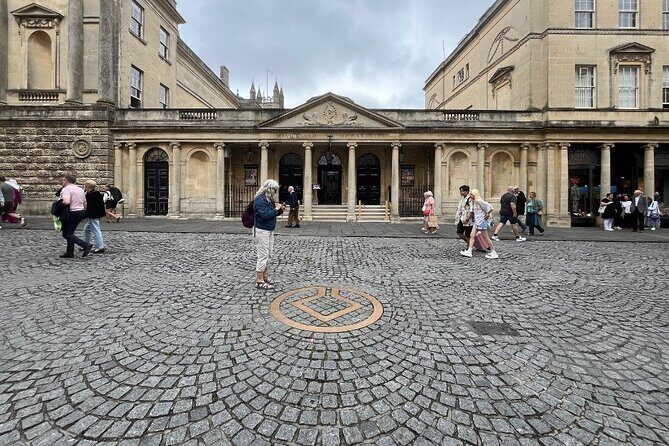
After the Royal Crescent, you’ll reach a stop connected to a Georgian theatre built in 1805. The Theatres Trust describes it as one of the most important surviving examples of Georgian theatre architecture.
Even if you don’t know theatre history, this stop gives you a “why this matters” moment. Bath isn’t only crescents and parks; it also has buildings shaped by entertainment, public life, and design ideas from that era. This helps your walking game feel more layered than a simple sightseeing list.
If you like spotting architecture and want your break moments to include something meaningful, this stop does the job.




The Circus: seeing Bath’s controlled chaos
Then comes the Circus, a ring of large townhouses forming a circle with three entrances. It’s another landmark that people often recognize fast, but the “three entrances” detail makes it more interesting when you’re actually near it.
Your stop time is about 30 minutes, which is perfect for taking in the geometry. Look at how the ring shape holds its own against the streets around it, and notice how the entrances create different pathways into and out of the circular plan.
This stop is one of the reasons the hunt feels fun rather than purely educational. You get to test your eyes: once you understand the layout, the place feels like a puzzle you solved.
Roman Bath clues: UNESCO site energy with a museum option
From the Circus you move to Roman Bath, a UNESCO World Heritage Site. The hunt prompts you to explore the history and archaeology, and you’re directed to visit the museum and see the collection, plus enjoy events if they’re running.
This is a smart “switch” in the route. Up to now, you’ve been working through Georgian and city-planning landmarks. Roman Bath brings you back further in time and gives you a change of pace that’s often refreshing—especially if the weather turns.
One practical thought: you’ll want to plan your indoor/outdoor balance. The hunt is self-paced, but you can still choose to spend more or less time depending on how you feel that day. If you want fewer steps, lean more on the indoor museum time here.
Royal Victoria Park: where the hunt lets you breathe
Next is Royal Victoria Park, with bandstand, botanical gardens, crazy golf, and more listed as attractions. It’s marked as having no admission charge and being open at all times, which makes it an easy break in the middle of your walking loop.
Your stop time is about 30 minutes, and that’s ideal for a mental reset. In Bath, the parks help soften the streetscape. You can regroup, grab a drink, and keep your energy for the shopping streets and squares later.
Also, “open at all times” is useful for flexibility. If you started later than planned, you’re not stuck wondering whether the park is available.
Bath Abbey timing stop: from 7th-century roots to 19th-century restoration
The route includes a stop tied to an institution founded in the 7th century, reorganised in the 10th century, and rebuilt in the 12th and 16th centuries. Major restoration work is credited to Sir George Gilbert Scott in the 1860s.
That sequence is a great reminder of how Bath’s buildings weren’t made in one moment and finished forever. They evolved. The hunt nudges you to notice that long timeline, which makes the architecture feel less static and more alive.
Your best move here is to focus on the feeling of age and change. Even without deep architectural knowledge, you can compare what looks older versus what looks restored or repaired, and let the timeline connect the dots.
Kingsmead Square: snack-and-walk logic for a smooth afternoon
At Kingsmead Square, the hunt shifts into practical city-life mode. It’s described as a lively area with several interesting places to eat and drink, and your stop time is about 20 minutes.
I like this kind of mid-route “breather” because it keeps the game grounded. You’re not only moving between viewpoints—you’re also being pointed toward where people actually spend time. If you want to take a short break without losing the thread of the hunt, this is a good place to do it.
Aim to grab what you need, then return your attention to the phone tasks. The best part of a scavenger hunt is that even errands feel like part of the game.
Great Pulteney Street: a grand line that points you to art
Next is Great Pulteney Street, described as a grand thoroughfare connecting Bathwick on the east side of the River Avon with the city of Bath. From the city side of the bridge, the road leads directly to the Holburne Museum of Art.
This stop helps you connect map lines to real space. The street isn’t just a passage; it’s a corridor that frames where you’ll go and what landmarks line up when you’re standing in the right place.
Your stop time is about 30 minutes, which suggests the hunt expects you to slow down and actually take in the route. If you like urban design, this is one of those moments where Bath feels planned rather than accidental.
Milsom Street: Georgian townhouses turned everyday commerce
Then you’ll reach Milsom Street, built in 1762 by Thomas Lightholder. The info notes that the buildings were originally grand townhouses, but most are now used for shops, offices, and banks.
That contrast is the point. Bath’s grand architecture didn’t freeze in time; it adapted. The hunt makes you notice that transformation while you’re walking, instead of leaving it as trivia you read later.
For a practical experience, treat this as your “walk and browse” slot. If you want to pick up a souvenir, check out shopfront details, or simply enjoy a change of pace from monumental sights, this is where you do it.
Parade Gardens clue: where city walls and orchards once met
The final listed historical note points to the Parade Gardens area. In the 17th century, it was part of the Abbey Orchard and lay outside the city wall.
Even with a short stop, that kind of context changes how you see a place. You’re not just standing somewhere pretty—you’re looking at land that belonged to a different kind of city boundary system. It’s the kind of small history payoff that scavenger hunts do well, because it gives you a reason to look up and around.
Once you finish this final part, the hunt brings you back to 6 N Parade, so you can end the afternoon without extra navigation.
Price and value: $37.49 for a group of up to 6
The price is $37.49 per group, up to 6 people. That matters because it shifts the math from per-person to shared fun. If you have a small group, you can often make this more cost-effective than tours that charge per adult.
You’re also getting a full 3–4 hour walking experience built around major Bath sights. Plus, the stops are marked as admission-free for the hunt route, which helps keep the total day cost predictable.
One more value point: you get something flexible. If you’re tired, you can shorten a stop. If the weather’s great, you can extend your time where you enjoy the views.
Just remember the one cost not included: smartphone and data. If you don’t have reliable mobile access, you could end up paying in frustration rather than money.
Who this e-Scavenger hunt fits best (and who might want something else)
This works well for people who like exploring at their own speed and prefer learning through questions and observations rather than long explanations. It’s also a solid match for groups that want to stay together without coordinating with a bunch of strangers.
It’s offered in English, and the experience says most travelers can participate. If you need a tour that is fully accessible in the sense of an in-person guide adapting content on the fly, this phone-led format might feel limiting.
Also, since it’s a walking route through streets, parks, and landmarks, it suits anyone comfortable with a few hours on foot. The payoff is that you’ll see a wide slice of Bath without feeling like you’re on a strict timetable.
Should you book this Bath e-Scavenger hunt?
Book it if you want a relaxed Bath day with a plan. The route hits the big iconic landmarks—Pulteney Bridge, Royal Crescent, the Circus—and it adds smart stop points like Roman Bath and a park break so the day doesn’t feel like nonstop sightseeing.
Don’t book it if you know you’ll struggle with phone use. The experience requires a smartphone and data, and those aren’t included. If your device is likely to run low on battery or you don’t want to rely on mobile connections, you’ll have a better experience with something that doesn’t depend on a screen.
If you’re the kind of person who enjoys turning a walk into a game, this is a very practical way to explore Bath with your group—at a pace you control.
FAQ
How long does the e-Scavenger hunt Bath take?
It takes about 3 to 4 hours.
How much does it cost?
It costs $37.49 per group, up to 6 people.
What language is the activity offered in?
The e-Scavenger hunt is offered in English.
Where do we meet and where does it end?
You start at 6 N Parade, Bath BA1 1LF, UK and the activity ends back at the same meeting point.
What do we need to use during the hunt?
You’ll need your own smartphone and data, since they are not included.
Is this a private activity?
Yes. It’s private, meaning only your group will participate.
What are the operating hours?
It’s listed as available Monday through Sunday, 12:00 AM to 11:59 PM, during the date range shown.
Can we cancel for free?
Yes. You can cancel for free up to 24 hours in advance for a full refund.
Are service animals allowed?
Yes, service animals are allowed.