REVIEW · OXFORD
Stepping Through Oxford Express Walking Tour
Book on Viator →Operated by Vox City International Ltd · Bookable on Viator
Oxford can be a bit of a maze at first. This quick walking tour gives you the big sights and the context in one smooth run, starting right on High Street and running through Oxford’s star academic landmarks.
I especially like the way the route balances postcard views with real stories, from the Oxford Martyrs connection to the moments where scholars and buildings share the spotlight. The other win for me is that it’s short but still satisfying, so you walk away with a clear sense of the university center without losing half your day. One thing to consider: entry to attractions isn’t included, so you’ll mostly be seeing exteriors and photo points rather than going inside every stop.
In This Review
- Key things I’d zero in on
- Starting at 44–45 High St: the fast way to orient yourself
- High Street’s dreaming spires: where the photos start working
- The Oxford Martyrs church stop: spire, stained glass, and real meaning
- All Souls College and the Radcliffe Camera: scholarship you can see
- Bodleian Library and Weston Library: turning library legends into street-level reality
- Hertford College skyway and University symbols: the small bridge with big vibes
- University College, Sheldonian Theatre, and the one roof you’ll remember
- History of Science Museum: science you can keep after the walk
- So is it worth $14.95? Value that matches a short day
- Should you book this Oxford Express walking tour?
- FAQ
- How long is the Stepping Through Oxford Express Walking Tour?
- What does the tour cost?
- What language is the live commentary offered in?
- Is admission to attractions included?
- Where do I meet the tour guide?
- What do I need on the day for the app and audio?
Key things I’d zero in on

- Live commentary in English that keeps the route from feeling like a simple photo walk
- About 45 minutes for a high-impact overview of central Oxford
- Mobile ticket + sightseeing app support, including self-guided routes
- Oxford Martyrs and Cranmer’s Pillar linked to the church stop’s deeper meaning
- Bodleian Library highlights like the Magna Carta and a Gutenberg Bible mention (view-focused, since entry isn’t included)
Starting at 44–45 High St: the fast way to orient yourself
Your tour begins at the City Sightseeing Oxford Visitor Information Point, 44–45 High St. The pace here matters. At roughly 45 minutes, this is designed for “get my bearings fast” sightseeing—ideal if you’re on a tight schedule, stopping between other Oxford plans, or just want a smart orientation walk before you wander on your own.
You’ll also want to factor in the practical rhythm. Tours depart at the booked timeslot, and the guide expects you to be there about 5 minutes early. There’s a hard limit of 100 travelers, so you won’t feel swallowed by the crowd, but it’s still a group format—meaning you should keep your camera ready, not constantly stopping for deep indepth reading.
One more practical note: the tour provides a sightseeing app and live commentary (English). The listing says a mobile device and headset aren’t included, so you’ll need your own phone. If the audio portion matters to you, bring earbuds. Also, you’re asked to scan the QR code on your voucher to download the app prior to arrival.
You can also read our reviews of more tours and experiences in Oxford.



High Street’s dreaming spires: where the photos start working

The walk opens on Oxford’s High Street, the kind of street that makes you instantly understand why people call it famous. You get that classic “dreaming spires” view plus a front-row seat to Oxford’s specialist shop vibe—without needing to hunt for the good angles yourself.
This first stop is valuable because it sets your mental map. After a few minutes here, the city starts to click: where the colleges sit, how the spires frame the skyline, and how the university core feels connected rather than scattered. If you like taking photos, this is also the easiest part of the route—wide sight lines, iconic building silhouettes, and a street scene that reads as unmistakably Oxford.
Tip: if you want the cleanest shots, stand slightly to the side rather than right in the middle of the flow. That keeps you in the frame for spire views while still matching the movement of the group.
The Oxford Martyrs church stop: spire, stained glass, and real meaning

Next comes an Anglican church famous for its elegant spire, described as among the most beautiful in England. This isn’t just an architectural pause. You also get story context that gives the building weight.
The tour highlights:
- surrounding gargoyles and statues
- stained glass windows with parts from the Renaissance era
- the church’s role as the site of the heresy trials for the Oxford Martyrs in 1555
- Cranmer’s Pillar, commemorating martyrs of the Reformation period
That mix is why this stop works on a short tour. A lot of quick walks throw names at you. Here, you get a sense of why this place mattered to Oxford’s identity—religion, scholarship, and the high-stakes history that shaped the country.
If you’re the type who likes at least one stop with emotional context—not just “pretty building”—this is the one. And if you’re traveling with teens or family, it’s also a good pause because it’s the kind of story that sparks questions fast.
One consideration: this part is still a sightseeing stop, not an all-access museum experience. Since entry to attractions isn’t included, you should assume you’ll be looking from outside or from areas the tour can access, rather than expecting a full interior visit.
All Souls College and the Radcliffe Camera: scholarship you can see
After the church, the tour moves into the heart of Oxford’s academic symbolism.
First is All Souls College—officially described as the College of the Souls of All the Faithful Departed. The tour notes its founding by King Henry VI and also makes an interesting point for anyone assuming Oxford is all students walking around: the college has no undergraduates today. It’s primarily a research institution, with only a handful of examination fellowships per academic year, and admission is framed as exceptionally competitive.
Whether you care about admissions or not, that detail changes how you see the place. You’re not just looking at a “pretty college.” You’re looking at Oxford’s scholarly engine—quiet, selective, and built around research rather than constant student traffic.
Then you get a classic Oxford icon: Radcliffe Camera. The name is explained as coming from physician John Radcliffe plus the Latin word for room, and the tour connects the building’s role to the nearby Bodleian reading function. Even if you never step inside, the meaning lands because you’re told what it serves and why it sits where it does.
Practical photo advice: for the Camera and nearby views, don’t only shoot straight-on. Try a slight angle that includes both the building and the surrounding streetscape. That helps the photo tell the story of where you are, not just what you saw.
Bodleian Library and Weston Library: turning library legends into street-level reality

The tour’s biggest “wow” moment is clearly the Bodleian Library area.
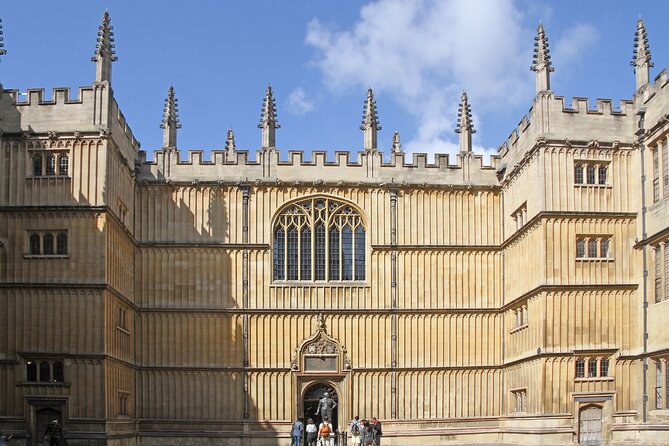
You’ll get the key facts that make people call it legendary: it’s one of Europe’s oldest libraries at over 400 years old, and its collection includes an often-mentioned set of treasures such as a copy of the Magna Carta, a Gutenberg Bible, and a first edition of Don Quixote. The tour also adds local texture—when you look up at the Bodleian, you may hear passing scholars refer to it as Bodley or simply Bod.
That last detail matters more than it seems. It helps you understand you’re not touring a dead monument. Oxford’s learning culture is still alive, still spoken about in shorthand, and still present in the everyday flow of the city.
From there, the route includes the Weston Library, described as part of the Bodleian and established in 2015. You’re told it was quickly shortlisted for the Stirling Prize for architecture and that it offers free exhibitions of Bodleian collections.
However, here’s where you should manage expectations for value. The tour does not include entry to attractions, so you may not get to walk through exhibition spaces as part of the guided portion. Still, knowing there are free exhibitions is useful. If a particular display sounds interesting, you can plan a longer Oxford day later.
If you like learning how a city works, this section is strong because it links Oxford’s mythmaking to practical reality: a library isn’t just books behind doors; it’s a living institution that shapes how people study and how visitors experience the place.






Hertford College skyway and University symbols: the small bridge with big vibes
Oxford has plenty of grand sights, but it also has clever in-between features that make the city feel like a school you can almost step into.
The tour passes by the Hertford Bridge, also known as the Bridge of Sighs. It links the old and new quadrangles of Hertford College. The detail that it’s not open to the public is important, but the tour also tells you what you can do with that reality: you’ll often see students crossing through.
This is a great example of getting value even when you can’t enter. You’re still seeing how the university connects its spaces, and you’re getting the iconic “Oxford college” look that people come to photograph.
Then you move into additional college context, including the point that Hertford College accepted female students in 1974 and that the coat of arms features a hart’s head (male red deer) and a Templar cross. Again, even if you don’t memorize the details, those facts change how you interpret the architecture—you begin to see Oxford colleges as institutions with decisions, timelines, and identity.
A quick but meaningful stop follows with the University of Oxford context: it’s described as one of the oldest universities in the world and the oldest in the English-speaking world, with establishment over 900 years ago and a global draw for prospective students. The tour also notes that Oxford alumni, called Oxonians, have become world leaders across fields like Olympic sports and law.
This part works because it ties the buildings to a larger idea: you’re standing in one of the world’s longest-running intellectual ecosystems.
University College, Sheldonian Theatre, and the one roof you’ll remember
The later portion of the walk leans into big architecture and names you’ve probably heard before.
University College enters as Oxford’s oldest school within the university (founded 1249). The tour calls it often referred to locally as Univ, and frames it as the more community-feel option due to comparatively smaller grounds. It also includes a list of famous alumni you might recognize, including Bill Clinton, Stephen Hawking, and C.S. Lewis.
Even if you’re not tracking alumni lists, you’ll likely appreciate why this matters. Oxford can be overwhelming when every building looks historic. Anchors like the oldest college name and the “community feel” description help you remember what you’re seeing rather than just soaking it in.
Then comes the Sheldonian Theatre, designed by Sir Christopher Wren. This is described as a must-see attraction, and the key architectural hook is the geometrical roof with an eight-sided cupola at the center. The tour also explains that the theater is mainly used today for concerts, lectures, and ceremonies.
This stop is worth your full attention because it’s not just about age. It’s about design. Wren’s name and that roof structure give you something visual you can carry in your mind even after the tour ends.
If you’re a photo person, angle your camera so you can capture both the street-level façade and as much roof structure as possible—depending on the crowd and viewing position.
History of Science Museum: science you can keep after the walk
The tour includes a pass by the History of Science Museum, established in 1683 and described as the world’s first and oldest purpose-built museum. That’s a striking line, and it’s the kind of detail that makes you pause and think: Oxford isn’t only about literature and theology. It has a long thread of scientific curiosity too.
The tour points out that the museum houses astronomy instruments, scientific objects, and even Einstein’s blackboard among other items.
Here’s the practical piece for you: since entry to attractions isn’t included, you won’t get the full museum experience in the tour itself. But you’ll leave knowing there’s a reason to schedule an extra hour later if science history is your thing.
This is also a smart stop for families and groups. The concept of Einstein’s blackboard travels well, even when the tour stays outside.
So is it worth $14.95? Value that matches a short day
For $14.95, you’re buying a compact package: live commentary in English, a route that hits the Oxford core, and app support through a sightseeing system. The big value is time. You get the names, the meaning, and the “how it all connects” story without paying for multiple separate admissions.
The trade-off is also clear. Because entry to attractions isn’t included, you’re not paying for full inside access to places like the libraries or museums. So the tour shines if your goal is:
- get an Oxford orientation fast
- understand what key buildings mean
- pick good stops to revisit later under your own schedule
This is also a friendly fit if you’re traveling solo and want structure, or if you’re a couple who doesn’t want to spend hours reading maps while time ticks away.
Should you book this Oxford Express walking tour?
You should book this if you want a short, well-paced introduction to central Oxford with live narration and major landmarks stitched together into a coherent walk. It’s a good first stop for anyone who plans to roam afterward, because it helps you know what’s worth a second look.
Skip it or pair it with something else if you’re expecting ticketed entry inside the big sights. This walk is designed for seeing, photographing, and understanding from the street and public viewing areas, not for full-on museum time.
If you’re the type who likes stories with both architecture and history, you’ll likely appreciate the mix—from Cranmer’s Pillar to the Bodleian name shorthand, and the neat Oxford skyway details.
FAQ
How long is the Stepping Through Oxford Express Walking Tour?
It’s about 45 minutes.
What does the tour cost?
The price is $14.95 per person.
What language is the live commentary offered in?
Live commentary is offered in English.
Is admission to attractions included?
No. Entry to attractions is not included.
Where do I meet the tour guide?
Meet at City Sightseeing Oxford – Visitor Information Point, 44–45 High St, Oxford OX1 4AP. The guide will wear a dark blue uniform.
What do I need on the day for the app and audio?
You’ll need your own mobile device (it says mobile device isn’t included). You’ll also scan the QR code on your voucher to download the sightseeing app prior to arrival, and headsets aren’t included.