REVIEW · LONDON
Winston Churchill’s London At War. A Private Walk Through Britain’s Darkest Hour
Book on Viator →Operated by Richards Tours · Bookable on Viator
Churchill’s London tells a story in footsteps. This private walk through Winston Churchill’s London connects homes, wartime offices, and secret sites to the moment Britain held together. You’ll also save time with fast-track entry to the Churchill War Rooms, so the day moves at a smart pace without feeling rushed.
I love that you get an actual private guide who keeps attention on your group and connects the dots between buildings and key wartime decisions. I also love the mix of stops: you’re not only looking at famous landmarks, you’re seeing where people worked, planned, and even bought cigars.
One consideration: it’s a morning-style outing, and no lunch is included, so plan to grab food either before you start or after you finish at the War Rooms.
In This Review
- Key things that make this Churchill walk work
- Winston Churchill’s London At War: a private walk that gives the city context
- Mayfair: where Churchill started and why it matters
- St. James: tailors, clubs, and the intelligence web
- The Roosevelt and Churchill allies monument: friendship as strategy
- St. James Square and Carlton House Terrace: D-Day planning and a German embassy past
- Whitehall: the highest concentration of key WW2 buildings
- Westminster and Parliament Square: roof-top bomb watching and VE Day perspective
- Churchill War Rooms: the fast-track finish that lets you stay as long as you like
- Price and value: is $242.71 per person worth it?
- Who this tour fits best (and who might want a different plan)
- Should you book Winston Churchill’s London At War?
- FAQ
- How long is the Winston Churchill London At War private walk?
- Where does the tour start and end?
- Is the Churchill War Rooms entrance included?
- Is lunch included?
- What language is the tour offered in?
- Is this a private tour?
- Do I need to print tickets?
- Are service animals allowed and is it near public transportation?
- What’s the cancellation policy?
Key things that make this Churchill walk work
- Private, guide-led attention as you move street to street through real wartime geography
- Fast-track entry to the Churchill War Rooms so you don’t lose time in queues
- At least 10 Churchill-linked sites across Mayfair, St. James, Whitehall, and the Westminster area
- A cigars-and-character stop where Churchill’s purchasing habits get treated like part of the story
- High-stakes planning locations, including a secret Eisenhower HQ site connected to D-Day preparations
- Blitz and VE Day perspective around Westminster and Parliament Square
Winston Churchill’s London At War: a private walk that gives the city context
There’s a special kind of London tour that doesn’t just point at buildings. It explains why those buildings mattered when the danger was real. This experience is built around Winston Churchill and the wartime world that grew up around him—so when you stand in front of a government façade or a former foreign embassy, you understand what was at stake.
You’ll be out for about 3 to 4 hours, with a 10:00 am start that leaves the rest of your day open. That matters, because the War Rooms take up real time. Instead of stuffing everything into one frantic loop, you get to slow down where it counts most—down in the underground museum and map rooms.
And if you’re lucky enough to get Richard, you’ll see why people get excited about guides for this one. In the feedback I’ve read, Richard is described as funny, personable, and sharply informed—not only about Churchill, but about the surrounding geography that makes the story make sense. That combination is exactly what you want on a walking tour, because London can feel like a maze if someone doesn’t connect the streets for you.
You can also read our reviews of more tours and experiences in London.


Mayfair: where Churchill started and why it matters
The tour begins in Mayfair, one of those London areas that still feels like money and manners—but it’s also where you start mapping Churchill’s personal story.
Here, you’ll focus on where Churchill first lived and where his early domestic life unfolded. You’ll learn about his path from a long and eventful career toward British Prime Minister and wartime leadership. What I like about starting in Mayfair is that it prevents the tour from becoming only a war story. You get context first: this wasn’t just a man who appeared at the microphone during crisis. You’re tracing the stepping stones that got him there.
This section stays fairly light on logistics and heavy on understanding. It’s also an easy mental warm-up before the walk tightens into the wartime power corridors further east.
St. James: tailors, clubs, and the intelligence web
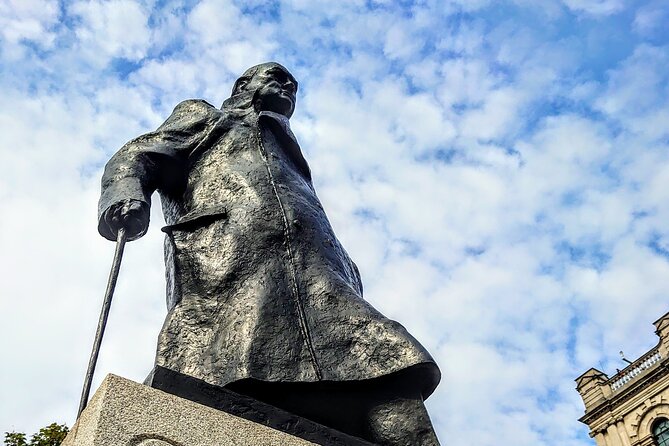
From Mayfair, the tour shifts into St. James’s, a district layered with “quiet” power. Today you’ll pass places that look like classic London—gentlemen’s tailors, private member clubs—but the story you’re given is about intelligence and wartime information.
You’ll learn about WW2 espionage in this area and even a little about connections that later influenced what people associate with James Bond themes. The point isn’t to turn the tour into fiction. It’s to help you recognize that espionage wasn’t abstract—it sat inside real offices and real networks.
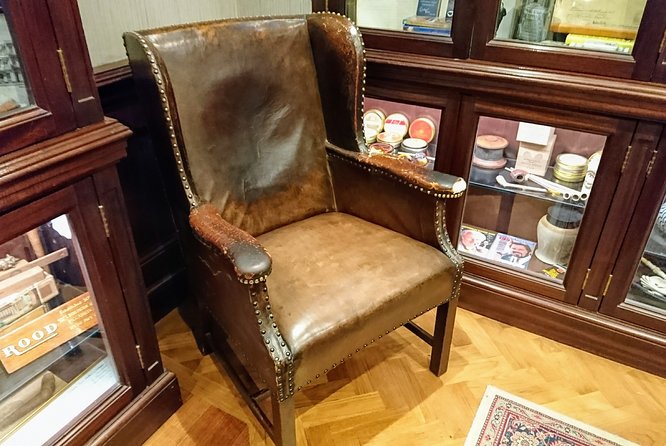
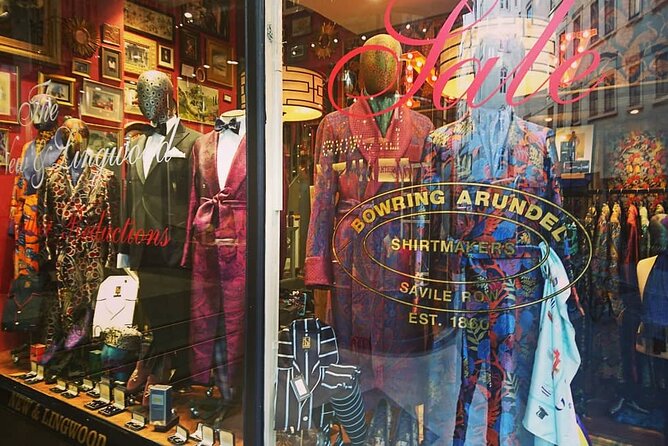
You also stop at a place connected to Churchill’s personal habits: a store where he bought his cigars. That might sound like a quirky side quest, but it works. Churchill’s cigars are part of his public image, and in wartime London, public image mattered too. One feedback highlight was actually getting to try out his favorite chair for a photo, which gives the whole thing a human, memorable edge without losing the seriousness of the setting.
The Roosevelt and Churchill allies monument: friendship as strategy
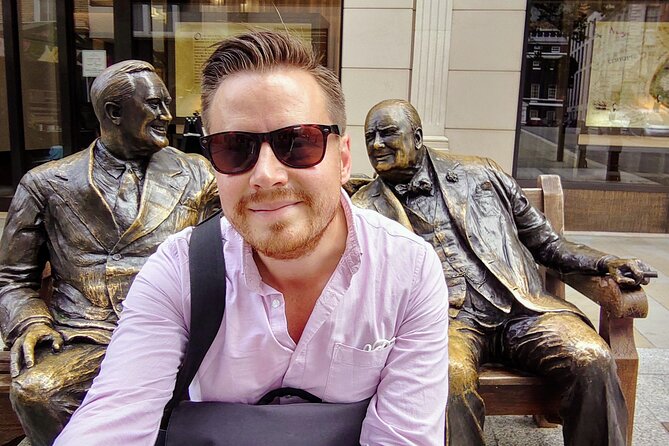
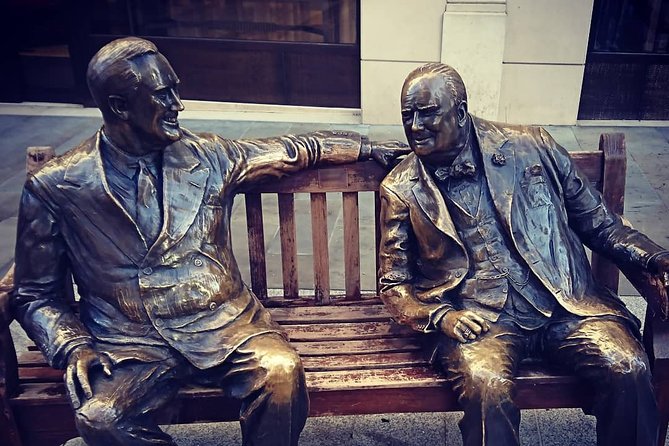
Not every wartime landmark is about secrecy or suffering. You’ll also spend a short stop at the Churchill and Roosevelt Allies Sculpture, commissioned to celebrate the friendship between the leaders and the two countries.
It’s quick, but it’s a useful reset. You don’t want a tour that only tells you how frightening things were. You also need the other ingredient: allies, coordination, and shared decision-making. Seeing the bond in stone helps you remember that the darkest hour wasn’t faced alone.
St. James Square and Carlton House Terrace: D-Day planning and a German embassy past
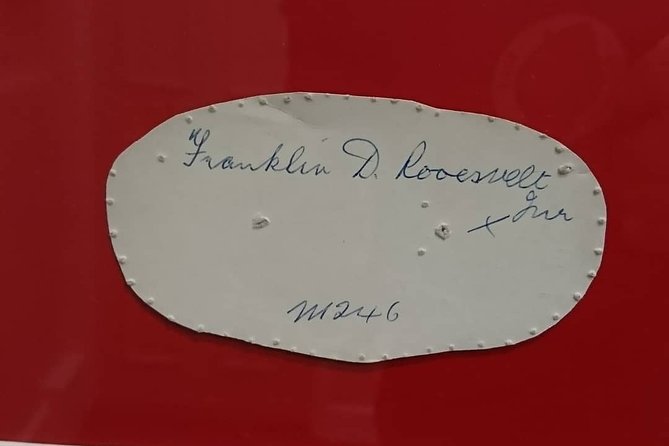
As you move, the tone sharpens again. At St. James Square, you’ll visit Norfolk House, described as a secret London HQ for Dwight Eisenhower during D-Day preparations. You’ll also learn that top-level Allied Chiefs of Staff would meet there to plan Operation Overlord.
This is one of those moments where a short stop can still feel weighty. The building itself anchors a massive timeline. You’re not just seeing a structure—you’re being shown that the biggest planning in the war had a London address, and people worked there with enormous consequences.
Then you head to Carlton House Terrace, connected to the former German Embassy. From 1936 to 1938, this was the office of Joachim von Ribbentrop. You’ll also hear about how SS guards were stationed outside and how official vehicles flew the swastika. Ribbentrop left in 1938 and later became Nazi Foreign Minister.
A stop like this works best when your guide keeps it grounded: who was there, what role the embassy played, and how the wartime relationship with Germany turned into an occupation-level threat. If you like the war story being tied to the physical city, this section delivers.





Whitehall: the highest concentration of key WW2 buildings
Then comes Whitehall, the zone that turns a London walk into something like a guided scan of Britain’s wartime command center.
You’ll hear about the concentration of important WW2 buildings and learn about early war details around Churchill’s role. One highlight is Admiralty House, where Churchill lived as First Lord during the early days of WW2, plus descriptions of secret communications centres and bunkers.
This is where a strong guide earns their keep. The value isn’t just that they know facts—it’s that they can explain what each building type meant in practice. The “why” is what helps you understand why someone would have risked everything to protect information and keep lines of communication open when air raids were part of everyday reality.
Westminster and Parliament Square: roof-top bomb watching and VE Day perspective
Whitehall leads you toward Westminster, and suddenly the tour becomes about both damage and survival.
Around Westminster Abbey and the Downing Street area, you’ll hear stories about Churchill’s dangerous nighttime visits to the roof of the Foreign Office to watch London being bombed during the Blitz. Your guide will also point out scarring on nearby buildings that were damaged in air raids and explain how this area held one of the biggest secrets of WW2.
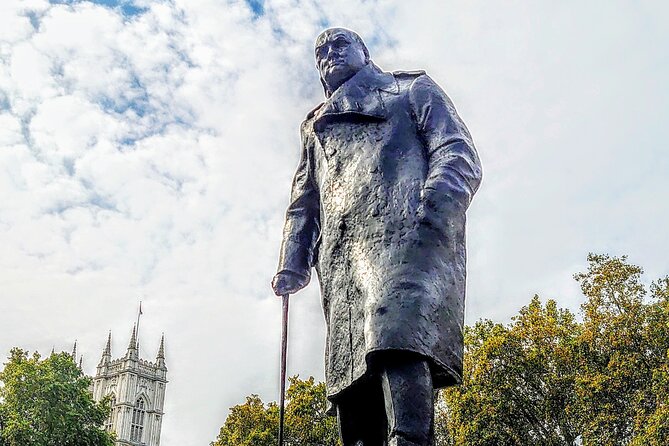
Then you move to Parliament Square, where you’ll learn about the House of Commons and Lords, and how large air-raid shelters were located under the square during WW2. The Churchill statue dominates the southern end, and your guide will explain why it sits there.
One moment you’ll be asked to imagine in real time is VE Day. Churchill addressed crowds from the balcony of the nearby Ministry of Health. Looking up at that balcony during your walk helps the day feel less like a lesson and more like a scene.
Churchill War Rooms: the fast-track finish that lets you stay as long as you like
The tour ends at the Churchill War Rooms, the secret underground HQ under Whitehall where Churchill declared that from this room he would direct the war. This isn’t just a museum stop. It’s the emotional climax of the whole outing.
You’ll get an overview first, and then you’ll have fast-track access so you can skip the queue. That’s a real value feature, because the War Rooms can be busy. Once inside, you’ll have as much time as you like to enjoy the Churchill Museum and the Map Rooms.
What makes this ending especially satisfying is how the walk sets you up. When you’ve just heard about Whitehall offices, communications centers, and bunkers, the underground room doesn’t feel random. It feels like the logical conclusion of the city’s wartime nervous system.
If you want to get the most from the museum time, give yourself permission to slow down. Look at the spaces and imagine the constant pressure of decision-making. You don’t need to rush to “see everything.” The map rooms are the kind of place where your brain naturally starts building timelines.
Price and value: is $242.71 per person worth it?
Let’s talk money in a practical way.
This costs $242.71 per person and lasts roughly 3 to 4 hours. For that price, you’re paying for three big things:
First, you’re getting a private tour where it’s only your group. That’s not the same as joining a crowded bus tour where you whisper your questions to yourself.
Second, you’re receiving fast-track entry to the Churchill War Rooms, plus the entrance is included. Skipping time in line matters in London, and it also reduces the chance you’ll feel rushed at the most important stop.
Third, the experience strings together multiple Churchill-linked locations across central London—Mayfair, St. James, St. James Square, Carlton House Terrace, Whitehall, Westminster, and Parliament Square—so you’re not spending your day bouncing between unrelated sights.
One thing that’s not included is lunch. That doesn’t ruin the value, but it does mean you should plan a meal either before you go or right after you finish at the War Rooms.
Overall, if you’re the type who likes to understand what you’re seeing—real places, real wartime roles—this tends to feel like money well spent.
Who this tour fits best (and who might want a different plan)
This experience is a strong fit if you:
- Want Churchill in a way that connects biography to locations, not just dates
- Prefer walking tours with a guide who stays focused on your group
- Enjoy museums, but also want the street-level context that makes a museum meaningful
- Like the human side of history, including personal details like Churchill’s cigars
It might be less ideal if you:
- Only want a quick hit of the War Rooms and prefer not to walk between multiple sites
- Need lunch included as part of the schedule (since it’s not offered here)
Should you book Winston Churchill’s London At War?
If you’re planning a London trip and Churchill is a priority, I’d book this—especially if you want a guided storyline through the city’s wartime geography, ending with enough time to actually absorb the underground experience.
The fast-track War Rooms access is a smart perk. The private guide attention is the real difference-maker. And if you can get Richard, based on the positive feedback about his knowledge and humor, you’ll likely find the tour feels less like sightseeing and more like a well-run guided chapter through London’s darkest hour.
FAQ
How long is the Winston Churchill London At War private walk?
The tour runs about 3 to 4 hours total, with the Churchill War Rooms visit taking about 3 hours.
Where does the tour start and end?
It starts at 1-3 Arlington St, London SW1A 1RA and ends at the Churchill War Rooms at King Charles St, London SW1A 2AQ.
Is the Churchill War Rooms entrance included?
Yes. Entrance to the Churchill War Rooms is included, and the tour includes fast-track access to help you skip queues.
Is lunch included?
No, lunch is not included.
What language is the tour offered in?
The tour is offered in English.
Is this a private tour?
Yes. It’s private, meaning only your group participates.
Do I need to print tickets?
No. You get a mobile ticket.
Are service animals allowed and is it near public transportation?
Service animals are allowed, and the tour is near public transportation.
What’s the cancellation policy?
You can cancel for a full refund if you cancel at least 24 hours before the experience’s start time.