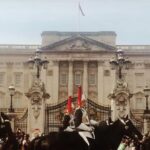
London’s uniforms are even better up close. This Changing of the Guard walking tour turns a chaotic crowd moment into a guided route with stops you can actually enjoy and photograph. I like that you get Household Cavalry views plus a clear plan from Parliament Square to St James’s Palace, with an expert guide keeping the history and timing straight.
I also love the photo approach: you get vantage points at Buckingham Palace and the nearby royal buildings without needing to fight for the front-gate chaos. One thing to consider: the tour does not go to Buckingham Palace’s front gates, so if that’s your must-see spot, you’ll need a separate visit or photo plan.
In This Review
- Key highlights before you go
- The royal route: how this tour keeps the morning from getting messy
- Meeting at the Jan Smuts statue: your simplest way to start on time
- Horse Guards Parade at Whitehall: the Household Cavalry moment you came for
- The Mall walk: turning St James’s Palace into a living procession
- Wellington Barracks: the behind-the-scenes staging area
- Buckingham Palace outside views: great photos without front-gate access
- Clarence House and St James’s Palace: working residences and a calmer ending
- Price and value: what $21.72 gets you (and what it doesn’t)
- The guide factor: where the experience really tightens
- Who this tour suits best (and who might want a different plan)
- Should you book this Changing of the Guard walking tour?
- FAQ
- FAQ
- What time should I arrive for the tour?
- Where does the Changing of the Guard walking tour start and end?
- Is Buckingham Palace entrance included?
- Does the tour go to Buckingham Palace’s front gates?
- How long is the tour?
- What do I do if I arrive late?
Key highlights before you go
- Max 20 people: small enough to move as a group and still hear the guide.
- A clear start point at the Jan Smuts statue in Parliament Square (easy to find).
- Household Cavalry on Whitehall at Horse Guards Parade, with sentry-box action.
- The Mall ceremonial walk toward St James’s Palace for a classic procession feel.
- Good Buckingham Palace photo angles from outside viewpoints (no front-gate access).
- A calmer ending at St James’s Palace after the main crowd starts to thin.
The royal route: how this tour keeps the morning from getting messy
If you’ve tried to watch the Changing of the Guard on your own, you know the problem: the ceremony is popular, and the best positions are usually taken long before you arrive. This tour solves that with a smart walking itinerary and a guide who tells you where to stand, what you’re looking at, and what’s happening next.
The day runs about 2 hours 30 minutes. You’ll start at 9:45 am (but really aim to arrive by 9:35 am), then work your way through the core landmarks tied to the ceremony. The pace is designed to fit actual viewing time at each spot, not just rapid sightseeing.
And because it’s a small group (up to 20), you’re not dealing with the kind of crowd that turns photo-taking into a shoulder-to-shoulder endurance test. You still get that London energy, but it’s organized energy.
You can also read our reviews of more walking tours in London
Meeting at the Jan Smuts statue: your simplest way to start on time
The tour begins at the General Jan Smuts statue in Parliament Square (SW1P 3JX). It’s described as the only green statue in Parliament Square, which is a genuinely helpful landmark detail. If your phone battery dies, you’ll still have a solid visual target.
The guide meets you there with a placard for the tour name, then gives a quick intro before moving out. From a timing standpoint, this matters. The tour asks you to report by 9:35 am so the group can assemble smoothly before the walk and viewing begin.
Getting there is straightforward via the Underground. The nearest station is Westminster on the District, Circle, and Jubilee lines. From there, it’s a short walk to Parliament Square.
One more practical point: if you arrive late, the guide will meet you at the next stop along the route. That’s a relief, because London delays happen.
Horse Guards Parade at Whitehall: the Household Cavalry moment you came for
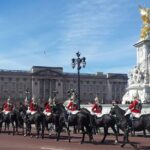
Your first big viewing stop after Parliament Square is Horse Guards Parade at Whitehall, home to the Household Cavalry. This is where the ceremony becomes real, not just scenic.
You’ll see troopers taking positions in the sentry boxes. That detail—sentry-box duty—is why this stop is so photogenic. It’s also why it tends to be a favorite part of the morning: you’re watching the visible mechanics of the tradition, not just people in uniforms standing around.
You’ll be here about 25 minutes, which is long enough to:
- get a few different photo angles,
- watch the routine unfold without rushing,
- and still have time to adjust if the crowd shifts.
The setting is also perfect for first-time Londoners. Whitehall is the kind of street where the scale of government buildings makes the ceremony feel extra important.
The Mall walk: turning St James’s Palace into a living procession
After Horse Guards Parade, you head along The Mall, London’s grand ceremonial boulevard. This stretch matters because it’s not just moving from point A to point B—it’s the “in-between” that makes the Changing of the Guard feel like a real event.
As you walk, you’re aiming toward St James’s Palace, where guards form up and march in a striking procession. The tour builds this into another 25-minute viewing window, so you can actually watch the lineup and movement, rather than only catching a glimpse as it passes.
What I like about this part is the pacing. Instead of cramming every stop with maximal crowd time, the route gives you repeated opportunities to observe from different angles. You’ll feel like you’re participating in the parade flow rather than just waiting.
Wellington Barracks: the behind-the-scenes staging area
Next is Wellington Barracks, headquarters of the Foot Guards. This is the stop that gives you the most “how it works” feeling.
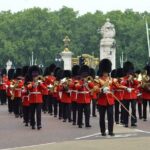
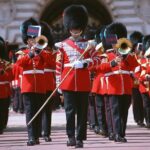
You’ll watch the new guards preparing to march to Buckingham Palace, and you’ll also see them assemble in full uniform with a regimental band. Seeing the build-up stage—rather than only the final movement—helps the ceremony click. It stops being a TV moment and becomes a real military operation with rhythm and discipline.
This section runs about 20 minutes. It’s long enough for a few good photos and close viewing, but not so long that you start feeling pinned down by crowds.


Buckingham Palace outside views: great photos without front-gate access
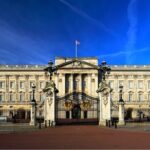
Now for the big one: Buckingham Palace. You won’t enter. You also won’t get access to the front gates, and that’s a key detail to accept up front. But the trade-off is valuable: you’ll get views from the outside and a vantage point designed to help you avoid the worst congestion.
The tour notes a viewpoint from the West Africa Gate side, with about 30 minutes at this stop. From there, you can admire the iconic façade and royal surroundings while keeping your energy for photography.
Here’s the context the guide brings to the moment: Buckingham Palace is the official London residence of the British sovereign. It was constructed in 1703 and expanded over time. The palace is described as having 775 rooms, including the Throne Room and lavish Ballroom. And while the ceremony draws huge attention, Buckingham remains a working institution that hosts events.
If your only goal is the ceremony, this stop gives you what you need. If your goal is an inside visit too, you’ll still need a separate plan—entrance tickets aren’t included.
Clarence House and St James’s Palace: working residences and a calmer ending
After Buckingham, the tour moves to Clarence House. This is the official residence of King Charles III and his family, and it’s been a royal home since the 1820s. The tour emphasizes that public access is limited, so what you’re really getting here is recognition and atmosphere—seeing one of today’s working royal residences from the outside while the day’s energy starts to ease.
Clarence House gets a shorter stop, about 10 minutes. That brevity works because by then you’ve already built up the parade intensity, and you’re not just “collecting stops.” You’re layering in context.
Then the tour finishes at St James’s Palace. Expect the final group of new guards to arrive here before they head toward Buckingham Palace. This timing is smart for visitors: much of the main crowd has begun to leave, so you get more relaxed photo opportunities and a bit more freedom to enjoy your last minutes at a slower pace.
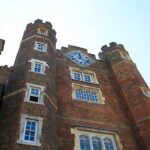
St James’s Palace is described as one of the oldest royal residences, established in 1536 and commissioned by Henry VIII. It served as the monarch’s official home until the 18th century, and today it still holds ceremonial significance and royal offices. The focus here is on Tudor-era architecture and the sense that this isn’t a “theme park” version of monarchy.
Price and value: what $21.72 gets you (and what it doesn’t)
At $21.72 per person, this is one of the more affordable ways to experience a highly popular London moment—especially because the tour includes a guided walk and multiple viewing points.
What you get included:
- a guided walking tour of the ceremony,
- help with photo opportunities at Buckingham Palace, St James’s Palace, and Clarence House,
- up-close chances to photograph the Royal Horse guards of the Household Cavalry,
- and an expert guide from an award-winning company.
What you don’t get:
- entrance tickets to Buckingham Palace (you’re outside only),
- and access to Buckingham Palace’s front gates.
So is it good value? Yes, if your priority is the ceremony and the route. No, if you’re hoping the tour is also a substitute for a palace interior visit. For most people, though, it hits the sweet spot: you spend your time where the spectacle is, not stuck in ticket lines.
The experience is also set up for real schedules. Total time is about 2.5 hours, it’s in English, and it’s issued with a mobile ticket, which helps a lot when you’re touring with maps and buses and the usual London rhythm.
The guide factor: where the experience really tightens
The biggest difference between a self-guided ceremony and a guided one is timing and context. A good guide tells you what you’re seeing and when to expect the next movement, so you don’t miss the best second just because you were checking where you were supposed to stand.
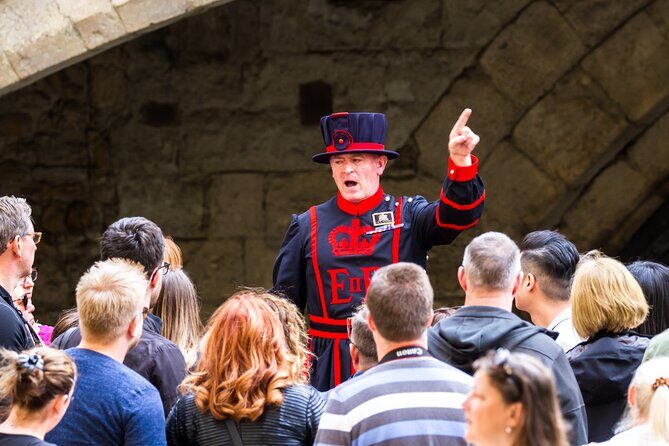
The tour emphasizes an expert guide, and one specific name you may see connected with the experience is Sean. He’s praised for strong expertise and energy, plus pacing that keeps the group moving without feeling rushed. That kind of guide style matters here. Changing of the Guard is fast-moving—your success depends on staying oriented.
You’ll also get questions answered during the morning intro, which is helpful if you’re not already a UK-royal-history spreadsheet person.
Who this tour suits best (and who might want a different plan)
This tour is a great fit if you:
- want a structured way to see the ceremony without guessing where to stand,
- like photos but don’t want to camp in one spot for hours,
- enjoy seeing how multiple royal sites connect—Parliament Square, Whitehall, The Mall, and the palace area.
It may be less ideal if you:
- only care about Buckingham Palace’s front gates (this route avoids them),
- plan to visit the palace interior during the same trip (you’ll need separate tickets),
- or are traveling on a very tight timeline and can’t get to the meeting point by the recommended 9:35 am arrival.
Good weather is required for the experience, so keep an eye on the forecast.
Should you book this Changing of the Guard walking tour?
I think you should book it if you want the ceremony in a way that feels organized, photo-friendly, and easy to follow. The route hits the key sights—Household Cavalry at Horse Guards, the procession feel on The Mall, and the palace area—with enough time at each stop to actually enjoy what’s happening.
Skip it only if your must-have is inside access or front-gate access at Buckingham Palace. If you’re okay seeing the palace from smart outside vantage points and letting the guide handle timing, this is a strong, good-value way to experience one of London’s signature traditions.
FAQ
FAQ
What time should I arrive for the tour?
You should arrive by 9:35 am so the guide can welcome the group. The tour begins at 9:45 am.
Where does the Changing of the Guard walking tour start and end?
It starts at the Jan Smuts Statue in Parliament Square and ends at St James’s Palace.
Is Buckingham Palace entrance included?
No. The tour includes outside viewing only, and entrance tickets to Buckingham Palace are not included.
Does the tour go to Buckingham Palace’s front gates?
No. The tour states it does not access the front gates of Buckingham Palace.
How long is the tour?
The duration is about 2 hours 30 minutes.
What do I do if I arrive late?
If you arrive late, the guide will meet you at the next stop along the route so you can join the group in progress.