REVIEW · OXFORD
Oxford: 90 minute Architectural & Historical Highlights Tour
Book on Viator →Operated by Oxford History Tours · Bookable on Viator
Oxford in ninety minutes? Yes, and it works. You get a smart hit of architectural and historical Oxford, from a Victorian memorial to Saxon stone and working university spaces. It’s the kind of tour that helps you see the city as one story, not just a pile of colleges.
I especially like the guide style. If you land with Sophie, you’ll get crisp explanations and a great sense of humor, and she can handle both English and French. I also like the practical add-ons: you get a complimentary map and guidebook, plus personal recommendations on where to eat and drink so your day doesn’t end when the tour does.
One consideration: this is a stop-and-say-meaningful-things tour, not a sit-and-stare all afternoon plan. With so many sights packed into about 90 minutes, you’ll have to accept quick looks now, and then choose what to return to later.
In This Review
- Key highlights worth your attention
- Oxford in 90 Minutes: What You’re Really Buying
- Start at Weston Library, End at Golden Cross, and Learn the Walking Rhythm
- Martyrs’ Memorial and St Michael at the North Gate: The Oxford That Bites Back
- Exeter and Lincoln Colleges: Chapels, Origins, and Names You Recognize
- St Mary the Virgin and Its Spire: A View Into Oxford’s First Building
- Oriel and Corpus Christi: Rowing, Tortoises, and Animal Carving
- Merton College and Examination Schools: How Oxford Learned to Teach
- Queen’s College, High Street Facts, and New College Gates
- Bridge of Sighs, Sheldonian Theatre, and Oxford’s Ceremony Machine
- Oxford Central Library, Bodleian Library, and the Radcliffe Camera: Your Reading List Starts Here
- A Quick Christchurch Pass and Why You’ll Want to Go Back
- What You Get Besides Stops: Map, Guidebook, and Food Tips That Actually Help
- Should You Book This 90-Minute Oxford Highlights Tour?
- FAQ
- How long is the Oxford architectural and historical highlights tour?
- Where does the tour start and end?
- Is pickup offered?
- Do I need a printed ticket?
- What language is the tour offered in?
- How big is the group?
- Is admission included for the stops?
- Will I have access to any college interiors?
- Is the tour suitable for most travelers?
- What happens if the weather is poor?
- Is the tour refundable if I cancel?
Key highlights worth your attention
- Sophie-led stories: clear, attentive guiding that turns stone and street corners into real context
- College access included: free admission is built into the schedule, including a medieval college visit
- A fast, useful route: you’ll cover the core Oxford feel without losing half a day to transit
- Spire and stained glass time: St Mary the Virgin is a standout with possible spire climbing
- Food-and-drink suggestions: you leave with a plan, not just photos
- Small group pace: capped at 15, which helps questions and keeps things moving
Oxford in 90 Minutes: What You’re Really Buying
This tour is priced at $0.00 per person in the information I received, and even if you treat it as a promotional “free” offer, the value is still the point. You’re paying with your feet and about 90 minutes of time, but you’re getting a structured walk through the parts of Oxford that explain how it grew—religion, education, power, and culture all tangled together.
What makes it work is the way the route builds meaning. You start with a monument tied to 16th-century religious conflict, then step into older Oxford defenses, and only later zoom out to the university machine—exams, ceremonies, libraries. By the end, you can connect names you’ve heard (Lewis, Tolkien, Rowling) to actual places you’re standing in.
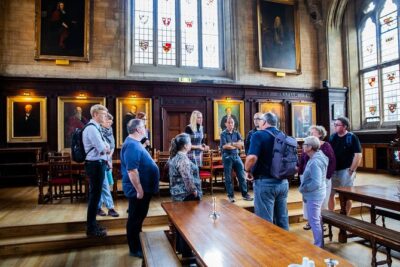
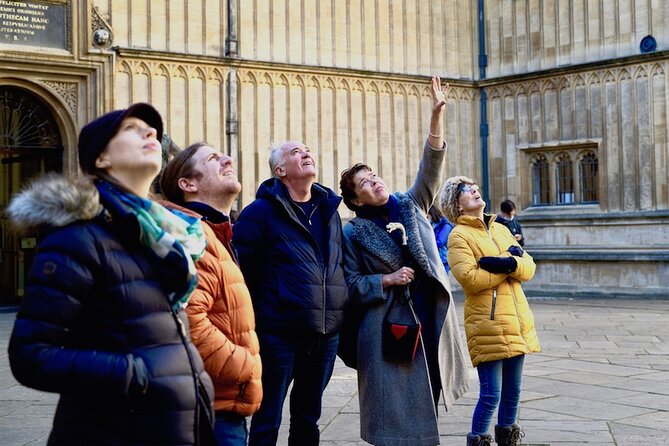
And yes, it’s guided. The small group size (15 max) matters because you’re not just listening to facts—you’re able to ask for clarification and get answers in real time. In at least one account of this tour, the guide’s attentiveness and ability to handle different ages (children through grandparents) made the pace feel fair rather than chaotic.
You can also read our reviews of more tours and experiences in Oxford.


Start at Weston Library, End at Golden Cross, and Learn the Walking Rhythm
You meet at Weston Library on Broad Street (Oxford OX1 3BG). The tour ends at Golden Cross (Oxford OX1 3EU). That matters for two reasons.
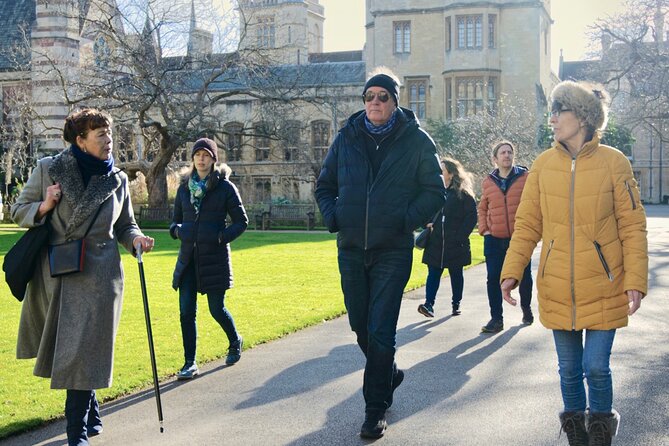
First, it keeps you in the center of town. You’re not commuting across Oxford to see the “next thing.” Second, the route is designed like a continuous city walk. You’re moving on foot between colleges, gates, and major university buildings, with short stops where you get the key story and a chance to look closely.
Pickup is offered, and the tour uses a mobile ticket. It’s also described as being near public transportation, which is helpful if you’re building a day around trains, buses, or a transfer from another city.
Most of all, the tour timing is realistic. At about 1 hour 30 minutes, you won’t feel like you need to rest afterward just to function. You’ll likely still have energy for an Oxford wander after.
Martyrs’ Memorial and St Michael at the North Gate: The Oxford That Bites Back
The first stop is Martyrs’ Memorial, a Victorian monument to Protestant martyrs of the 16th century. It’s not a random statue moment. The guide framing here gives you a sense of how religious conflict wasn’t some distant “back then” drama—it shaped who had power, who got punished, and what stories later generations preserved.
Then you move to St Michael at the North Gate, an Anglo-Saxon tower that was part of the Medieval city gate. The tour points out that it’s probably the oldest surviving building in Oxford today. That’s a big deal visually, because it forces your brain to shift gears: the medieval university you’re about to see sits on much older ground.
A quick practical tip for these early stops: look at the edges and the way the stonework sits within its setting. Even when you’re only there a few minutes, noticing how buildings connect (and how walls once mattered as city protection) makes the rest of the day click.
Exeter and Lincoln Colleges: Chapels, Origins, and Names You Recognize
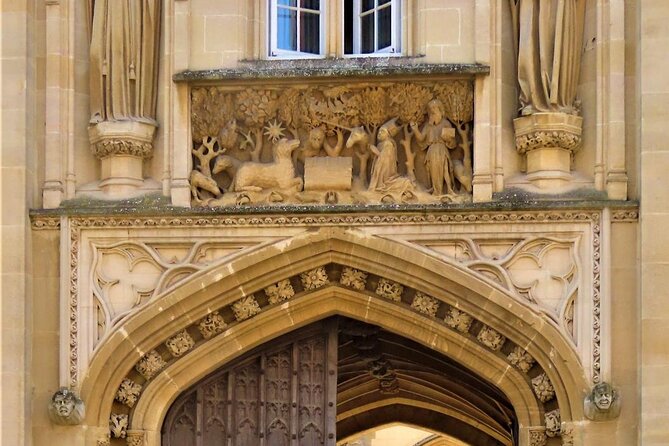
At Exeter College, you focus on the chapel and how it reflects ideas about faith and authority. The chapel is inspired by the Oxford Movement and modeled on Paris’ St Chapelle. That’s a fun connection because it reminds you Oxford didn’t evolve in a cultural vacuum—it borrowed, adapted, and reinterpreted.
This is also one of those stops that turns famous writers into more than name-dropping. Exeter’s graduates include Philip Pullman, J. R. R. Tolkien, and Alan Bennett. If you’ve read even a little, you’ll start seeing the university as a place where belief, learning, and imagination share the same walls.
Next comes Lincoln College, where the front face onto Turn Street tells a story about the university’s origins and its relationship with the city. You also get the “today” angle here: Lincoln College was home to Methodist Wesley Brothers, and it recently got its first Prime Minister, Rishi Sunak.
The drawback at stops like these is simple: you can’t absorb everything in a few minutes. Use the guide’s story as a map, then choose one college or chapel later to return to for longer. Think of this segment as setting your bearings.
St Mary the Virgin and Its Spire: A View Into Oxford’s First Building
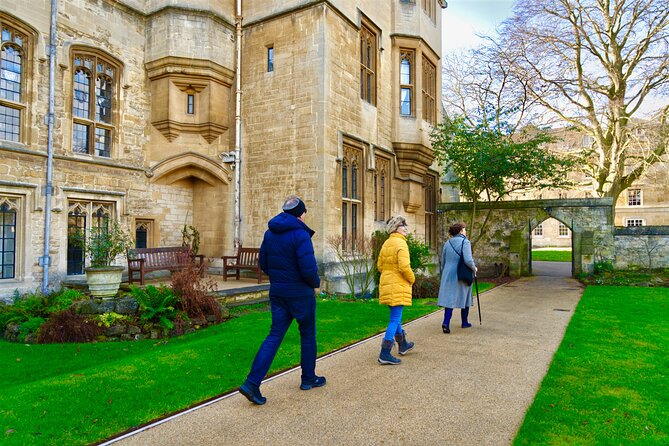
The route then heads to the University Church of St Mary the Virgin. This church is described as the university’s first building, and it’s listed in the Doomsday Book. Even if you don’t care about medieval records, the point is clear: this is Oxford’s early institutional anchor, long before the colleges looked like a collection of architectural trophies.
You also get stained glass and the connection to CS Lewis, plus the tour notes that it’s possible to climb the magnificent spire. If spire climbing is on your list, this is the moment to decide. It’s also a great use of time because you’ll get a different kind of Oxford view—more rooftops, more layout, less postcard close-up.
If weather is good, St Mary’s is where I’d prioritize your focus. The combination of stained glass, deep time, and possible height gives you variety in a relatively short stop.






Oriel and Corpus Christi: Rowing, Tortoises, and Animal Carving
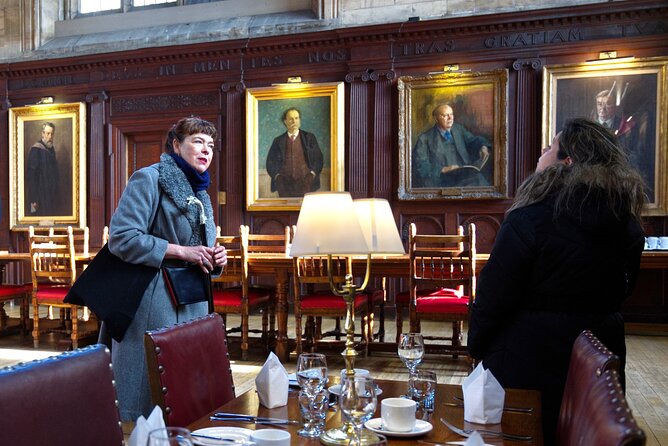
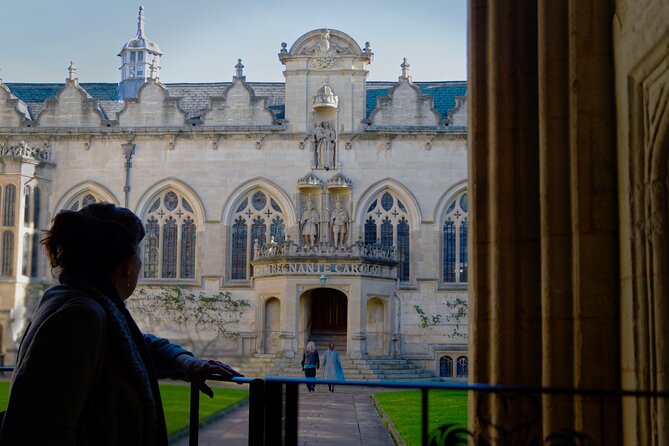
At Oriel College, the tour frames the college as one of Oxford’s oldest, and it calls out rowing as one of its today-famous traditions. The front quad with Oriel windows is highlighted as stunning, and the real value here is in understanding how Oxford’s college life shaped culture outside the classroom.
From there you move to Corpus Christi College, known for early 16th-century architecture with moving animal figures, including a pious pelican. It’s the kind of detail that makes you look twice. Someone carved a creature into the stonework and expected it to mean something—religion, morality, symbolism, or simply beauty offered to the eye.
The tour also points out the cobbled street set under Corpus Christi being listed as a national treasure. That might sound like a bureaucratic label, but on foot it becomes meaningful: it’s a reminder that small streets and textures are part of Oxford’s heritage, not just the grand halls.
Side note you’ll appreciate later: Oriel neighbors Corpus Christi, and Corpus Christi famously hosts the annual tortoise race. It’s light-hearted, but it also shows how long-running traditions can be quirky and still matter.
Merton College and Examination Schools: How Oxford Learned to Teach
At Merton College, you get one of the most memorable visual elements on the walk: a 15th-century frieze over the gatehouse, described as a favorite creation because it tells the tale of college founding. You’ll also see the chapel’s flying buttresses, richly decorated.
Merton also ties directly into the Bodleian Library story. Thomas Bodley, founder of the Bodleian, was a graduate from Merton. The tour also notes Merton’s library as the oldest continuously surviving library in Oxford. Even if you only get a short look, hearing that line changes how you view the building. You’re not just seeing books—you’re seeing continuity.
Then comes the Examination Schools, and this stop is pure education history. Oxford’s first written exam is described as early 19th century, and the building itself is a Victorian extravaganza of Jacobean and Tudor styles, at its peak in the 1870s. The tour frames the deeper meaning as education becoming more widely available—an egalitarian spirit applied to exams and institutions.
For you, this is a good moment to pause mentally. Up to now, you’ve absorbed mostly architecture and legend. Here, you get how Oxford organized learning into a system that could test and rank people, not only tutor them.
Queen’s College, High Street Facts, and New College Gates
At Queen’s College, you connect Oxford to pop culture in a grounded way: it’s the alma mater of Rowan Atkinson. The tour also explains the college’s origin story: founded for poor scholars from the north of England. One of those scholars became wealthy enough that his donation funded an 18th-century rebuilding, with designs contributed by Christopher Wren and Nicholas Hawksmoor.
This is another moment where you should listen closely to the “why.” Architecture here isn’t just style. It’s a record of who was valued, who got funding, and how Oxford grew its buildings by recruiting talent from elsewhere.
Then you hit the High Street with its Oxford-specific oddities. The tour notes it as the road to London and mentions Frank Cooper’s Marmalade being first made there, later becoming a worldwide fad. It also mentions the site of England’s first coffee house, connected to Jewish people being welcomed back after bans dating to the 13th century during Oliver Cromwell’s Republic.
Finally, you pass New College, where the gates tell a foundation story after the plagues of the 14th century. New College also appears in film sets, which is a gentle reminder that Oxford’s “old” look is not just for tourists—it’s a working stage for modern storytelling.
Bridge of Sighs, Sheldonian Theatre, and Oxford’s Ceremony Machine
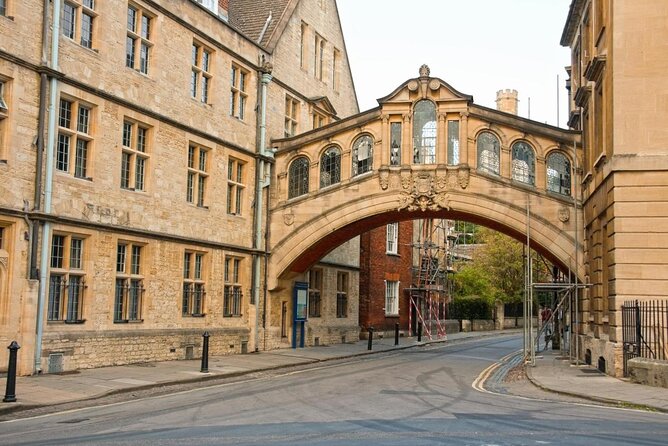
The Bridge of Sighs is next, belonging to Hertford College. It looks like an old Venetian bridge, but the tour points out it was built in the 20th century. That contrast is fun because it tells you how “copying” can still become part of Oxford’s identity.
You’ll also learn it sits next to Edmund Halley’s house—Halley is tied to the comet that bears his name. If you like science stories, this stop gives you a tidy bridge between the university and the wider world.
Then it’s on to Sheldonian Theatre, a 17th-century home for Oxford University ceremonies. The tour says it’s believed to be the first building by Christopher Wren, also known as the architect of St Paul’s Cathedral in London. It adds a detail about Wren as Astronomer of Photography at Oxford University—an unusual tidbit that you’ll either find hilarious or mind-bending, depending on your tolerance for Oxford trivia.
This segment matters because it shows Oxford as theater. Exams and libraries are serious, but ceremonies have their own architecture, rituals, and stagecraft.
Oxford Central Library, Bodleian Library, and the Radcliffe Camera: Your Reading List Starts Here
Now you reach the library-heavy part of the walk. First is Oxford Central Library, built on top of the medieval perpendicular Divinity School. The tour highlights the Duke Humphrey Library: a 15th-century library built to house a gift of over 200 books from the King’s brother. It also notes that both of these rooms were selected by J. K. Rowling for Harry Potter scenes.
Next is the big one: the Bodleian Library. It’s described as having over 13 million books. The tour focuses on the 17th-century buildings and on the origins of the library and how it still works today. Even if you can’t spend hours inside, hearing how the Bodleian operates gives you a sense of why it’s still a living institution rather than a museum shell.
Then you get Radcliffe Camera, described as Oxford’s first science library. The tour frames it around one of Oxford’s most eccentric and generous benefactors: Royal Physician Sir John Radcliffe. That’s the key word here—benefactor. Oxford’s libraries and institutions didn’t appear because someone wished for them. They happened because people funded them, argued about them, and built them into the city.
If libraries are your thing, this is the best payoff part of the tour. You’ll leave knowing where the stories come from, not only seeing the exterior drama.
A Quick Christchurch Pass and Why You’ll Want to Go Back
Near the middle, the tour passes Christ Church. The route doesn’t linger, but it explicitly gives you a good idea for after: you might want to go back and enjoy the Christchurch Picture Gallery tucked behind the Eastern entry to the college.
That’s a smart end-of-tour behavior: your guide doesn’t just point forward. It gives you a next step that fits your time and interests.
And the final university point comes at Balliol College, where the tour mentions undergraduates starting to have access to the university and its colleges. It’s another reminder that Oxford’s story isn’t only about famous buildings—it’s about access, rules, and who gets to learn.
What You Get Besides Stops: Map, Guidebook, and Food Tips That Actually Help
The best part is often what happens after you finish walking.
You get a complimentary map and guidebook for further exploration. That matters because Oxford can feel like a maze of gates and quads. A good map helps you pick where to go next without wasting time hunting.
You also get personal recommendations on where to eat and drink. That’s not fluff. If you’re only in Oxford for a short day, a few good suggestions can turn your afternoon from random choice into a plan that fits what you liked on the tour—architecture lovers, literature nerds, and coffee hunters included.
Finally, the overall tone of the experience—supported by the consistently high rating—seems to be about making the university feel human. The guide’s humor shows up alongside facts, including connections between art and science, and between medieval faith and later literature.
Should You Book This 90-Minute Oxford Highlights Tour?
I’d book it if you want a quick, well-led way to understand Oxford’s big themes without losing your day to logistics. It’s ideal for first-time visitors, for travelers staying only a short time, and for anyone who likes their sightseeing with story and context.
I’d pass or at least adjust expectations if your goal is long interior time. This tour is built for highlights and meaning, not for extended museum-style wandering. Use it as an orientation. Then come back—especially if you want to linger at libraries, chapels, or any single college that really grabs you.
If you’re someone who enjoys architecture, literature connections, and the way education institutions shape culture, this is a solid use of your time in Oxford.
FAQ
How long is the Oxford architectural and historical highlights tour?
It lasts about 1 hour 30 minutes.
Where does the tour start and end?
It starts at Weston Library on Broad Street, Oxford OX1 3BG, and ends at Golden Cross, Oxford OX1 3EU.
Is pickup offered?
Yes, pickup is offered.
Do I need a printed ticket?
No. You use a mobile ticket.
What language is the tour offered in?
The tour is offered in English.
How big is the group?
There is a maximum of 15 travelers.
Is admission included for the stops?
The tour information shows admission tickets as free for the scheduled stops, including several colleges and major sites.
Will I have access to any college interiors?
The highlights say it includes entry to a medieval college, and the schedule includes multiple stops with free admission.
Is the tour suitable for most travelers?
Yes, most travelers can participate.
What happens if the weather is poor?
This experience requires good weather. If it’s canceled due to poor weather, you’ll be offered a different date or a full refund.
Is the tour refundable if I cancel?
No. It is non-refundable and cannot be changed for any reason.