REVIEW · LONDON
Soho London Private Music Self-Guided Tour
Book on Viator →Operated by Pandemic Tours · Bookable on Viator
Soho has a soundtrack, and you can follow it. This self-guided music route turns the neighborhood into an audio map, with Evren as your human voice guide and Soho music history you can pause, replay, and re-walk at your own pace. I like that it’s built for flexibility: start when it suits you, and use the in-app directions to keep moving without stress.
I also like the way the stops cover more than one side of music. You bounce from West End theaters to Tin Pan Alley-style songwriting streets, then land at legendary studios and jazz rooms that shaped careers. One drawback to plan for: there’s no in-person guide, so you’ll want to use the app and read the stop context yourself.
In This Review
- Key Points You’ll Actually Use
- Price and Time: $12.47 for Two Hours That Keep Paying Off
- Where It Starts and Ends (and Why That’s Handy)
- Getting Oriented Fast with the In-App Maps and GPS Route
- Stop-by-Stop Walk: Dominion Theatre to Trident Audio Post
- Starting the West End Soundtrack: Dominion Theatre and the Astoria Legacy
- Denmark Street: Tin Pan Alley Energy in Walking Form
- Forbidden Planet and a Quick Culture Reset
- Back to the West End: Phoenix Theatre, Phoenix Garden, and Saville Theatre
- Apple Store, Not Guitar Shop: Macaris and Foyles as Creative Stops
- Live-Music Reality Check: Borderline Nightclub Closure
- Soho Square Pause: Secret Performances in a Leafy Center
- Pub Stop for Atmosphere: The Dog and Duck
- Mozart Blue Plaque: The Earlier Roots of Music in Soho
- Ronnie Scott’s and 2i’s Coffee Bar: Jazz and Rock’s Early Engines
- Marquee Club to Reckless Records: From Debuts to Your Next Record Obsession
- Ending at Trident Audio Post: Studio History in One Final Beat
- Who This Tour Fits Best (and Who Might Want Something Else)
- Should You Book the Soho London Private Music Self-Guided Tour?
- FAQ
- How long is the Soho London Private Music self-guided tour?
- What does it cost per person?
- Is there an in-person guide with this experience?
- Can I access the tour more than once after booking?
- Where does the tour start and where does it end?
- Is this tour refundable if I cancel?
Key Points You’ll Actually Use
- Evren’s audio guide (not robot narration): you get a real voice tour that fits a walking pace.
- Three weeks of unlimited access: you can repeat sections later, or split the route into two smaller walks.
- In-app maps and GPS route: fewer wrong turns in tight Soho streets.
- Start anytime, based on your schedule: you’re not chained to one departure time.
- Lots of stops are outside and ticket-free: many sights work well even if you’re just browsing.
Price and Time: $12.47 for Two Hours That Keep Paying Off
At $12.47 per person, this is priced like a budget activity, not an all-day tour. The big value comes from the match between time and content: it’s about 2 hours, but you get 3 weeks unlimited access to the same audio and route.
That matters because Soho is one of those places where you may get distracted by storefronts, pubs, and record shops. With replay access, you can walk once to get the story straight, then return to linger at the stops that grabbed you. If you like music facts, you’ll appreciate being able to rewind and re-hear details.
You can also read our reviews of more tours and experiences in London.


Where It Starts and Ends (and Why That’s Handy)
The tour starts at Dominion Theatre, 268–269 Tottenham Court Rd, London W1T 7AQ. It ends at Trident Audio Post, 33 Great Pulteney St, London W1F 9NP, and after you finish, you’re free to wander Soho on your own.
This start-to-end setup is useful because it naturally takes you through different corners of Soho instead of forcing you to walk back the same way. Also, the route is marked to run Monday through Sunday, 12:00 AM to 11:30 PM, so you can fit it around dinner plans.
Getting Oriented Fast with the In-App Maps and GPS Route
Soho streets can feel like a maze if you’re wandering without a plan. This tour helps you get your bearings fast using in-app maps and directions, plus a GPS route that guides you stop to stop.
Practically, that means you don’t need to keep checking your phone like a confused detective. You can focus on walking and listening, then glance at the map when you’re near a junction. It’s also worth it to plan your phone battery. If your phone dies, your audio and route support go with it.
Language is English, so you’ll get the full experience without translation layers.
Stop-by-Stop Walk: Dominion Theatre to Trident Audio Post
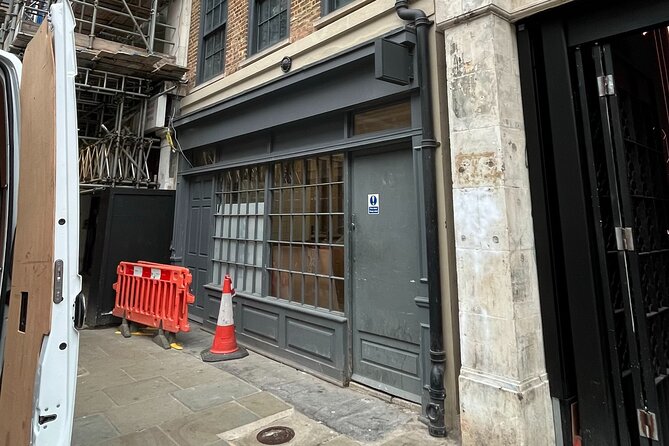
This route mixes famous names with the places where the work happened—studios, publishing offices, and songwriter corridors. I like that it’s not just about performers on stage. It also shows how music got created and packaged in Soho.
Starting the West End Soundtrack: Dominion Theatre and the Astoria Legacy
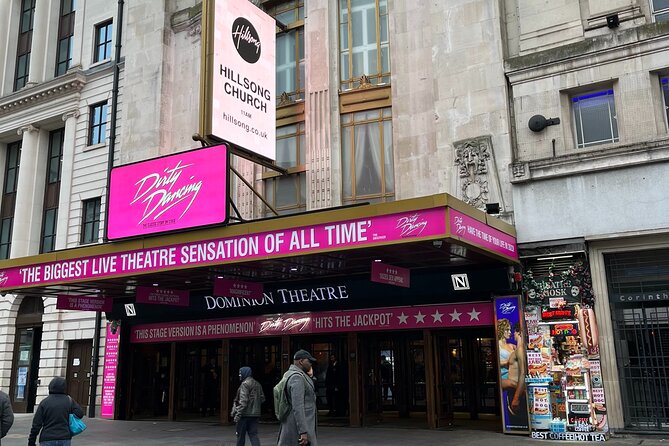
Your first stop is Dominion Theatre on Tottenham Court Road. The venue has hosted musicals and concerts over the years, including a landmark performance by David Bowie. It’s a strong opener because it sets the tone: Soho’s music story isn’t only underground—it’s been on major stages too.
Next you reach the Astoria Theatre, which once held bands and artists in the center of Soho’s music scene. It’s closed now, but the route keeps the connection alive by pointing out its legacy as a launch pad for careers. For me, that’s the smart way to handle closed venues: you don’t treat them as dead ends—you treat them as chapters.




Denmark Street: Tin Pan Alley Energy in Walking Form
Denmark Street is the heart of the songwriting legend, and you’ll spend multiple stops here.
First comes Denmark Street itself, often called the British Tin Pan Alley. The area is linked to major songwriting and recording activity, with references to careers that started there, including artists like Elton John and the Rolling Stones. The point of this stop is orientation: once you understand Denmark Street’s role, every nearby building starts to feel connected.
Then you visit the 12 Bar Club, known for grassroots gigs and for hosting early performances from names like Adele and The Libertines. This stop works best when you imagine small rooms and close listening—soho’s music isn’t just big venues, it’s also a place where careers got attention.
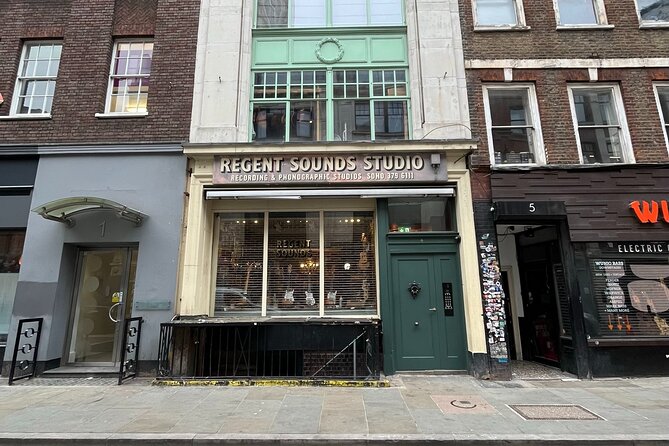
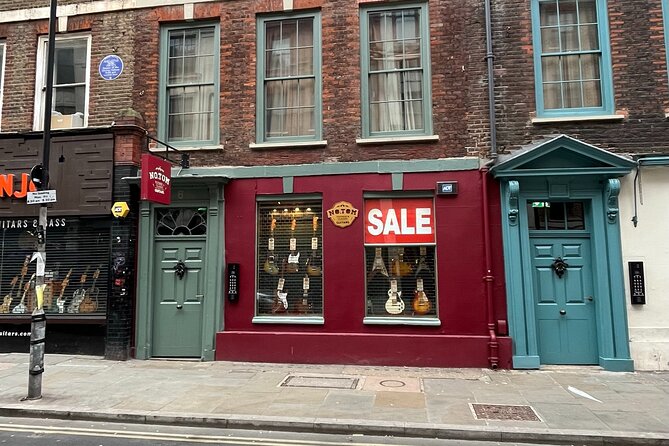
After that, you hit Regent Sounds Studio. It’s legendary for recorded classics, including sessions tied to The Beatles and the Rolling Stones. The tour notes that it’s now a guitar shop, which is a great example of Soho repurposing music spaces instead of erasing them.
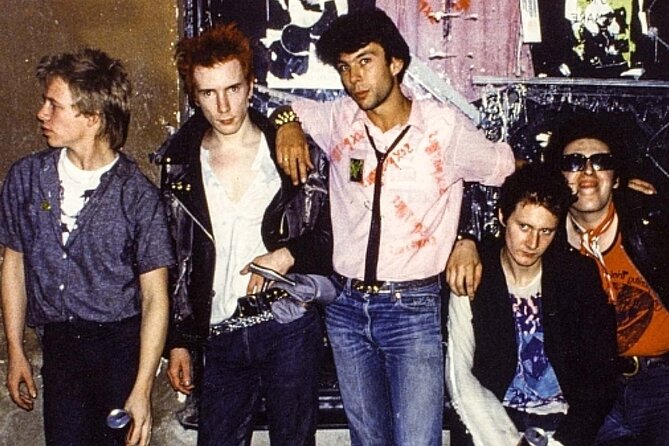
Next is No. 6 Denmark Street, connected to the Sex Pistols, who lived and recorded music there in the 1970s. This is where the route shifts from mainstream music business to punk attitude. Even if you don’t know the address by heart, you’ll understand the moment it represents.
You also pass Mills Music, a storied music publishing company from Denmark Street’s Tin Pan Alley era. The route points to its early-20th-century roots and mentions involvement with major figures like Jimmy Page and David Bowie. I love this stop because it explains the side of music that many people ignore: publishing is where songs become properties and income streams.
Then there’s La Giaconda, a café associated with musicians and songwriters in the 1960s, including David Bowie, Jimi Hendrix, and Elton John. This isn’t a recording studio, but it’s one of the most important types of places in any music scene: the hangout where ideas form.
The Denmark Street cluster ends with KPM Music House, tied to global music publishing and also known for film and TV scores. This stop is valuable if you want the full picture of how music spreads beyond radio singles.
Forbidden Planet and a Quick Culture Reset
A short break from music-world specifics comes at Forbidden Planet. It’s famous as a major comic, science fiction, fantasy, and cult entertainment retailer. The tour is honest about the link being less direct, but that’s the point: Soho’s creative energy includes comics and pop culture, not just recording.
If you’re a person who likes to understand neighborhoods as a whole ecosystem, this stop adds perspective without derailing the theme.
Back to the West End: Phoenix Theatre, Phoenix Garden, and Saville Theatre
After Forbidden Planet, you reach the Phoenix Theatre. The route highlights the venue’s grandeur and variety of shows, and notes a performance by David Cassidy in Blood Brothers. This is a solid step in Soho’s performing arts chain.
Next is Phoenix Garden, a community garden that gives you a pause. While it’s not directly music history, it’s a quiet reset where you can breathe for a moment and look around without staring at phone screens. It’s also a good reminder that Soho isn’t only brick and noise.
Then you stop at ODEON Covent Garden, formerly Saville Theatre. The route connects it to major 60s performances, including The Beatles and Jimi Hendrix, and mentions that it was managed by Brian Epstein. This stop is useful because it links theater power to artist management—the backstage world that shapes what reaches the stage.
Apple Store, Not Guitar Shop: Macaris and Foyles as Creative Stops
You’ll also pass Macaris Guitar Shop, now an Apple Store. The story here is about continuity: the shop once supplied instruments to musicians and stars, and the tour points out that Soho’s music spirit still lingers in the area even when the business changes.
Next comes Foyles Book Shop. It’s not a music site on paper, but the tour connects it to Soho’s creative and intellectual side. The practical payoff is that Foyles has a strong selection and you can browse music-related books and biographies without leaving the mood of your walk.
Live-Music Reality Check: Borderline Nightclub Closure
The route includes The Borderline Nightclub, but it’s listed as currently closed. That can be a buzzkill if you were hoping for a quick music stop, yet it also serves as a realistic snapshot of how scenes change over time. When you’re standing outside a closed venue, the tour’s audio context matters more, because the building can’t talk for itself.
Soho Square Pause: Secret Performances in a Leafy Center
Next you reach Soho Square, one of London’s oldest squares. The route includes a note about a building owned by Paul McCartney and mentions secret performances, including Prince doing two shows in one night. Even if you don’t see a plaque or a marker, this stop helps you understand the “small but legendary” scale of Soho’s music world.
Soho Square is also a good place to check your pace. If you’re running late, you can move faster. If you’re ahead, you can linger for photos and then continue.
Pub Stop for Atmosphere: The Dog and Duck
You’ll pass The Dog and Duck Pub, a historical English pub. The tour keeps its music ties more subtle, but that’s not a problem. A pub stop is useful because it gives you a chance to cool down and reflect on what you’ve heard on the audio track.
If you want to turn this into a longer outing, this is an easy point to take a break before the jazz section.
Mozart Blue Plaque: The Earlier Roots of Music in Soho
Then comes the Mozart Blue Plaque, marking the residence where Wolfgang Amadeus Mozart at age 8 composed his first symphony in 1764. This is one of those stops that widens the timeline fast, proving Soho’s connection to music-making is not only 20th-century rock and jazz.
It’s a quick stop, but it gives you a satisfying “oh wow” moment when your brain has been focused on punk, studios, and theaters.
Ronnie Scott’s and 2i’s Coffee Bar: Jazz and Rock’s Early Engines
Next up is Ronnie Scott’s Jazz Club, a landmark since 1959. The tour emphasizes that it has hosted nearly every notable jazz artist, and names Miles Davis, Ella Fitzgerald, and Nina Simone. This is the kind of stop where you can feel the weight of musical nights even from outside.
After that, the route includes 2i’s Coffee Bar, described as the birthplace of British rock ’n’ roll. It was a hub for emerging talent in the 1950s and 60s, and the tour mentions discoveries like Cliff Richard and Tommy Steele. It’s noted as no longer standing, so your audio becomes the main way to connect to the story.
Marquee Club to Reckless Records: From Debuts to Your Next Record Obsession
The tour continues with The Marquee Club, once a major London venue on Wardour Street. The route notes debut performances by big names including The Rolling Stones and The Who, and ties it to the 60s cultural revolution. It’s closed now, but it’s still a meaningful stop because it frames Soho as a place where careers got that first big break.
Then you land at Reckless Records, an independent record shop with a large selection of second-hand vinyl, CDs, and DVDs. This is a practical stop that turns the tour into action. If you’ve just heard about a studio or a band from the audio, you can actually look for something related—whether it’s a classic album or a deeper cut.
Ending at Trident Audio Post: Studio History in One Final Beat
The final music-creation stop is Trident Studios, described as a legendary recording studio. The route mentions recordings including David Bowie’s Hunky Dory and albums by The Beatles. It’s also described as being in the heart of Soho, where artists and bands created major works.
Your tour ends at Trident Audio Post on Great Pulteney St, which puts a clear stamp on the final leg: you finish near where the studio legacy continues in some form. After the audio stops, you can decide if you want to browse nearby shops, grab a drink, or just keep walking while the story is still fresh.
Who This Tour Fits Best (and Who Might Want Something Else)
This tour is a great match if you:
- like walking and want your own pace
- enjoy music trivia tied to real places
- want a budget-friendly way to learn Soho’s music story over a couple of hours
- like the idea of replaying the route when you’re back home or when you return to London
It’s less ideal if you:
- want a live Q and A during the walk
- prefer guided explanations without using an app
- need someone to manage route changes due to closures or construction
Also, because it’s private for your group and service animals are allowed, it can be comfortable for many visitors who want flexibility.
Should You Book the Soho London Private Music Self-Guided Tour?
Yes, if you want Soho’s music story in a format that works with real travel life. The $12.47 price is hard to beat for a 2-hour walk, and the three weeks of unlimited replay makes it more than a one-and-done activity. I’d especially recommend it if you’re the type who likes to learn, then immediately look for related albums, posters, or books.
Skip it only if you need an in-person guide. Since the tour is self-guided and relies on the app for navigation, you’ll get the most from it if you’re willing to press play, follow the map, and let the streets do the talking.
FAQ
How long is the Soho London Private Music self-guided tour?
It’s about 2 hours.
What does it cost per person?
The price is $12.47 per person.
Is there an in-person guide with this experience?
No. It’s self-guided, and it’s offered as a private activity for your group.
Can I access the tour more than once after booking?
Yes. You get 3 weeks of unlimited access to the self-guided tour in the app.
Where does the tour start and where does it end?
It starts at Dominion Theatre, 268–269 Tottenham Ct Rd, London W1T 7AQ, and ends at Trident Audio Post, 33 Great Pulteney St, London W1F 9NP.
Is this tour refundable if I cancel?
No. The experience is non-refundable and cannot be changed for any reason, and you won’t get your money back if you cancel.