REVIEW · NEWCASTLE UPON TYNE
Newcastle: History and Highlights Private Guided Walking Tour
Book on Viator →Operated by Newcastle Tour Company · Bookable on Viator
Newcastle has a way of grabbing you fast—especially on foot. This private guided walk connects Newcastle-upon-Tyne and Gateshead with real landmarks, tight routing so you don’t wander, and a guide who turns street scenes into stories. I love the focus on “easy to find, easy to enjoy” stops like Grey’s Monument and Grainger Market, plus the payoff of crossing the Gateshead Millennium Bridge for big views. One possible drawback: it’s a short, packed 2-hour walk, so if you want lots of sitting time or long indoor stops, you’ll need to plan your expectations.
I also like that this tour feels personal even though you’re seeing the essentials—small-group energy, with the guide able to match the pace to what your group cares about. Guides in the past have included people like Fran, Anna, Judith, and Anne, and the common thread is simple: they’re friendly, story-driven, and good at mixing history with what you actually see today. If you’re traveling with strong mobility limits, just keep in mind it’s still a walking route through city streets.
In This Review
- Key things to know before you go
- A private Newcastle and Gateshead walk that keeps you from getting lost
- Meeting at Neville Street and ending on the Millennium Bridge Quayside
- From Newcastle United FC to Earl Grey: the stories behind the landmarks
- Central Arcade and Grainger Market: shopping streets with character
- Newcastle Castle and the bridge lineup: seeing the city’s structure
- Crossing Gateshead Millennium Bridge: the built-in photo and view moment
- Baltic Centre and the Glasshouse: quick culture stops that still hit
- Price and value: $308.48 for up to 10 makes it work for groups
- Pace, group size, and what you’ll actually feel during the walk
- Who should book this Newcastle and Gateshead tour?
- Should you book this tour?
- FAQ
- How long is the Newcastle and Gateshead private walking tour?
- What’s the group size and price?
- Where do we meet, and where does the tour end?
- Is the tour in English?
- Are there entry fees included?
- Is Grainger Market open on Sundays?
Key things to know before you go
- Private, tailor-made route options: pick your start/end points within the city and choose start times.
- Smart ending point for an easy return: the walk finishes at Gateshead Millennium Bridge, right by the Quayside.
- Grainger Market timing matters: it’s closed on Sundays, with a Quayside Market alternative if needed.
- The view payoff is built in: Baltic Centre includes a visitor viewing platform, and Level 5 is an option if time allows.
- Most stops are free to enter: but entry fees aren’t included if you choose paid add-ons.
A private Newcastle and Gateshead walk that keeps you from getting lost
If you’ve ever tried to “wing it” through a new city, you know the problem: you end up with great photos but a blurry understanding of what you’re looking at. This tour solves that with a professional, local guide and a logical route. You’ll see the city’s highlights without the stress of figuring out directions, crossings, and which landmark matters most.
The best part for most people is the balance. You get key sights—castle, bridges, markets, and culture—while the guide’s commentary helps it all click. And because it’s private for your group (up to 10), it’s easier to ask questions and adjust pace when something catches your eye.
You can also read our reviews of more tours and experiences in Newcastle upon Tyne.



Meeting at Neville Street and ending on the Millennium Bridge Quayside
The tour starts at Tickets Bar Newcastle, Neville St (NE1 5DG). That’s a practical meeting point in central Newcastle with plenty going on around you before you meet up. You’ll get a mobile ticket, and you’re booking an activity in English.
What I like most is how the tour is designed to flow across the river. You don’t just start somewhere scenic and then retrace your steps. Instead, you end at Gateshead Millennium Bridge (S Shore Rd, NE8 3BA). From there, getting back toward Newcastle is straightforward, and the guide can also help you continue on if you need it.
You also have flexibility: you can choose start times and tailor start/end points within the city. That matters if you’re trying to fit this into a day with shopping plans, a museum visit, or a transit schedule.
From Newcastle United FC to Earl Grey: the stories behind the landmarks
The walking route begins at the Newcastle United FC football stadium. Even if you’re not a hardcore match-day fan, it sets the tone: Newcastle has identity tied to sport, pride, and local culture. It’s a recognizable start that also helps you orient yourself before the tour shifts into the older, story-heavy core.
Next up is the Monument to Earl Grey—and yes, that Earl Grey. The fun twist is that you’ll connect the name you already know from your tea cup to the person and the legacy behind it. It’s the kind of fact that makes a city feel less like a collection of buildings and more like a place with personalities.
If your group likes historical context but doesn’t want a lecture, this is a good match. The commentary is built for walking pace, not classroom pace.
Central Arcade and Grainger Market: shopping streets with character
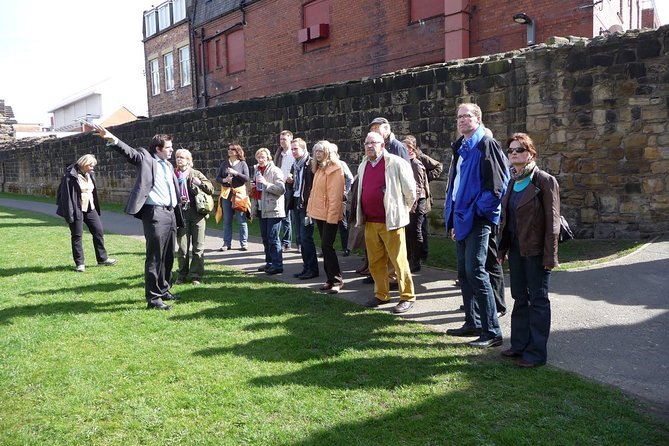
From there, you move into a quieter stretch of “walk-through sights” that still feel worth your time.
Central Arcade is a beautiful shopping arcade, and you’re not meant to treat it like a long shopping stop. Think of it as a quick, atmospheric pass where you get the look and feel of Newcastle’s indoor city spaces.
Then comes Grainger Market, a Victorian covered market. This is where the tour gets more real and less “postcard.” Grainger Market is noted for being home to the oldest and smallest M&S in the world. Even if you don’t plan to shop, this is a neat reminder that big brands often adapt themselves to local history instead of replacing it.
One important consideration: Grainger Market is closed on Sundays. If you’re visiting on a Sunday, you’ll want to plan around that. The tour can swap in time for the Quayside Market instead, so you still get a market experience without ending up at locked doors.
Newcastle Castle and the bridge lineup: seeing the city’s structure
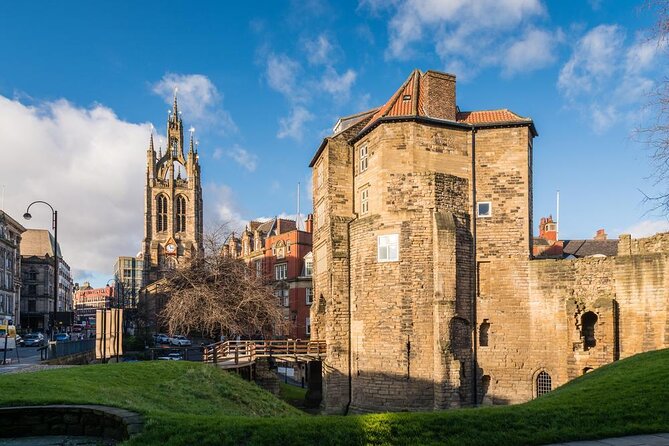
You’ll also stop by the castle that gave the city its name. It’s one of those landmarks that helps you understand why Newcastle grew where it did. Even from the outside, the castle anchors the city’s identity, and the guide’s explanation helps you connect the dots between power, river trade, and the shape of the streets around it.
Then you’ll check out one of the seven bridges that span the river in the city. Bridges are where Newcastle’s layout becomes obvious. They show you how people moved, how different neighborhoods connected, and why the river isn’t just scenery—it’s part of the city’s daily logic.
Don’t expect this segment to be about random “bridge spotting.” The tour uses the bridge moment to give you a map in your head before you cross the most famous one.



Crossing Gateshead Millennium Bridge: the built-in photo and view moment

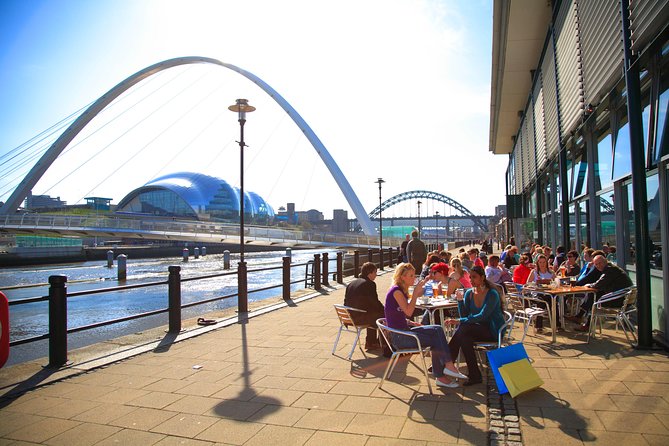
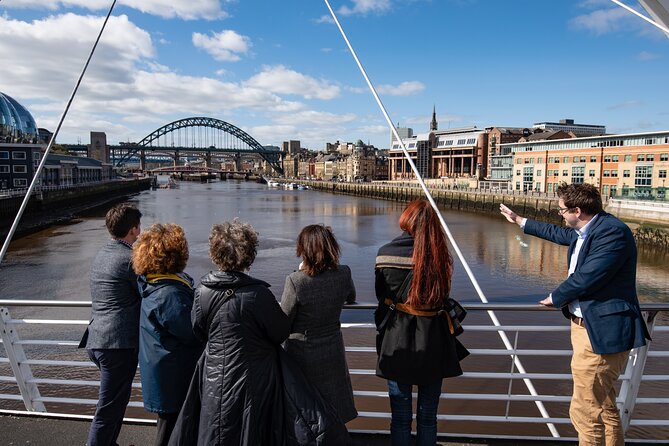
The highlight that most people remember is the walk over Gateshead Millennium Bridge. It’s described as spectacular for a reason: you’re not just crossing. You’re also taking in views of other bridges and the surrounding architecture, which helps you see Newcastle and Gateshead as a linked waterfront system rather than two separate towns.
This is also the part of the day that usually feels the most “rewarding for your effort.” You’re already seeing the city’s history, but crossing the river on foot gives you that extra layer of perspective—especially if you’re arriving for the first time and want a quick visual understanding of the riverfront.
Baltic Centre and the Glasshouse: quick culture stops that still hit
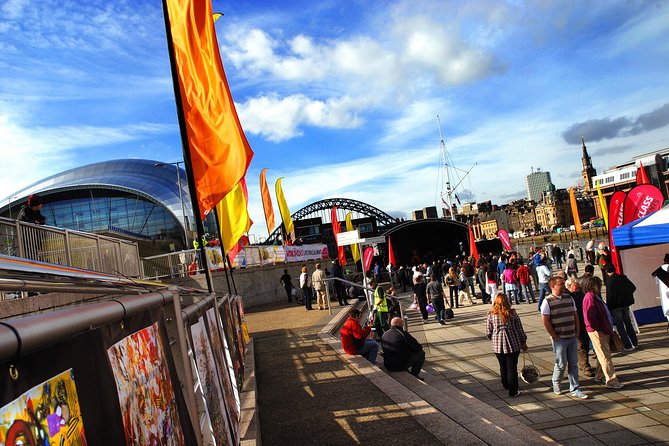
On the Gateshead side, the tour brings you to two cultural stops, each with a slightly different vibe.
First is the Baltic Centre for Contemporary Art. The key practical value here is the visitor viewing platform—a place where the architecture and river views do a lot of the work. If time allows, you can go to Level 5, which is described as one of the best views in town. Even if contemporary art isn’t your main thing, the view makes the stop feel worthwhile.
Then you’ll head to the Glasshouse International Centre for Music, including the Philharmonic concert hall. This is useful even if you’re not catching a performance because it’s part landmark, part public space. You’ll also have access to basics like a café, souvenir shop, and WC, which makes it easier to keep the day comfortable and not rushed.
Price and value: $308.48 for up to 10 makes it work for groups
The price is $308.48 per group for up to 10 people, with a 2-hour duration. On paper, that looks like a bigger number than a typical single walking tour. But private pricing works out best when you’re traveling with more than one person.
Here’s how to think about value:
- If you fill most of the group limit (up to 10), the effective cost per person drops a lot.
- If you’re a smaller group, it can still feel fair because you get a single professional guide for everyone, instead of splitting attention among multiple parties.
- The tour includes the guide and is tailor-made for start/end points, which is handy if you’re working around your day.
Also note: entry fees aren’t included. That sounds like a downside, but it’s balanced by the fact that many listed stops have free admission. Just remember to budget for any paid exhibits or special programs you choose to add on your own.
Pace, group size, and what you’ll actually feel during the walk
Two hours is long enough to connect the dots, but short enough that the tour doesn’t drag. In the past, groups have highlighted a terrific pace, plus the guide’s ability to pause when something mattered to the group. That’s a big deal on a walking tour: the difference between seeing a city and understanding it is often just time for questions and a brief stop when curiosity hits.
Because it’s private, you’re not fighting with a crowd or waiting for late arrivals. The guide can also connect landmarks into a single storyline—so the history doesn’t feel like random facts you’ll forget at the next corner.
Who should book this Newcastle and Gateshead tour?
This tour is a strong fit if you want:
- A clear overview of Newcastle and Gateshead without getting lost.
- A guided route that includes both river views and key city landmarks.
- A cultural mix that still stays practical: markets, architecture, bridge views, and quick art/music stops.
It’s also a good choice if you’re short on time. The stops are set up like a “high-yield day,” which is especially helpful for people fitting Newcastle into a busy itinerary.
If you know you’ll struggle with walking for two hours, the tour may still be doable since it says most travelers can participate—but I’d treat it as a walking-focused plan rather than a sit-down experience.
Should you book this tour?
Book it if you like the idea of a private, guided walk that covers the “what matters” parts of Newcastle and Gateshead, with a clear ending at the Quayside. The combination of market time, castle context, bridge views, and quick culture stops makes it feel efficient without being rushed.
Skip or reconsider if your top goal is long museum-style time, because this is built around short stops and movement. Also, check your day if you’re visiting on a Sunday since Grainger Market is closed—though the tour can adjust with the Quayside Market option.
FAQ
How long is the Newcastle and Gateshead private walking tour?
It runs for about 2 hours.
What’s the group size and price?
It’s $308.48 per group, for up to 10 people.
Where do we meet, and where does the tour end?
You meet at Tickets Bar Newcastle, Neville St (NE1 5DG) and end at Gateshead Millennium Bridge, S Shore Rd (NE8 3BA), with an easy walk back toward Newcastle by the Millennium Bridge.
Is the tour in English?
Yes, it’s offered in English.
Are there entry fees included?
A guide is included, but entry fees are not included. Many stops are listed with free admission.
Is Grainger Market open on Sundays?
No—Grainger Market is closed on Sundays, and the plan can be adjusted to include time at the Quayside Market instead.