REVIEW · LONDON
Guildford Walking Tour
Book on Viator →Operated by Walking tour company · Bookable on Viator
Guildford packs a lot into 75 minutes. This guided walk threads you through Holy Trinity Church and Guildford’s castle grounds, then eases you toward a riverside pub—so you get a practical feel for the town without spending the whole day. I like that the route links architecture, old trade, and local stories into a simple flow, so the places make sense as you walk between them.
Two things I really like: you get included admission at multiple key stops (so you’re not constantly deciding whether it’s worth paying), and the guide experience can be personal. In particular, the provider has used Emily, who speaks English, French, and Spanish, and her style is relaxed enough that questions feel easy. One drawback to factor in: the tour needs good weather and can also be canceled if the minimum number of travelers isn’t met, so it’s not the best pick if your schedule can’t bend at all.
In This Review
- Key Highlights You’ll Care About
- The Sweet Spot: Why This Guildford Walk Feels Efficient
- Holy Trinity Church: A Palladian Church With a Rebuild Story
- The Three Pigeons and Tunsgate Arch: Pub Legends and Market-Minded Architecture
- Guildford Castle Gardens: Moat Views and Prison-Story Details
- Why the Gardens Stop Works
- The Oldest Church Stop: Lewis Carroll on a Guildford Pulpit
- River Wey Finale: White House Guildford and the Summer Market Hint
- Price and Value: What $37.68 Buys You in Real Terms
- Duration, Pickup, and the Private-Tour Feel
- Weather and Timing: What Can Change Your Plan
- Who This Guildford Walk Is Best For
- Should You Book This Guildford Walking Tour?
- FAQ
- How long is the Guildford walking tour?
- Is this tour private or shared?
- Are admission tickets included?
- Where does the tour start and end?
- Can I cancel for a full refund?
- Are service animals allowed, and is it near transportation?
Key Highlights You’ll Care About
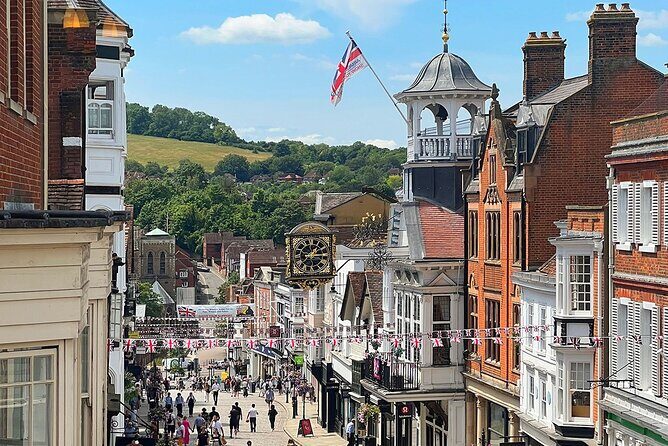
- Palladian Holy Trinity Church: a mid-1700s rebuild with Roman-inspired styling right after an earlier church collapsed.
- The Three Pigeons: a historic mid-1700s pub with a popular haunted legend attached.
- Tunsgate Arch’s trading history: corn merchants and guildhall-area activity give the street-level architecture context.
- Castle grounds access: you can step into the gardens, Royal Bowls Green, and moat area rather than just looking from outside.
- Lewis Carroll connection: a quick stop tied to his preaching visits from Oxford.
- River Wey finale: a breezy riverside approach that can match summer market vibes.
The Sweet Spot: Why This Guildford Walk Feels Efficient
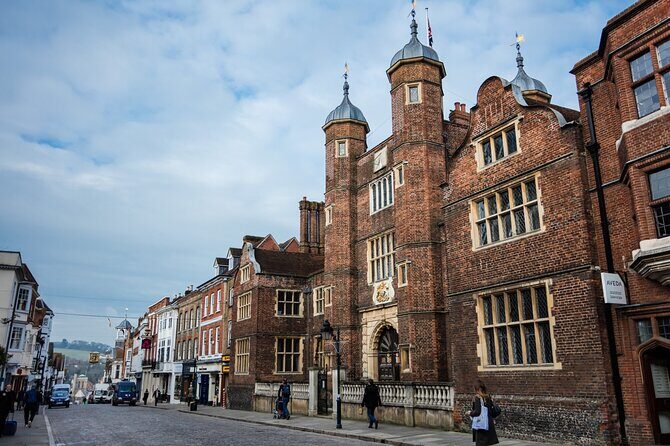
A lot of tours in the London orbit try to do too much. This one doesn’t. It’s about 1 hour 15 minutes, which means you cover meaningful spots while still leaving you energy to explore on your own afterward.
I also like how the pacing matches the places. Some stops are tight—around 5 to 10 minutes—so you get to see what matters most without the “stand in line forever” feeling. And because it’s designed as a guided route through older, story-rich sites (churches, castle grounds, and the old town lanes), it’s a great way to get your bearings fast.
It’s also a solid choice if you’re gift shopping. A walking tour that mixes a few paid attractions and ends somewhere pleasant (a riverside pub area) feels more thoughtful than a vague voucher.
You can also read our reviews of more walking tours in London



Holy Trinity Church: A Palladian Church With a Rebuild Story
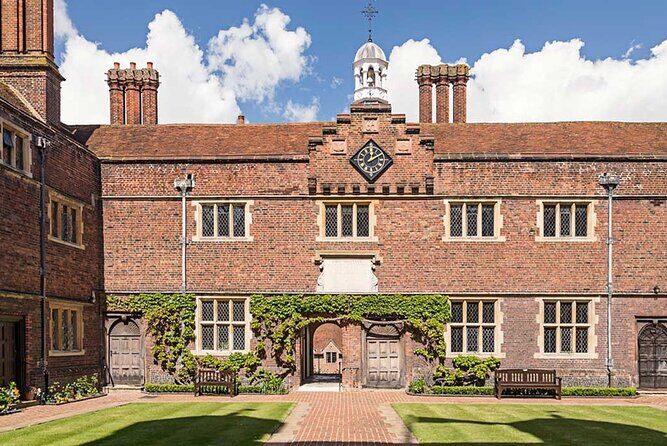
Your first major stop is Holy Trinity Church, a building tied to a specific historical moment. The original medieval church fell down in 1740, and Holy Trinity was built in the 1750s afterward. The style is Palladian, inspired by Roman architecture—so even before you read any details, you can sense it’s meant to feel orderly and classically composed.
You’ll also get an admission ticket included at this stop, which is a big deal for value. When an entry ticket is part of the tour, it usually means you’ll be able to see more than just the exterior facade. If you like churches for their design choices (shape, symmetry, and how the interior feels), this one is a strong start.
Practical tip: because the stop is around 10 minutes, aim to focus on two things—what the building looks like from the outside, and what stands out inside. If your brain tries to absorb everything at once, you’ll miss the main architectural cues.
The Three Pigeons and Tunsgate Arch: Pub Legends and Market-Minded Architecture
Next you’ll cross paths with The Three Pigeons, Guildford, listed as one of the oldest pubs in town, dating to the mid-1700s. It even comes with a story people love—there’s a haunting legend tied to it. Even if you don’t buy ghost stories (I’m pretty practical), it’s fun to hear how local lore sticks to a specific building and becomes part of the town identity.
This stop is short—about 5 minutes—so treat it like a quick history snapshot. Look at the pub’s age, notice how it fits into the street scene, and then move on while it’s still fresh. That’s the advantage of a time-smart tour: you don’t get bored halfway through.
Then comes Tunsgate Arch, a feature that’s easy to underestimate until someone explains its role. During the 16th and 17th centuries, corn merchants used the ground floor space off the guildhall for trade, and the area was used for a variety of events over time. In other words, this isn’t just an arch—you’re seeing a former work-and-meeting zone.
Another admission ticket is included here, which helps you justify the guided stop over just wandering yourself. If you like understanding how trade shaped the look of a town, Tunsgate Arch is one of the more “how did people live here?” moments on the route.
Guildford Castle Gardens: Moat Views and Prison-Story Details
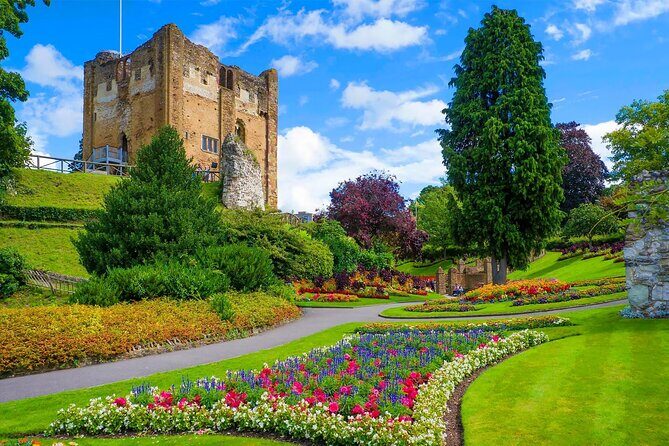
The castle stop is the backbone of the walk. You get access into the castle gardens, the Royal Bowls Green, and the moat area around the keep. That access matters, because from the street you’d mostly get partial views. Here, you actually step into the landscape people would have associated with the castle’s daily power and control.
Guildford Castle is connected to the Norman era—built by William the Conqueror or one of his barons shortly after 1066. Even if you don’t want a full medieval lecture, the timing helps frame the site: you’re standing in the kind of place that followed conquest, organization, and shifting authority.
This is also where you’ll feel why the tour is priced the way it is. Castle-related access plus included admissions is where many similar tours would charge extra—or skip.
Why the Gardens Stop Works
You don’t just “walk through the greenery.” The gardens time is about stories tied to who visited and who was held there. You’ll learn about kings and queens who visited Guildford Castle, and you’ll also hear about prisoners kept in the keep. That prison detail can be heavy, but it adds realism. Castles weren’t only about pageantry. They were also about control.
The stops are chunked—about 10 minutes each for the castle and then the castle gardens. The structure keeps it moving, so you get the castle’s big idea, then a more specific angle right after.
If you’re taking photos, pause briefly for the moat-area views. Don’t spend the entire stop behind your phone screen; the garden paths are part of what you’re paying to access.






The Oldest Church Stop: Lewis Carroll on a Guildford Pulpit
After the castle, the route shifts into the town-center layer—where you’ll find the oldest church in the town and a medieval wall painting. That’s the kind of detail that changes your experience from sightseeing to noticing.
Here’s another standout connection: Lewis Carroll is said to have preached there during his visits from Oxford. That’s the sort of cultural link that makes a quick stop feel less like a checkpoint and more like a mini story you’ll remember.
This stop is listed as free, and it’s about 5 minutes—so think of it as a short, focused moment to orient yourself. If you’re the type who can spend 20 minutes staring at a single architectural feature, you might feel the time limit. Still, the free price point helps you not feel like you’re being rushed.
One more layer is tied to the nearby shopping area: the current shopping centre is on the site of a Dominican friary. Even if you don’t see friary ruins, the reminder helps you read the place with a longer lens.
Practical tip: choose one thing to look for—either the medieval wall painting aspect or the Lewis Carroll association—and then let the rest pass quickly. You’ll enjoy the tour more when you’re selective.
River Wey Finale: White House Guildford and the Summer Market Hint
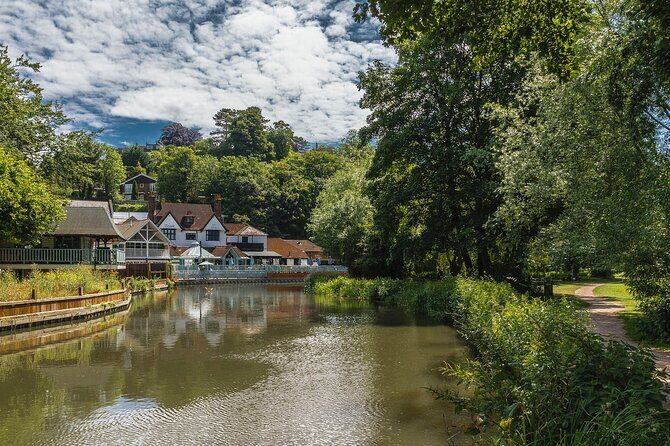
The final stretch heads toward White House Guildford, featuring a bridge over the River Wey. This part feels different in a good way: after churches and stone walls, you get sky, water, and a wider sense of space.
Markets are mentioned here for summer—so if you’re walking during warmer months, you might catch that lively riverside atmosphere. The River Wey is also noted as one of the first British rivers to be made navigable, with navigation opening to trade. Even with limited time, the tour gives you enough context to understand why the river mattered.
This stop includes an admission ticket and is about 15 minutes, which is longer than most other stops—likely because the riverside area invites lingering. If the weather is cooperating, this is where you can take a slow walk pace and let the town end on a pleasant note.
The tour then heads to its endpoint at a riverside pub, which is a nice fit for the overall flow. You’ll finish where you can sit down right away and plan your next move.
Price and Value: What $37.68 Buys You in Real Terms
At $37.68 per person, the price is not huge, but it’s not “drop-in casual” either. The value comes from how the itinerary is built.
Here’s the key: admission tickets are included at multiple stops. You’re not just receiving commentary—you’re getting access where entry matters, including Holy Trinity Church, The Three Pigeons, Tunsgate Arch, Guildford Castle, Guildford Castle Gardens, and the White House Guildford area. Meanwhile, the oldest church stop is listed as free.
So you’re paying for a guided route that bundles entry costs across several landmarks. If you’ve ever tried to plan a self-walk and realized you’re paying separately at every stop, you’ll see why this can be a good deal.
One more value angle: it’s a private tour where only your group participates. Private doesn’t always mean “exclusive luxury” in every tour company, but it does change how comfortable it feels—especially if you want to ask questions or keep the pace comfortable.
Duration, Pickup, and the Private-Tour Feel
The tour is listed at about 1 hour 15 minutes, which means you should treat it like a focused town introduction rather than a full day program. You’ll likely want a meal afterward, or at least time to browse on your own.
Pickup is offered, and the tour uses a mobile ticket. It’s also described as near public transportation, which is helpful if you’re already in that part of London and don’t want to juggle complicated local logistics.
As for group experience, a small private group makes the walk more conversational. One account described it as just three people, which kept the interaction easy. Even if your group size differs, private formatting means you won’t get swept into a big pack.
Weather and Timing: What Can Change Your Plan
This experience requires good weather. If conditions are poor, you’ll be offered a different date or a full refund. The tour can also be canceled if the minimum number of travelers isn’t met, with a similar fallback (different date or full refund).
So if your visit schedule is locked tight and you can’t spare time for rescheduling, consider that. But if you’re flexible by a day or two, the refund options make it much less stressful.
Also worth noting: there have been reports of guide issues in the past, including a case where a guide didn’t show and contact wasn’t made right away. The provider later responded that Emily is now the guide (with English, French, and Spanish). I’d still recommend you keep an eye on your confirmation details and be ready to message promptly if anything feels off.
Who This Guildford Walk Is Best For
This tour fits best if you want:
- Compact history without museums and long lines
- Churches, castle grounds, and the way towns organize around trade and power
- A guide who can explain places clearly in more than one language (Emily’s languages are English, French, Spanish)
It also works well as a gift idea. At $37.68 per person and a short duration, it’s easy to justify as an experience rather than a vague attraction ticket.
I’d skip it if:
- You only like deep, slow site exploration where you can spend long stretches inside buildings
- You don’t want to deal with a weather-dependent plan
- You’re looking for a broad “London highlights” day (Guildford is the focus here, and the walk is designed around that)
Should You Book This Guildford Walking Tour?
If you’re heading to the Guildford area and want an efficient, story-driven walk that includes several paid admissions and ends somewhere relaxing, I think it’s a strong pick. The castle access and the Holy Trinity start are the kind of anchors that make the 75 minutes feel worthwhile, not rushed.
Book it when you can be a little flexible with weather and you’re happy to walk at a steady, time-managed pace. Skip it only if you need a slow, self-directed wander where nothing is scheduled—or if your dates can’t shift at all.
FAQ
How long is the Guildford walking tour?
It’s approximately 1 hour 15 minutes.
Is this tour private or shared?
It’s a private tour/activity, so only your group will participate.
Are admission tickets included?
Admission tickets are included at several stops on the route, while one stop (the town church-related stop) is listed as free.
Where does the tour start and end?
The tour starts in the Tudor district and ends at a riverside pub.
Can I cancel for a full refund?
Yes. Free cancellation is available, and you can cancel up to 24 hours in advance for a full refund.
Are service animals allowed, and is it near transportation?
Service animals are allowed, and the tour is near public transportation.