REVIEW · LONDON
Medieval History Walking Tour from The Tower of London
Book on Viator →Operated by London : Medieval History Walking Tour from The Tower · Bookable on Viator
A medieval London walk you can actually follow. This 2-hour route connects famous sites to the stories that shaped the city, and it does it with tight stops and clear explanations. I especially like the Tower Hill to St Paul’s flow for first-time orientation, and the way the guide’s storytelling makes big events feel human and linked. The one catch: several highlights are outside or require extra entrance time since admission is not included for some stops.
You get a lot of London in a short window, from the Norman era feel around the Tower to the later shocks of the 1640s and the Great Fire era themes you hear about along the way. At just 20 people max, the pace stays manageable, and it doesn’t feel like you’re sprinting between landmarks. You’ll still want to move steadily, because most stops are timed and you only linger for about 10 minutes each.
The best part for planning your day is the ending point: the tour finishes near St Paul’s, where getting a bus or tube onward is straightforward. It’s also easy to join since it starts at 2:00 pm with a mobile ticket, and the tour is offered in English. Wear comfortable shoes, especially if you’re going in windy or rainy conditions, because this is a real walk along the Thames.
In This Review
- Key highlights I’d target on this tour
- Tower Hill to the Tower of London: where power begins
- Tower Bridge and HMS Belfast: crossing the Thames between eras
- London Bridge to Borough Market: medieval trade and the shocks that changed it
- Southwark Cathedral and Winchester Palace ruins: church authority and medieval justice
- Golden Hinde and Shakespeare’s Globe: Thames voyages and the theatre age
- The Thames, Millennium Bridge, and St Paul’s Cathedral: ending with the big view
- Price and value: $25 for a lot of guided London
- Tour pacing, what to wear, and how to get the most out of 10-minute stops
- Who this tour is perfect for (and who should choose something else)
- Should you book this Medieval History Walking Tour from the Tower of London?
- FAQ
- How long is the Medieval History Walking Tour from the Tower of London?
- Where does the tour start and end?
- What time does the tour begin?
- Is the tour offered in English?
- Are admission tickets included for all stops?
- Which stops are marked free for your stop time?
- Do I need a printed ticket?
- How big is the group?
- What is the cancellation policy?
Key highlights I’d target on this tour
- Tower of London context without waiting: see where 900+ years of power and conflict played out
- Thamesfront variety in one loop: Tower Bridge, HMS Belfast, the river’s long story, and two Thames crossings
- Medieval Southwark stops you might skip alone: Southwark Cathedral and Winchester Palace ruins
- Food and street-life history at Borough Market: a market you can walk past with centuries in mind
- Drake to Shakespeare in the same afternoon: the Golden Hinde area and Shakespeare’s Globe nearby
- Quick, guided interpretation: short visits that still connect the dots to bigger themes
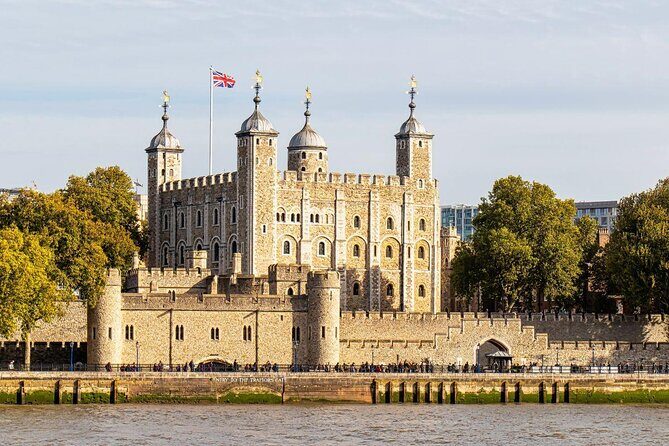
Tower Hill to the Tower of London: where power begins
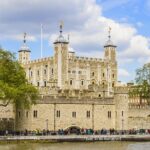
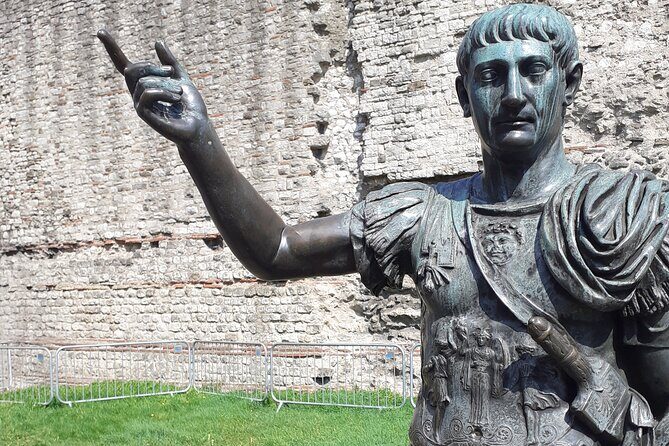
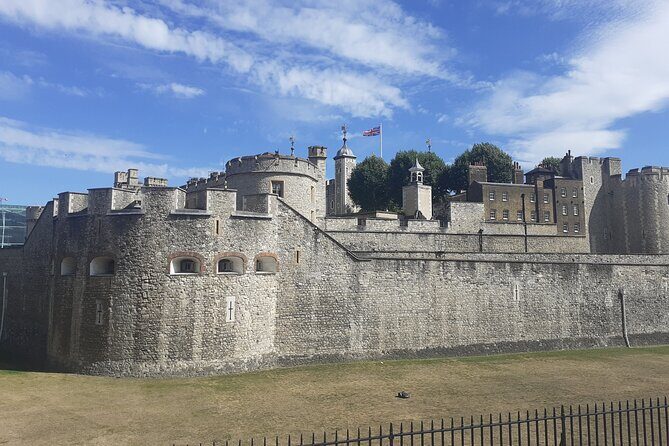
The tour kicks off at Tower Hill, just outside the Tower of London area. This matters because it puts you in the right mental space fast: you’re not starting with a generic “London facts” intro. You start with the kind of place that screams authority, fear, and control.
At the Tower stop, you pass the Tower’s long timeline, reaching back to its original build in 1078 and forward to how it’s understood today. The key value here is framing: even if you don’t go inside during your scheduled time, you learn what makes the Tower so central to medieval England’s story. You also get a sense of why later landmarks along the route feel linked to what happened here.
One practical note: the Tower stop is listed with admission ticket not included, so don’t expect this stop to replace a full Tower of London visit. Think of it as guided orientation plus storytelling hooks—then, if you want more later, you’ll know what to chase.
You can also read our reviews of more walking tours in London



Tower Bridge and HMS Belfast: crossing the Thames between eras
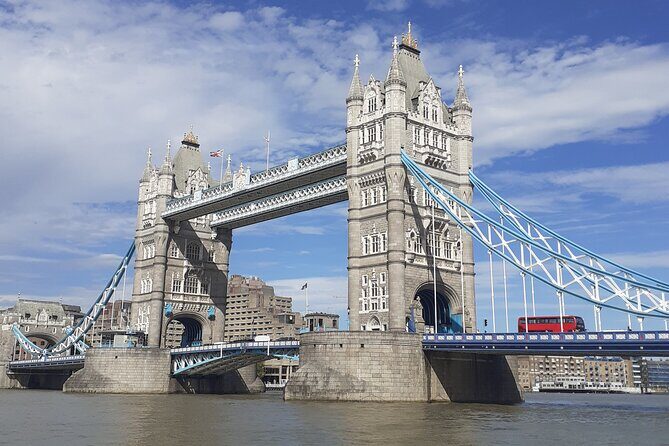
From the Tower area, you move to Tower Bridge and then over toward HMS Belfast. This pairing is a clever trick for your brain: it stops you from treating the Thames as one single “old river” vibe. You get the iconic bridge moment and then the wartime scale of a battleship next.
At Tower Bridge, the focus is on how it was built—so you’re learning the why behind the landmark, not just taking photos. Then comes HMS Belfast, tied to WWII conflicts and participation in the D-Day landings. Even with a short stop, this gives the Thamesfront a second life: not only medieval and early modern London, but also the 20th century’s weight.
The value for you is contrast. You’ll leave the bridge area seeing London as layered, not frozen in one century. And since admission isn’t included at HMS Belfast during your timed stop, treat this as a guided introduction to decide whether you want a deeper visit on your own afterward.
London Bridge to Borough Market: medieval trade and the shocks that changed it
Next you shift toward London Bridge and then Borough Market, two places that feel different on the ground but connect through the idea of movement. London Bridge anchors the story of the city’s geography beginning as far back as 43 AD, and the narration stretches into later medieval turning points. You also hear about the 1212 Great Fire of Southwark and the 1640s English Civil War era, which helps you understand why the city’s “same streets” still carry new meanings.
Borough Market adds the human layer. You pass the market and hear how old it is—about 900 years—and that it sits beneath early Victorian railway arches. The big takeaway isn’t just that it’s famous; it’s that London’s food and commerce have always been tied to where people gather, travel, and take risks.
Since Borough Market is listed with admission free, you can treat this stop as a quick orientation pause if you want to grab a snack later. Just keep in mind that your guided time here is short, so arrive expecting the stories more than a full market browse.
Southwark Cathedral and Winchester Palace ruins: church authority and medieval justice
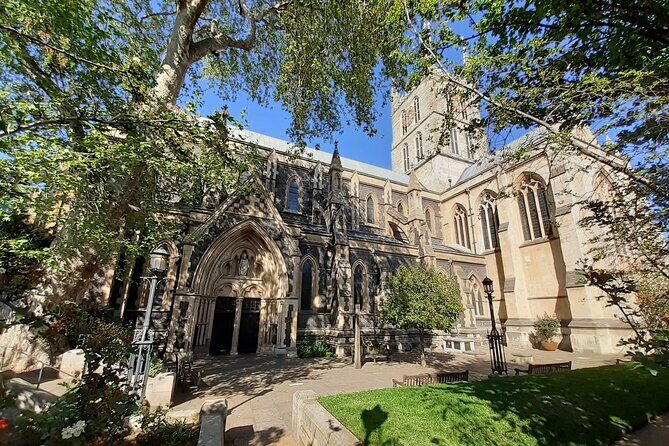
Southwark is where the tour really starts to feel like you’re stepping off the main postcard trail. Southwark Cathedral is presented as a place of continuity—standing as you’ll see it since 1420, with a worship site on that spot going back to 606. That kind of timeline gives you a powerful lens: medieval London wasn’t only castles and kings; it was also institutions that lasted through chaos.
The narration also connects the cathedral to the heresy trials tied to Bloody Mary in the 1550s. Even if you don’t memorize every detail, you’ll understand the cathedral as a stage where religion, politics, and punishment intersected.
Then the route takes you toward Winchester Palace ruins, a 12th-century palace site that once ranked among medieval London’s most important buildings. You also hear it ties into the Liberty of the Clink and includes what’s described as the country’s oldest prison. That’s a vivid combo: royalty and law in the same footprint, with a very medieval sense of how power worked.
Winchester Palace is listed with admission free for your stop, so you’re not paying to access the interpretation time you get here. Still, because it’s ruins, your experience depends on what the guide points out—this is exactly where guided storytelling does the heavy lifting.
Golden Hinde and Shakespeare’s Globe: Thames voyages and the theatre age
The Thamesfront keeps rolling, and this section turns the river into a highway for big names. At the Golden Hinde stop (St Mary Overie dock area), you learn about Sir Francis Drake’s 1577 round-the-world voyage and the controversies tied to it. The payoff is that Drake’s story isn’t treated like a one-note adventure. You get the idea that maritime fame and moral mess often traveled together.
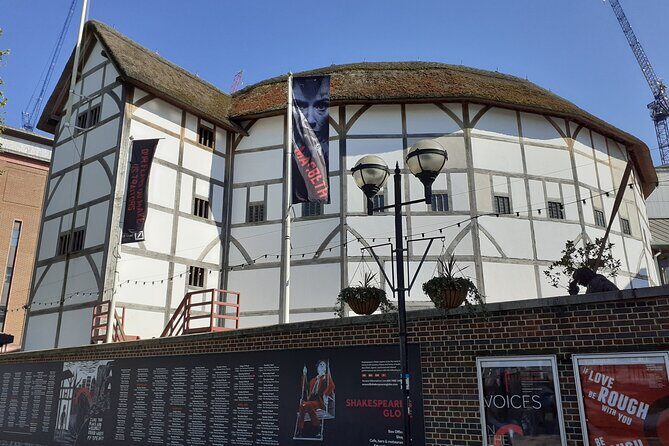
Next is Shakespeare’s Globe Theatre, described as rebuilt after a 1613 cannon-related fire and set right by the Thames. It’s also framed as a way of imagining 16th-century London life, across from St Paul’s—so even though you haven’t reached St Paul’s yet on the schedule, you’ll feel that connection.
Admission at these stops is not included, so this is again a guided look and context, not a full theatre or ship museum visit. That said, short stops can still be worth it if the guide is good at giving you what to notice. The best moment is when you realize the tour is teaching you to see patterns: ships, theatre, trade, and power all using the Thames as their main stage.
You can also read our reviews of more historical tours in London





The Thames, Millennium Bridge, and St Paul’s Cathedral: ending with the big view
As you move along the river, you get the tour’s long-time perspective: the Thames is described as having a 30-million-year history. Then the story shifts to the darker side of life along the river between the 11th century and Victorian times, including unpleasant elements tied to how people lived and worked by the water.
This is a useful reset for you. It prevents the afternoon from becoming just a set of famous facades. You get a sense of the river as a changing system—natural, then urbanized, then industrialized, then cleaned up in fits and starts.
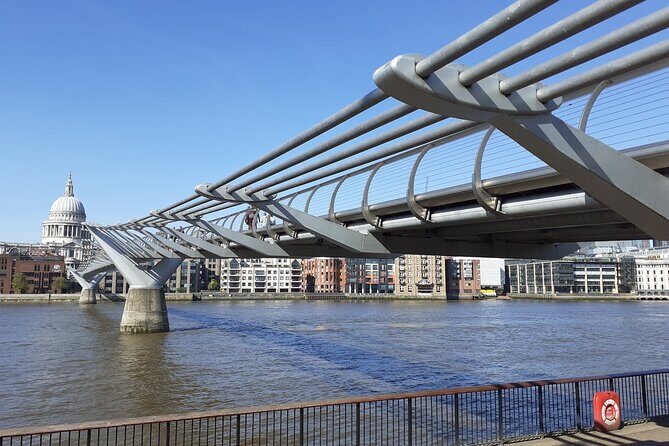
After that, you cross again on the Millennium Bridge for views toward St Paul’s. That crossing matters because it’s your chance to see how the route’s landmarks relate spatially. St Paul’s feels closer and more grounded when you’ve already walked toward its story through the earlier stops.
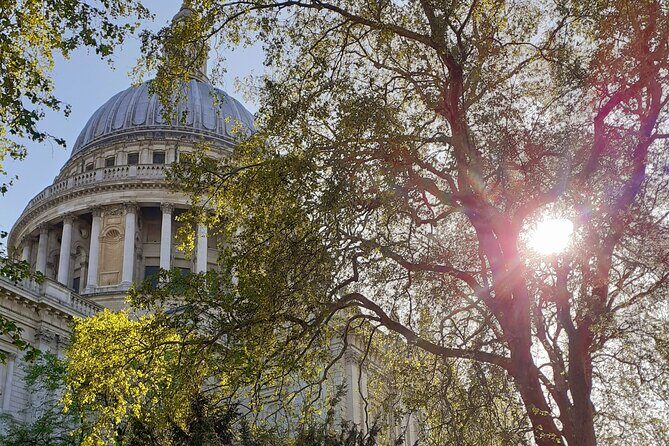
Finally, you reach St Paul’s Cathedral, tied to Sir Christopher Wren and described as standing since the 1670s. You also hear that worship has existed here since the 7th century, which makes St Paul’s feel like an old anchor rather than just a single building. Admission is not included at St Paul’s during the timed stop, so you’ll likely focus on the exterior and key architectural points.
The logistics are also friendly at the end. The tour finishes at St Paul’s Churchyard, close to major transit options, including the Central line on the red route. That means you can close the day with a simple tube ride or bus hop without backtracking.
Price and value: $25 for a lot of guided London
At $25 per person for about 2 hours, this tour is priced for doing serious sightseeing without paying for multiple full admissions right away. You’re not buying a museum crawl; you’re buying interpretation—someone turns landmark names into connected storylines.
Here’s how to think about the value realistically: several high-profile stops list admission ticket not included (Tower of London, Tower Bridge, HMS Belfast, Golden Hinde, Shakespeare’s Globe, St Paul’s). Some stops are marked free for your visit time (London Bridge, Borough Market, Southwark Cathedral, Winchester Palace, Thames River, Millennium Bridge). So your base cost buys the guided walk and the guided “what it means” for both free access areas and paid attractions.
If you’re the type who wants to go inside everything, you’ll likely add extra ticket costs on your own. If you’re the type who prefers learning first and then choosing later, this pricing model is smart. It helps you decide what deserves your time and money after you understand the themes.
Tour pacing, what to wear, and how to get the most out of 10-minute stops
The structure is straightforward: timed stops, around 10 minutes each, and the note that you only stop by for the allotted time. That’s not a flaw; it’s the whole deal. You get a focused story arc, and you don’t lose the group waiting at entrances.
This also means your best tactic is mental. Don’t treat every stop like it’s going to become a full deep-dive visit. Treat each one like a chapter title, then decide later if you want to read the full chapter.
Practical advice I’d follow:
- Pack comfortable walking shoes, because this is an active Thames-area route.
- If rain shows up, don’t let it ruin the plan. Several guides are praised for keeping groups engaged even in bad weather.
- Use the guided time to learn what to look for next time you’re outside on your own.
Since the max group size is 20, you should be able to hear questions and get answers without the chaos of huge crowds. And because the tour uses a mobile ticket and runs in English, you don’t need complex setup to join in.
Who this tour is perfect for (and who should choose something else)
I’d steer history buffs toward this right away. The tour is designed for people who like dates, turning points, and the way one place links to another across centuries. It also suits first-time London visitors who want an easy orientation day that still feels meaningful.
It’s also a good fit if you like walking tours that connect the dots rather than tours that just list sights. Ending at St Paul’s is a win if you want to keep exploring that neighborhood afterward, since you’ll be in a convenient transit zone.
If your main goal is museum-depth time inside big attractions like the Tower of London or HMS Belfast, you might feel constrained by the short timed stops. In that case, you could still enjoy the guided context, but plan to return later for longer visits.
Should you book this Medieval History Walking Tour from the Tower of London?
Book it if you want a guided walk that turns London’s landmarks into a connected story, from medieval power to later moments along the Thames. The $25 price makes sense as an intro route, especially because multiple stops are free for your on-foot time and the tour ends at St Paul’s with easy onward travel.
Skip or pair it differently if you know you only enjoy tours that include lots of interior time. Since admission isn’t included for several major sites, you’ll need to decide in advance which places matter most for you to visit deeper later.
If you’re aiming for a smart first pass through medieval London with a guide who can keep the group moving and laughing along the way, this is a very solid choice.
FAQ
How long is the Medieval History Walking Tour from the Tower of London?
It lasts about 2 hours.
Where does the tour start and end?
It starts at Tower Hill, London EC3N 4DJ and ends at St. Paul’s Cathedral, St. Paul’s Churchyard, London EC4M 8AD.
What time does the tour begin?
The start time listed is 2:00 pm.
Is the tour offered in English?
Yes, it is offered in English.
Are admission tickets included for all stops?
No. Some stops are listed as admission ticket not included, while others are listed as free for your visit time.
Which stops are marked free for your stop time?
London Bridge, Borough Market, Southwark Cathedral, Winchester Palace, Thames River, and Millennium Bridge are marked free for the stop time.
Do I need a printed ticket?
No. The tour uses a mobile ticket.
How big is the group?
The tour has a maximum of 20 travelers.
What is the cancellation policy?
Free cancellation is available if you cancel up to 24 hours in advance of the experience start time for a full refund. Changes within 24 hours aren’t accepted.