REVIEW · CAMBRIDGE
Cambridge Self Guided Walking Tour
Book on Viator →Operated by Pandemic Tours · Bookable on Viator
Cambridge without a tour guide? Perfect. I like the self-guided app with GPS routing and stop prompts, so you can move at your pace without getting lost. I also love the pacing and writing in the content, with an option for an audio guide delivered by Helen (not a computer voice) or a text-style mode you can follow on your phone. The one watch-out: several big-name sights on the route (like King’s College Chapel and a couple of churches) list admission as not included, so you may want to budget for entry times and tickets.
This is a straightforward walking route that you can do in about 2 to 3 hours, starting near Cambridge Bus Station on Drummer Street and ending by Cambridge University Library on West Road. You get 3 weeks unlimited access after download, plus map directions and a GPS route with each stop.
If you want a smart, low-cost way to see Cambridge’s college side, the River Cam moments, and serious museum stops without being herded into one fixed group schedule, this works well. And if you’re allergic to ticket lines, choose your entry priorities before you go.
In This Review
- Key things I’d focus on before you download
- A smart way to see Cambridge colleges, museums, and the River Cam
- Starting near Christ’s Pieces: getting your bearings fast
- Parker’s Piece: the park stop that gives context, not just greenery
- The University Museums: from 4.5 billion years to famous fossils
- Archaeology, anthropology, and the Whipple Museum’s science tools
- Pitt Building and Fitzwilliam Museum: 1833 to 1848 learning in grand style
- River Cam detours: Scudamore’s punting history and iconic bridges
- Corpus Christi, Bene’t Street, and the college maze feeling
- King’s College Chapel and St Mary the Great: iconic, but plan entry
- Cambridge’s Market Square, Round Church, and Senate House
- Wrapping up at the Cambridge University Library: architecture inside matters
- Timing, tickets, and how to walk this without rushing
- Value check: is $12.22 worth it?
- Who this Cambridge walk suits best (and who should skip it)
- Should you book this self-guided Cambridge tour?
- FAQ
- FAQ
- How long is the Cambridge self-guided walking tour?
- Where does the tour start and where does it end?
- How much does it cost per person?
- What language is the tour available in?
- Do I need tickets for all the stops?
- Is there an audio guide?
- How long do I have access to the tour after purchase?
- Is this a private tour?
- What are the opening hours for the tour?
- What if I need to cancel?
Key things I’d focus on before you download
- App pings at each stop, which keeps you from rushing and helps you read at a human pace
- Audio is guided by Helen, and it’s not the robotic style you might fear
- Several University museums hit science, evolution, archaeology, and the history of instruments in one walkable sweep
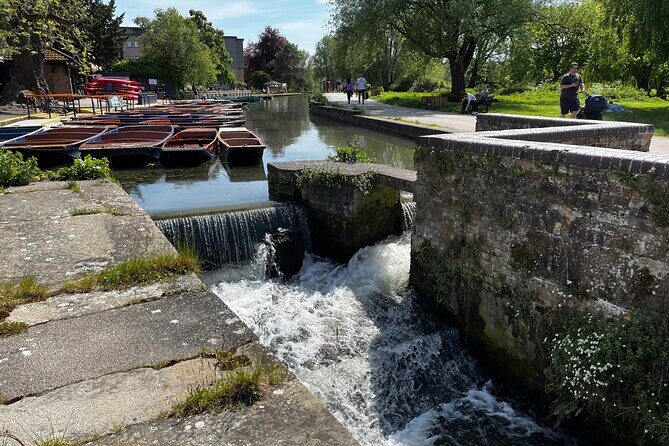
- River Cam crossings show off iconic Cambridge shapes like the Mathematical Bridge and Garret Hostel Bridge
- Some stops require paid admission, including King’s College Chapel and other major churches
- Good value at $12.22, especially since you can reuse it for up to 3 weeks
A smart way to see Cambridge colleges, museums, and the River Cam
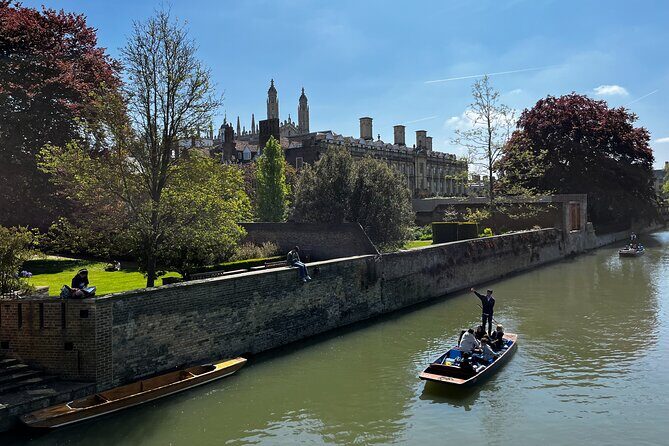
Cambridge can feel like three cities stacked on top of each other: the college world, the museum world, and the everyday city world. This self-guided walk is designed to stitch those together in a way that still makes sense for a normal visitor day.
You’re not just handed a route and left alone. The app provides the map, directions, and a GPS path, then cues you at each stop so you know when to pause and when to walk. That matters here, because Cambridge’s best sights often sit in tight clusters, and it’s easy to wander past the moment that would have made it click.
I also liked how the stops vary. One moment you’re in a park setting, the next you’re staring at big museum collections (including zoology and 4.5 billion years of planetary and fossil storylines), then you’re back outside walking between bridges and churches. The tour feels built for curiosity, not just checkboxes.
You can also read our reviews of more walking tours in Cambridge



Starting near Christ’s Pieces: getting your bearings fast
Your tour begins near Christ’s Pieces, a park area that acts like a natural launchpad. The tour introduction helps you connect Cambridge’s geography to what you’re about to see—so the first steps don’t feel like random sightseeing.
From there, you move toward Emmanuel College. This is where the story takes a very specific turn: Emmanuel College has an academic reputation, and the tour notes that John Harvard was baptised at the college chapel and later became a benefactor of Harvard University in the USA. Even if you’ve heard the name Harvard before, it’s the Cambridge-to-America link that makes Emmanuel feel more than postcard scenery.
Practical tip: since this route is self-guided, you’ll get the best experience if you allow a few minutes here to slow down. Cambridge’s college exteriors are gorgeous, but they make more sense when you know who and why they mattered.
Parker’s Piece: the park stop that gives context, not just greenery
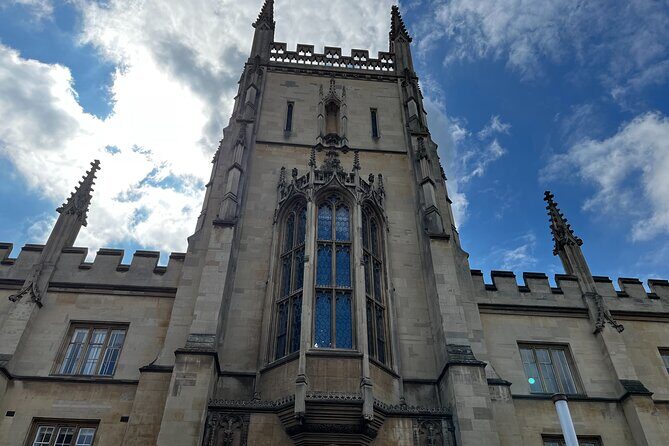
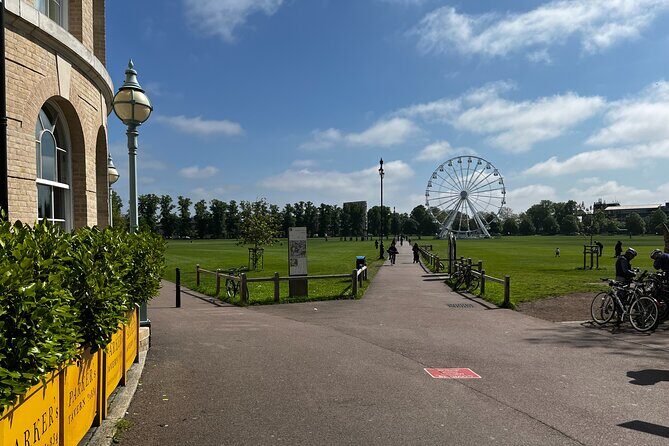
Next up is Parker’s Piece, a large public park in the heart of Cambridge. The tour points out the origin of its name: it’s named after Edward Parker, who donated a portion of the land to the city in 1613.
This stop is useful because it gives you a breather between major institutional sights. It also reminds you that Cambridge isn’t only about universities behind walls. There’s a public city layer, and parks like this show how the college world sits alongside community space.
If you’re doing this during warmer months, this is a great spot to decide your tempo for the rest of the walk. If you’re moving fast, you can still catch the museum rhythm. If you’re moving slow, you won’t feel guilty because this is a built-in pause.
The University Museums: from 4.5 billion years to famous fossils
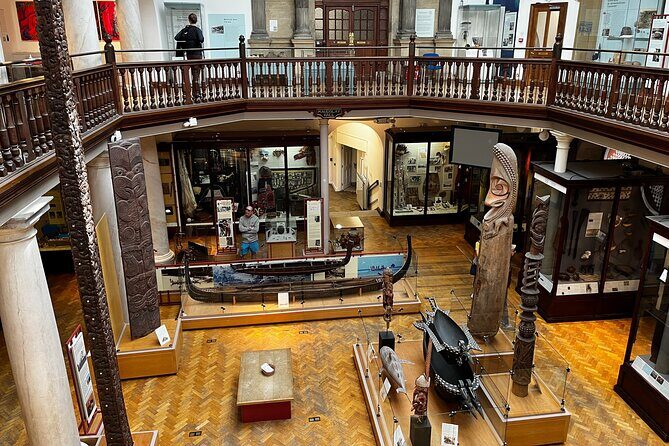
The route then swings into the University museum cluster, and this is one of the strongest reasons to do this tour.
First, you’re guided through the University’s oldest museum in a 4.5 billion year storyline, starting with meteoritic building blocks of planets, then moving through fossils that trace how life evolved in oceans, on land, and in the air. It’s the kind of big scale thinking that makes Cambridge’s academic identity feel real, not just brand-name.
Then you transition to the University Museum of Zoology brand new galleries, where the focus becomes animal life and the drama of change over time—extinction, survival, evolution, and exploration. The tour’s collection highlights make this stop feel like a scavenger hunt you’ll actually enjoy:
- Cambridge’s largest resident, a 21m fin whale
- The giant ground sloth
- One of the most complete Dodo skeletons in the UK
- Captain Cook’s conch
Even if you’re not a museum person, these highlights are concrete enough to anchor the experience. And if you are a museum person, you’ll appreciate that the route doesn’t just toss you into one exhibit. It gives you a lens for what you’re looking at.
Quick consideration: museum pauses can stretch your total time. If you’re aiming for the low end of the 2 to 3 hour window, do the highlights with intention, then move on.
Archaeology, anthropology, and the Whipple Museum’s science tools
After the natural science energy, the tour adds human history and the history of science.
You reach the Museum of Archaeology and Anthropology, with collections noted as numbering more than 800,000 objects of major research and historical value. The tour also calls out the scale of their photographic materials—over 100,000 field photographs and negatives—plus over 30,000 fonds of historical documentary archives. That’s a lot, and the key for you is understanding what kind of museum this is: it’s not only displays. It’s research material with physical weight.
Next comes the Whipple Museum, where the tour emphasizes the history of science through collections that include scientific instruments, models, pictures, prints, photographs, books, and other related materials. This is the stop that often surprises people. You see how science used to be built—by instruments and hands-on observation—rather than by a modern screen.
If you want one simple strategy: spend a little time reading captions and identifying a couple objects you can later remember. With collections this large, trying to absorb everything will tire you out.
You can also read our reviews of more guided tours in Cambridge



Pitt Building and Fitzwilliam Museum: 1833 to 1848 learning in grand style
Outside the deeper museum rooms, the route points you to the Pitt Building, constructed in 1833 and named after William Pitt the Younger, who served as Prime Minister of Great Britain in the late 18th and early 19th centuries.
It’s a small stop, but it gives you that Cambridge link between architecture and political history. Buildings here aren’t neutral. They’re statements.
Then you reach the Fitzwilliam Museum, a neoclassical building completed in 1848. The tour highlights an imposing facade with grand columns like ancient Greek and Roman temples, a majestic dome, and lions on either side of the entrance. This is one of those Cambridge moments where you can enjoy the exterior even if you don’t go fully inside for a long time.
Practical note: this tour marks many stops as free for access, but you should still keep an eye on what’s open during your visit window, especially if you’re trying to sequence paid-entry sites.
River Cam detours: Scudamore’s punting history and iconic bridges
If you’ve never experienced Cambridge by water, this route gives you plenty to chew on without needing a full separate day.
At Scudamore’s Mill Lane Punting Station, the tour includes the origin story: Scudamore’s Punting Company was founded in 1910 by Jack Scudamore, a boat builder who visited Henley upon Thames Royal Regatta and saw that punting was popular among upper and middle classes. You get the human origin behind a very Cambridge activity.
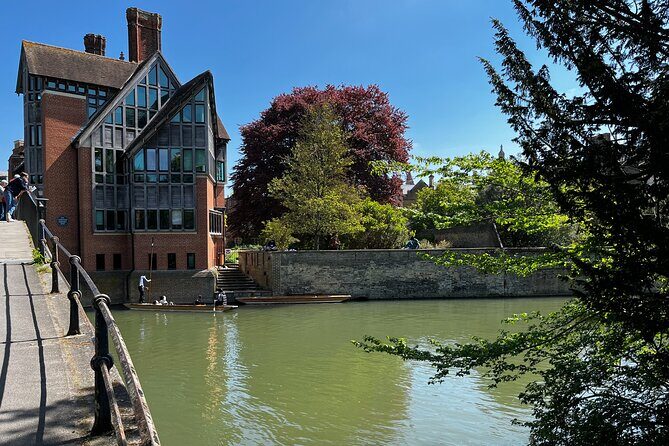
From there, you cross to the Mathematical Bridge, a wooden footbridge across the River Cam connecting two parts of Queen’s College. It’s a visually distinctive Cambridge feature, and even a short stop here feels worthwhile because it’s the kind of structure you’ll photograph and remember.
Later, the route includes Garret Hostel Bridge, with a fun geography detail: the River Cam floodplain is only about 4m above sea level, the riverbed about 2m above sea level, and the coastline is almost 50 miles away at King’s Lynn. That’s the kind of fact that makes you look at the river like it has a backstory, not just views.
If you’re deciding whether to add extra time for photos: this section is your best bet. The bridges and river moments are easier to enjoy in short bursts.
Corpus Christi, Bene’t Street, and the college maze feeling
The walking rhythm continues through another college stop: Corpus Christi College, founded in 1352 by the Guild of Corpus Christi and the Guild of the Blessed Virgin Mary. This is one of those medieval details that helps you understand why Cambridge college life has deep roots, well before modern tourism existed.
Then you reach Bene’t Street, described as an old street that’s not commonly on the tourist trail. The tour tells you it’s named after St Bene’t’s Church, and it’s positioned as one of the more interesting parts of the city. This is where Cambridge feels less like a theme park and more like a real place where people walk to shops, offices, and daily life.
Use this stop to reset your brain. When the tour starts hitting major churches and chapels, you’ll appreciate having one normal street moment in the middle.
King’s College Chapel and St Mary the Great: iconic, but plan entry
Now you’re moving into the big spiritual and architectural highlights.
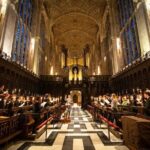
King’s College Chapel is one of the most iconic landmarks in Cambridge, and the tour notes the site’s deeper origin: it was originally part of the floodplain of the River Cam, with later medieval buildings. That small detail helps explain why the area feels historically layered, even if you’re just viewing it from outside.
Important for your plan: the tour marks admission not included for King’s College Chapel. So you’ll need to decide whether you want to purchase entry on your own, and you’ll want to consider opening times versus your remaining walk time.
Next comes Great St Mary’s Church, often called St Mary’s. The tour notes that it dates back to the 12th century, though most of the current building is late 15th and early 16th centuries. Again, admission is marked as not included, so plan accordingly.
This is where your time and ticket priorities matter most. If you’re a chapel-and-church person, build extra time and consider buying/confirming tickets in advance if required.
Cambridge’s Market Square, Round Church, and Senate House
As the route nears the city-center pulse, Cambridge Market Square appears next, next to the historic Guildhall. It’s home to one of the oldest and largest open-air markets in the country, and the tour marks it as free to enjoy as you walk.
This stop gives you everyday Cambridge texture. Even if you’re not shopping, it helps you remember that the city lives beyond college terms and museum hours.
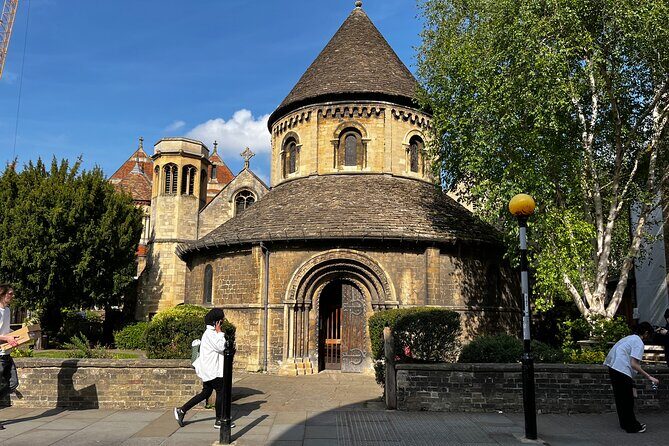
After that, you reach the Round Church, officially the Church of the Holy Sepulchre. The tour says it was founded in 1130 by crusaders who had returned from the Holy Land. It’s a compact stop, but the founding story makes the building feel intentional, not random.
Then you come to the Senate House, described as an example of neoclassical architecture designed by James Gibbs and completed in 1730. This is a good moment to pause and look up, because the details are part of what makes Cambridge’s academic power visible.
Wrapping up at the Cambridge University Library: architecture inside matters
The final stretch includes Trinity College (founded in 1546 by King Henry VIII, and noted as the largest college in Cambridge by both land area and student population). Then you cross toward Cambridge University Library on West Road.
The library is described as relatively new, early 20th century, but with some lovely features in the internal architecture. The tour marks it as not included for admission, so again: if you want inside time, plan for it rather than treating this as a quick glance.
The walk ends at Cambridge University Library, and you’re free to continue wandering. That matters because Cambridge is one of those places where you’ll want your freedom at the end—either to linger at a place you liked more than expected, or to detour for lunch.
Timing, tickets, and how to walk this without rushing
This tour is designed to take 2 to 3 hours, which is a sweet spot for a half-morning or late afternoon window. But you’ll get different results depending on two things: whether you go into the paid-entry stops, and how much time you spend in the museum rooms.
Here’s how I’d plan it:
- If you want the full experience, assume closer to 3 hours.
- If you’re selective at the museums, you might land around 2 to 2.5 hours.
- For the sights marked as admission not included (King’s College Chapel, Great St Mary’s, Round Church, and Cambridge University Library), decide early whether you’re buying tickets. That avoids the classic problem of reaching a must-see and realizing you’re out of time.
One more practical angle: do the prep in the BEFORE YOU GO section of your e-ticket. Since this is app-led, that kind of setup can save you stress when you’re standing outside in real life.
And since you can use the audio or the text-style content: choose what matches your walking mode. If you like to read while you pause, use text. If you want movement with your eyes forward, audio with Helen can keep the flow.
Value check: is $12.22 worth it?
At $12.22 per person, the value depends on what you compare it to.
If you’re comparing it to an in-person guide for just a couple hours, this is clearly cheaper. But the real question is: does it deliver the kind of context that makes Cambridge click? For this route, I think yes, because it ties specific people and places together—John Harvard and Emmanuel College, Edward Parker and Parker’s Piece, punting’s origin with Jack Scudamore, and the museum storytelling from planetary beginnings to zoology highlights.
Also, the app includes 3 weeks unlimited access, so you can revisit your favorite stops later without buying another thing. That’s a smart way to stretch value if your schedule shifts or if you want to return for another museum hour.
The trade-off is the missing human flexibility. There’s no in-person guide to answer questions on the spot. Still, for first-time visitors who want a guided feel without paying guide prices, it’s a good deal.
Who this Cambridge walk suits best (and who should skip it)
This works best for:
- First-time Cambridge visitors who want context along the way, not just photos
- People who like to set their own pace, reading or listening for a few minutes at a time
- Museum lovers who want science, evolution, archaeology, and instruments in a single compact routing
You might think twice if:
- You’re only interested in one or two major paid-entry sights and dislike ticket planning
- You hate phone-based navigation and prefer a map in your hand (though GPS route support is included)
Should you book this self-guided Cambridge tour?
Yes, if you want a practical, low-cost way to string together Cambridge’s big themes—colleges, major churches, River Cam landmarks, and university museums—into a walk that you can actually finish in one visit. The biggest selling points for me are the stop-by-stop pacing and the fact that the content is delivered in a guided way through Helen, with an option for a text mode that’s easy to follow.
If you do book it, do this one thing: decide which paid-entry stops matter most to you (chapel, churches, library) before you start walking. Then you won’t feel rushed when the route reaches those doors.
FAQ
FAQ
How long is the Cambridge self-guided walking tour?
It’s designed for about 2 to 3 hours, depending on how much time you spend at museums and paid-entry stops.
Where does the tour start and where does it end?
It starts at Cambridge Bus Station on Drummer St (CB1 1NE) and ends at Cambridge University Library on West Rd (CB3 9DR).
How much does it cost per person?
The price is $12.22 per person.
What language is the tour available in?
The tour is offered in English.
Do I need tickets for all the stops?
Some stops are marked as free, but several are marked with admission not included (including King’s College Chapel, Great St Mary’s Church, the Round Church, and Cambridge University Library). You may need to purchase entry separately.
Is there an audio guide?
Yes. You’ll be guided through an audio guide by Helen, and it is stated to be not computer-generated voice. You can also use text-style info in the app.
How long do I have access to the tour after purchase?
You get 3 weeks of unlimited access on the app.
Is this a private tour?
Yes. It’s private in the sense that only your group participates.
What are the opening hours for the tour?
The provided opening hours show 12:00 AM to 11:30 PM across the date range listed.
What if I need to cancel?
The experience is non-refundable and cannot be changed for any reason, based on the cancellation policy provided.
If you want, tell me your travel month and whether you plan to go inside King’s College Chapel and St Mary’s, and I’ll help you pick a realistic time plan for this route.